Many Chinese families avoid hammering, digging, moving furniture and renovating during a pregnancy, because folk belief says a fetus spirit (taishen, 胎神) lives in the house and can be disturbed. Health agencies give a different reason to be careful: paint fumes, and dust from lead paint in homes built before 1978.
Last checked: 26 November 2026
| Key fact | What the source says | Source |
|---|---|---|
| The belief | Expectant mothers are strongly discouraged from moving furniture or renovating, so the fetus position is not disturbed | Singapore Infopedia, "Chinese birth rituals" (valid as at 14 May 2013) |
| The spirit | It comes into being with the pregnancy and changes position in the house from day to day; nobody worships it, people avoid offending it | Harrell, "Domestic Observances: Chinese Practices" (1987) |
| Paint | Pregnant women should avoid painting projects and limit time in freshly painted rooms, especially with oil-based paint | US EPA, indoor air quality and remodeling |
| Old homes | Treat paint in pre-1978 homes as lead-containing unless an inspection shows otherwise | US EPA, indoor air quality and remodeling |
| Lead rule | Paid work that disturbs paint in pre-1978 homes needs a lead-safe certified firm; homeowners working on their own home are generally exempt | US EPA, Lead Renovation, Repair and Painting Program |
| Who does the work | Have a trusted adult who is not pregnant do painting and remodeling, and stay away from the work area | CDC ATSDR, "In the Baby's Room" (dated 18 Nov 2025) |
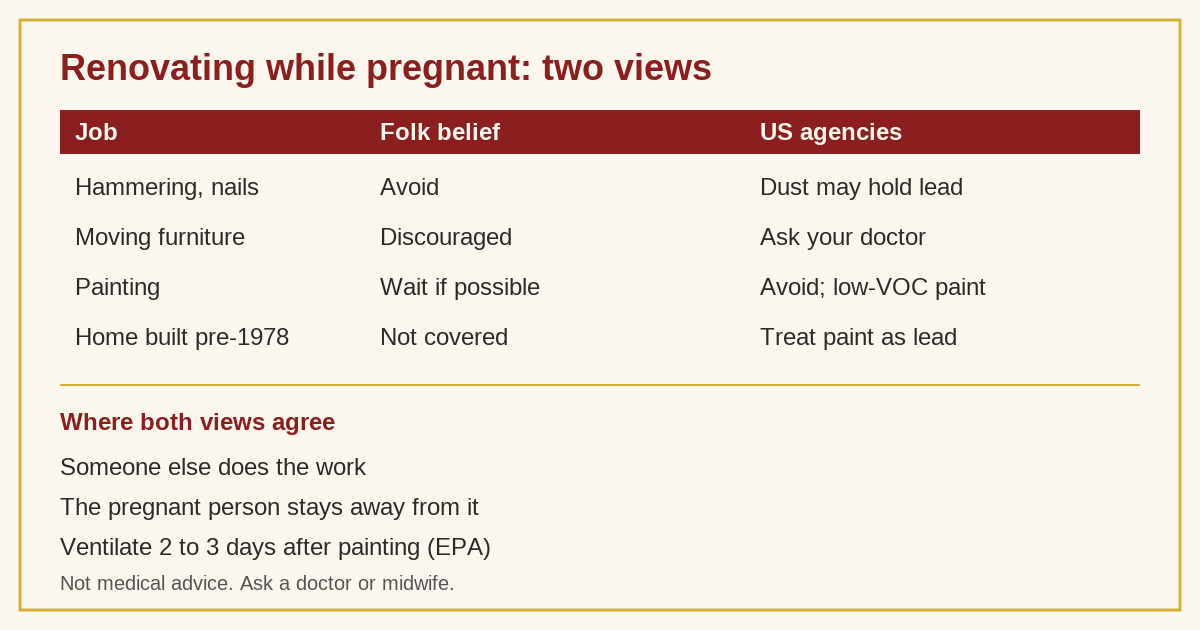
Nothing here says a renovation causes or prevents any outcome in a pregnancy. For your own situation, ask your doctor or midwife.
On this page
- What the tradition says
- Who the fetus spirit is
- How the belief varies
- What families do instead
- What health agencies say about renovating
- Lead paint in pre-1978 homes
- A worked plan for a household that follows both
- What families ask
- Sources
What the tradition says
Singapore's national library describes the custom plainly: expectant mothers are strongly discouraged from moving furniture or renovating the house during pregnancy, because the position of the fetus should not be disturbed in any way. The same entry lists digging, slaughtering and hammering among the things to avoid, and says disturbing the fetus is linked in the belief to a difficult birth, miscarriage or injury to the child.
Those are the claims of a folk tradition, written up by a cultural historian. They are not medical findings, and nothing on this page suggests a hammer or a sofa has ever been shown to cause any of them. We report the belief because it is the reason a family might ask you to wait, and knowing it helps when a grandmother objects to a new bookshelf going up.
One blog guide aimed at Singapore parents adds a practical layer: it says renovating in the first trimester is thought to bring bad luck, and that hammering, sticking things on walls and rearranging furniture can harm the baby's spirit. It also admits that some of this is myth and advises respecting it if it matters to your family.
Who the fetus spirit is
The anthropologist Stevan Harrell, writing in the Encyclopedia of Religion, calls it the fetus spirit. In his account it comes into being when a woman becomes pregnant, is not yet firmly attached to the fetus, and migrates around the house, changing its position from day to day. People do not worship it. They just avoid offending it.
His examples are specific. Moving things that have long lain still, while the spirit is in that room, is said to risk a miscarriage. Driving a nail into a wall where the spirit is staying is said to risk a child born with a harelip. Sawing or cutting cloth in its current room is said to risk missing limbs or digits.
The name you will see online, Tai Shen (胎神), is the same figure. Harrell mentions a ritual calendar that shows where the spirit is on a given day. We could not open an authoritative copy of one, so none is reproduced here. If your family follows a particular table, ask the relative who keeps it.
Advertisement
How the belief varies
It is not one rule held everywhere. The sources we opened differ on what is forbidden: Infopedia stresses furniture and renovation as a whole, Harrell's examples are about particular acts in the particular room where the spirit is, and the Singapore guide centres on the first trimester. Families from different regions and dialect groups also keep different food and speech taboos, as Infopedia notes for Cantonese and Hokkien mothers.
So when a relative says "not now", ask which job and which room they mean. The answer is often narrower than a blanket ban on renovating.
What families do instead
The sources describe few formal remedies, so this section sticks to what they and common practice suggest, and says which is which.
- Timing. The Singapore guide suggests spring or early summer for the work, avoiding the first trimester, and choosing a start date with the almanac. Our renovation start date guide explains how.
- Who does the work. Many families have someone other than the pregnant woman supervise or do the job, and some families send her to stay with relatives for the noisy days. This matches the agencies' advice below, for different reasons.
- Which tasks wait. A family that follows the belief can leave the nail-and-saw jobs and furniture moves for after the birth, and do the unavoidable repair on a day the household has chosen.
- Noise. The same guide says to schedule noisy work in daytime hours and to use hearing protection.
The wider Form School rules for renovation, such as which sector of the house to open up in a given year, are in the feng shui renovation dos and don'ts and the 2027 renovation directions to avoid.
What health agencies say about renovating
Agencies do not mention a fetus spirit. They worry about chemicals and dust, and their advice is concrete.
The US EPA's page on indoor environmental concerns during remodeling says pregnant women should avoid painting projects and limit time in freshly painted rooms, especially with oil-based paints. It says water-based paints generally give off fewer chemicals than oil-based (alkyd) paints, and that short-term solvent exposure from alkyd paint can be much higher than from latex. For ventilation, it says to run exhaust fans that vent outdoors from the start of painting until 2 or 3 days after it finishes, and to schedule interior painting when the home is empty. It also says to block heating and air-conditioning return openings so air from the work area does not spread through the home, and to take special care when sanding, because the dust can contain lead from lead-based paint.
The CDC's Agency for Toxic Substances and Disease Registry (ATSDR) gives a pregnancy-specific version, dated 18 November 2025. It suggests that a trusted adult who is not pregnant does the painting and remodeling, and that the pregnant person stays away from the work areas. It says to pick paint labelled low-VOC, zero-VOC or water-based, and to open windows or run fans.
Notice where the folk custom and the agencies agree: someone else does the work and the pregnant woman is kept away from it. They reach that for different reasons.
Lead paint in pre-1978 homes
The US federal government banned lead-based paint for use in homes in 1978, and the EPA says about three quarters of US homes built before then still contain some. The EPA tells owners to treat existing paint in a pre-1978 home as lead-containing unless a lead-based paint inspection shows otherwise.
Under the EPA's Renovation, Repair and Painting program, anyone paid to disturb painted surfaces in a pre-1978 home must be a lead-safe certified firm using lead-safe work practices. Homeowners working on their own home are generally exempt, unless they rent out part of it, run a childcare business there or renovate homes for profit. The EPA still recommends that homeowners hire a lead-safe certified contractor. ATSDR adds that a pregnant person in a pre-1978 home should consider hiring a certified professional to check for lead-based paint, and should avoid scraping or sanding lead-based paint.
These are US rules. Canada, the UK and other countries have their own, so check with your local building or health authority.
A worked plan for a household that follows both
Take a house built in 1965, with a first pregnancy and a grandmother who keeps the old customs. This is an illustration of how the advice combines, not a recommendation for your home.
| Job | Folk-belief view | Agency view | A way to schedule it |
|---|---|---|---|
| Repainting the nursery | Part of renovating, which the custom discourages | Avoid painting; low-VOC paint; ventilate 2 to 3 days | Another adult paints with low-VOC paint while the pregnant person stays elsewhere, or it waits until after the birth |
| Hanging shelves | Nailing into a wall is the classic taboo | Drilling can raise dust; pre-1978 paint may hold lead | Wait, or have a certified pro handle it |
| Moving a wardrobe | Discouraged, and long-settled objects are the worry | No agency rule on this page; ask your doctor or midwife about lifting | A relative moves it |
| Replacing a kitchen | Whole-project renovation is discouraged | Test paint first; seal off the area | Book for after the birth; set the start date from the almanac |
If a room needs to be ready for the baby, the nursery layout guide and the kids bedroom layout guide cover what to set up after the heavy work is done. For the wider topic, see the renovate and build pillar.
What families ask
Is it bad luck to renovate while pregnant in Chinese tradition?
Many families say so. The folk belief is that a fetus spirit (taishen, 胎神) lives in the house during pregnancy, and hammering, digging or moving heavy things can disturb it. Beliefs differ by region and family, and some families keep only part of the custom, such as no nails in the room where the spirit is said to be. None of this is a medical finding.
What is Tai Shen, the fetus god?
In the account by the scholar Stevan Harrell, the fetus spirit comes into being when a woman becomes pregnant, is not yet firmly attached to the fetus, and moves around the house from day to day. Nobody worships it. People simply avoid offending it, mainly by not driving nails, cutting or moving long-settled objects where it is staying.
Can I move furniture while pregnant according to Chinese custom?
The custom discourages it. Singapore's Infopedia describes expectant mothers as strongly discouraged from moving furniture or renovating, so the position of the fetus is not disturbed. Many families ask someone else to do the lifting. Separate from the custom, ask your doctor or midwife how much lifting is right for you.
Is renovating during pregnancy actually dangerous?
Some of the materials can be. The US EPA advises pregnant women to avoid painting projects and to limit time in freshly painted rooms, especially with oil-based paint, and to treat paint in pre-1978 homes as lead-containing unless tested. The agencies' concern is paint fumes and dust, not the hammering itself. Ask a doctor or midwife about your own situation.
How can we respect the tradition and still get work done?
A Singapore parenting guide suggests choosing a start date from the almanac, avoiding the first trimester and keeping noisy work to daytime. Practical options that fit both the belief and the agencies' advice are to have someone else do the work, to stay elsewhere while it happens, and to finish dusty or paint-heavy jobs before the pregnancy or after the birth.
Does the lead paint rule apply to my own home?
The US EPA's renovation rule covers paid contractors working in homes built before 1978, and owner-occupants doing their own work are generally exempt. The EPA still recommends hiring a lead-safe certified firm, and ATSDR suggests that pregnant people in pre-1978 homes consider hiring a certified professional to check for lead-based paint. Rules differ outside the US, so check with your local authority.
Sources
All checked on 26 November 2026.
- Singapore Infopedia (National Library Board): Chinese birth rituals, Teresa Rebecca Yeo, information valid as at 14 May 2013, for the furniture, renovation and hammering custom.
- Encyclopedia.com: Domestic Observances: Chinese Practices, Stevan Harrell, Encyclopedia of Religion (1987), for the fetus spirit and its examples.
- Wondrous Lavie: Renovation during pregnancy, Chinese tips for expecting parents, a parenting blog, for first-trimester, season and noise suggestions. Not a primary source.
- US EPA: Addressing indoor environmental concerns during remodeling, for paint, ventilation and pregnancy advice.
- US EPA: Lead Renovation, Repair and Painting Program, for the pre-1978 rule and the homeowner exemption.
- CDC ATSDR: Prenatal Assessment of Environmental Risk, In the Baby's Room (18 November 2025), for painting, low-VOC paint and lead testing advice.
We could not open an authoritative source for a day-by-day location calendar of the fetus spirit, so none is given.
Editorial note: Lucky Properties presents feng shui and Chinese folk practice as cultural tradition. This guide is educational and is not medical advice. Ask your doctor or midwife about your own pregnancy, and your local building department about permits and lead rules.