Three plants do most of the symbolic work in Chinese shops, offices, and living rooms: lucky bamboo, the money tree, and the jade plant. They sit by tills, on desks, and next to front doors, and they are given at openings, housewarmings, and New Year. Each one carries a set of customary meanings that have been taught for long enough that sellers print them on tags. Each one is also a real plant with a real species name, a home continent, and specific needs, and the two sides of the story explain each other. The customs grew up around plants that were cheap, portable, and hard to kill indoors, and the plants spread because the customs made them standard gifts.
This article covers the three plants in turn: what each species is, where the tradition attached to it, how placement and gift counts are usually handled, and what care keeps the plant alive. Customs are described as customs. Tradition assigns meanings to these plants; it does not settle what happens in a business or a household, and no teacher quoted here treats a plant as a substitute for the work itself.
Lucky bamboo: a dracaena with a gift culture
The plant sold as lucky bamboo is not a bamboo. It is Dracaena sanderiana, also sold under the name Dracaena braunii, a dracaena native to Central Africa. Bamboo is a grass; this is a member of the asparagus family, grown for its straight green canes ringed with pale bands that happen to resemble bamboo segments. The resemblance named the plant, and Chinese gift and shop culture did the rest of the work. Dracaena sanderiana grows fast, tolerates low indoor light better than most houseplants, and roots in plain water, which makes it easy to ship, easy to display in a glass vase, and easy to keep on a counter. A plant with those traits was always going to become a standard gift; the custom fitted itself to a plant that could survive the settings the custom put it in.
Because it ships as bare canes, lucky bamboo is sold by the stalk, and that commercial fact produced the most detailed part of the tradition: the stalk counts. Sellers arrange canes into bundles, spirals, and layered towers, and each arrangement has a count. Teachers and sellers attach meanings to the counts, and the meanings below are the ones commonly taught. They vary slightly between teachers, and every family knows a version of the list.
What the stalk counts are said to mean
| Stalk count | Customary meaning | Where people put it |
|---|---|---|
| 1 | A single clear path, focus | A student desk, a small home office |
| 2 | Love and partnership | A couple's home, an anniversary gift |
| 3 | Fu, Lu, Shou: happiness, prosperity, long life | The classic gift for openings and birthdays |
| 5 | Balance across life areas, the five elements | A family living room |
| 6 | Smooth flow, good fortune | A shop counter, a new business |
| 7 | Health | A gift for someone recovering or older relatives |
| 8 | Growth and prosperity | An office desk, a business gift |
| 9 | Lasting good fortune | A housewarming gift |
| 10 | Completion | A milestone gift |
| 21 | A strong all-purpose blessing | A large display for an opening or New Year |
A few of the counts rest on sound play, which is a steady feature of Chinese number customs. Six, liu, sounds close to the word for flow, so six stalks are read as things moving smoothly. Eight, ba, echoes fa, to prosper, and eight is the count most often chosen for a business gift. Three is the classic because it names Fu, Lu, and Shou together, the three star gods of happiness, prosperity, and long life, a combination that covers most of what a gift-giver wants to say.
Four is the count the tradition avoids, and the reason is linguistic. The word for four, si, is a near-homophone of the word for death, also si in a different tone. A gift of four stalks reads badly for the same reason the number is skipped in floor numbering and license plates across much of East Asia, a pattern covered in the site's guide to the number 4 in East Asia. Fourteen and twenty-four carry the same problem because both contain four, so sellers do not bundle them and gift-givers do not ask for them. The avoidance is about the message a gift sends, and it costs nothing to respect when you are choosing a count for someone else.
The five element display
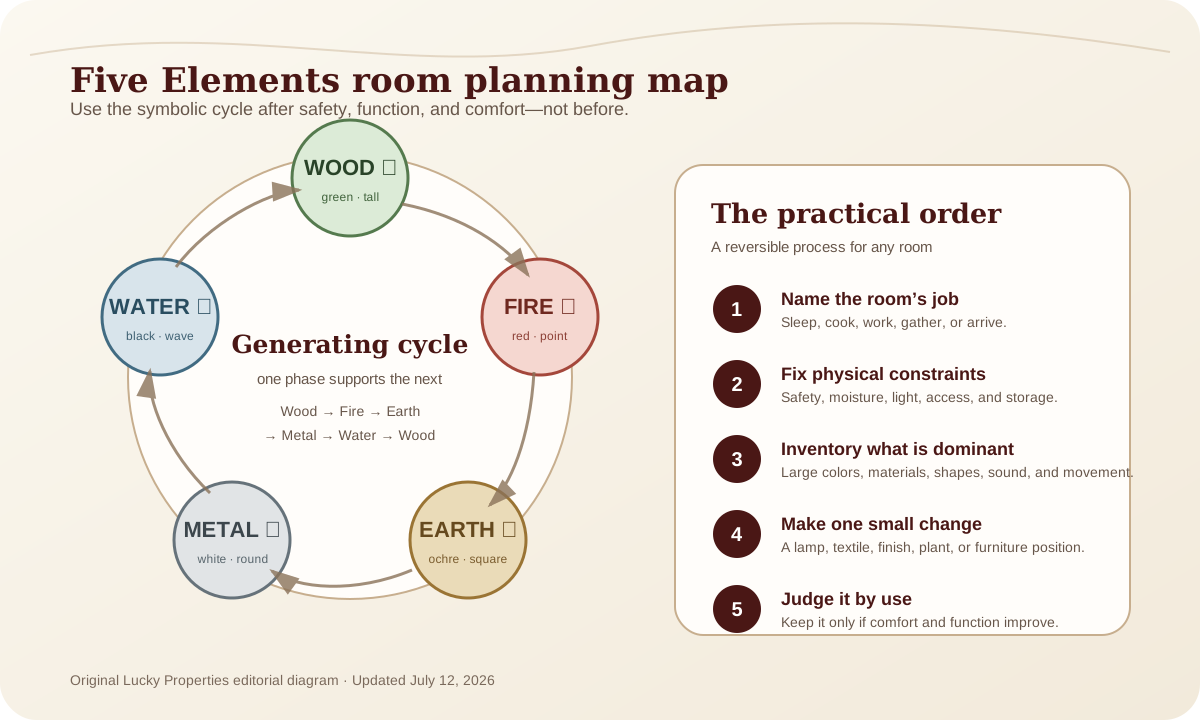
A dressed-up lucky bamboo arrangement is usually built to show all five elements at once, and once you know the recipe you start seeing it in every florist window. The plant itself is Wood. The water it stands in is Water. The pebbles or soil holding the canes are Earth. A red ribbon tied around the bundle, or a red pot, supplies Fire. A glass or metal pot, or a coin dropped into the base, supplies Metal. Traditional teaching aims for balance rather than dominance, so the display puts each element in view without letting one swamp the rest.
If you want the fuller treatment of how the five elements relate to each other and to rooms, the five elements balancing guide works through the cycles in order. The plant-specific point here is narrower: the ribbon and the pebbles on a gift plant are not decoration added by the florist. They are the rest of the element set, and a gift that arrives with all five is following the recipe on purpose. The same recipe explains the standard shop display, a glass vase of canes over pebbles with a red tie and a coin at the bottom.
Placement customs for lucky bamboo
East and southeast rooms are the traditional Wood sectors, so lucky bamboo is most often placed in an east room or the southeast part of a room. Shops put it on the counter near the till, where it is seen by everyone who pays. At home, a desk plant is the common choice for people who read the plant as a work focus symbol. These are customs of placement, taught as ways of matching a Wood plant to Wood sectors, and families follow them with different levels of strictness.
One practical rule is shared across schools: keep the plant healthy. In traditional terms a dead or dying plant is read as neglected qi, energy left untended. In practical terms a yellow, slumping plant on a counter looks like a business that has stopped paying attention, and nobody needs a tradition to read that signal. The symbolic reading and the ordinary reading arrive at the same instruction, which is probably why the instruction survives.
Care that keeps lucky bamboo alive
Lucky bamboo in water wants bright indirect light; direct sun through glass scorches the leaves, and a dark corner slows growth to a stop. The water needs changing regularly, and low-chlorine water works best. Tap water left out overnight, or filtered water, is the usual fix, because fluoride and chlorine in treated water can scorch the leaf tips brown. Roots should stay submerged and stems should not sit in stale water, which turns cloudy and smells.
Yellow stalks come up in every care forum, so here is the plain version: a stalk that has yellowed does not turn green again. Cut the yellow section away with a clean blade, or cut the green top above the yellow and root it in fresh water as a new cutting. Trying to nurse a yellow stalk back is the mistake; the plant propagates from the healthy part. Grown in soil instead of water, the same plant wants a free-draining mix kept lightly moist, and the element display then uses soil as the Earth component rather than pebbles.
Advertisement
Money tree: a wetland tree and a folk tale
The money tree is Pachira aquatica, a tree from the wetlands of Central and South America. Outdoors in its home range it grows into a full tree; indoors it is sold young, most often with several stems braided into a single trunk and a canopy of palmate leaves on top. The braiding is done by growers while the stems are pliable, and it is the braided form that carries the symbolism in shops.
The story attached to the money tree is a folk tale, and it should be told as one. In the telling, a poor man prayed for a way out of his situation, found this plant growing, took it home, and prospered by growing and selling it, discovering that it multiplied easily from seed and cuttings. Versions differ in the details, as folk tales do. What the tale actually records is the reason the plant spread: Pachira aquatica is easy to propagate and tolerant of indoor conditions, so it was cheap to raise and easy to sell. The story turned a nursery trade fact into a narrative people remember.
In shop tradition the money tree is a prosperity symbol, placed where money changes hands or where a business wants its growth on display. Reception desks, shop counters, and the corner by a register are the usual spots. The care is straightforward tree care scaled down. The plant wants bright light, more than the dim corner it often gets, and soil that dries between waterings. Wetland origin makes it forgiving of a heavy watering, but a pot with drainage and a dry-down between drinks keeps the braided stems from rotting. The braid slowly fuses as the stems thicken; do not try to unbraid or rebraid a mature plant.
Jade plant: coin leaves on a succulent
The jade plant is Crassula ovata, a succulent from South Africa. It grows slowly into a woody, branching shrub with thick oval leaves, and the leaves are the whole basis of its place in shop culture. A jade leaf is shaped and sized roughly like a coin, so in shops the plant became a prosperity symbol, something green and coin-like kept by the door or the till. The connection is visual, and the tradition has never pretended otherwise; the leaf looks like the thing it stands for.
Jade wants the opposite water regime from lucky bamboo. Give it gritty, free-draining soil, a pot with a drainage hole, and infrequent watering with a full soak and then a proper dry period. It wants strong light, up to direct sun once acclimated, and it tolerates a missed watering far better than an extra one. A jade that gets soft, translucent leaves is being overwatered; a jade with wrinkled leaves is thirsty and recovers after a drink. Because it is a succulent, it also propagates from a single leaf laid on soil, which made it, like the money tree, a plant that shops could raise cheaply and give away readily.
Placement follows the same shop grammar as the other two. Jade plants turn up by entry doors and next to registers, in the southeast sector of a room when the household follows sector placement, and on sunny windowsills where the light requirement wins the argument. The practical constraint rules here: a jade in a dim southeast corner will stretch and lean, so light decides first and sector second in most homes.
The three plants side by side
This site also has a guide that assigns feng shui plants by element; that guide sorts plants by which element they represent, while this one sorts by the customs attached to each species and by gift rules. The table below puts the three species in one view.
| Plant | Real species and origin | Where the custom comes from | Light and water needs | Traditional placement |
|---|---|---|---|---|
| Lucky bamboo | Dracaena sanderiana, Central Africa | Chinese gift and shop culture; roots in water, sold by the stalk | Bright indirect light; grows in water changed regularly, or moist soil | East or southeast sector, desk, shop counter near the till |
| Money tree | Pachira aquatica, Central and South America | A folk tale about a poor man who prospered selling the plant | Bright light; soil that dries between waterings | Reception desk, shop counter, by the register |
| Jade plant | Crassula ovata, South Africa | Coin-shaped leaves read as coins in shop culture | Strong light; gritty soil, full drainage, infrequent watering | Entry door, register, sunny windowsill, southeast sector when light allows |
Choosing between them, room by room
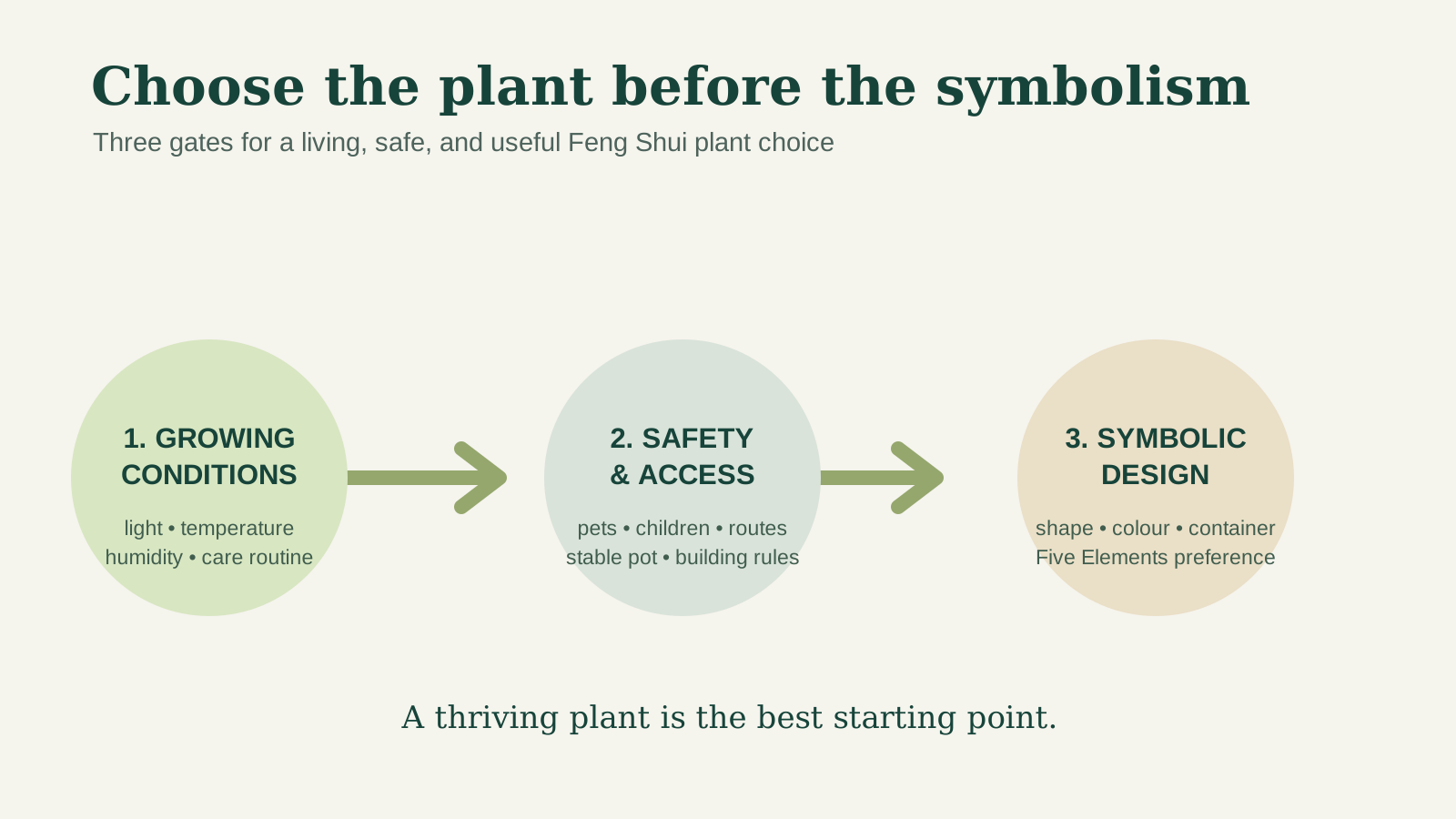
The choice is mostly a light and water decision wearing a symbolic one on top.
A dim room with one bright-ish corner and an owner who forgets watering cans suits lucky bamboo in water, since a glass vase shows the water level at a glance and asks only for a weekly change. A bright room with a south or west window suits the jade, which will use the light the bamboo would scorch in. An office or shop that wants a taller, tree-like plant and can offer real brightness suits the money tree. The sector guidance can then refine the spot inside the room: an east or southeast placement follows the Wood sector custom, and a plant by the till follows the shop custom. When the two point at different corners, light wins, because a dead plant satisfies no reading of the tradition.
Room function matters too. A plant for a desk usually stays small and structural, which points to a bamboo bundle or a young jade. A plant for a floor corner can be the money tree as it grows. A plant for a counter near customers should be the one you can keep looking tended with the least effort, which for most shops is the bamboo in water.
Gift-giving rules
Gift customs around these plants are specific, and they are the part of the tradition most likely to matter to a reader who is buying rather than keeping.
Choose the stalk count by its customary meaning and skip the counts built on four; the table above gives the working list. Tie or choose a red accent when the gift follows the five element recipe, since the ribbon supplies Fire and also signals that the gift was assembled with care. Give the plant healthy and, where you can, include the care basics with it, because a gift that dies in a fortnight sends the opposite of the intended message. A plant given by a shop to a new neighbouring business at an opening is traditionally a bamboo bundle or a money tree, both sized for counters.
Sector and corner guidance aimed at wealth symbolism generally sits inside the same tradition as the feng shui wealth corner guide, and colour choices for pots and ribbons follow the room colour customs set out in feng shui colors by room. The red ribbon is Fire in colour terms as well as element terms, which is why it does double duty in the display.
Where teachers disagree: plants in the bedroom
The bedroom question has no settled answer, and the disagreement is open in the teaching. One line of teachers keeps plants out of bedrooms, reading a growing plant as yang, active energy in a room arranged for rest. Another line allows one small, healthy plant and objects mainly to bedrooms crowded with large plants or plants in poor shape. Families tend to follow the school they learned from, and households that never heard either rule simply use the bedroom window as the sunny spot it is.
The shared ground is the condition rule that shows up everywhere in this topic: whatever you keep, keep it healthy. Every school accepts that a dying plant is the wrong choice for any room, bedroom included.
Keeping the symbolism and the plant in the same frame
The useful way to hold these customs is the way shops have always held them. The stalk counts, the red ribbon, the coin in the base, and the counter placement are a language for saying growth, steadiness, and good wishes in a form a person can give and tend. The species underneath are a dracaena from Central Africa, a wetland tree from the Americas, and a succulent from South Africa that met Chinese gift culture and stayed because they were portable, forgiving, and easy to multiply. Choose the count carefully, place the plant where its light needs are met, change the water, and the tradition and the plant both get what they ask for.