The short version
Short answer: People do not pick lottery numbers randomly, even when they think they do. Crowds lean on birthdays, anniversaries, the digit 7 and patterns that look tidy on the slip, such as 1, 2, 3, 4, 5, 6, multiples and straight lines. None of those habits changes the chance that a line is drawn, because every combination in a fair draw is equally likely. What the habits do change is how many strangers hold the same line as you. A popular line that wins is shared widely and pays less per winner. A quiet line that wins is shared narrowly. That single point, sharing rather than probability, is the only strategy point in this whole subject, and this page will keep returning to it.
For the wider map of what digits mean to people, start with lucky numbers around the world. For the cultural charge behind the most picked single digit, read lucky number 7 and unlucky 13.
The rule that does not move
Before the psychology, the arithmetic, stated without decoration. In a standard lottery draw, the machine or the random generator selects numbers without memory and without preference. A ball that appeared last week is neither tired nor due. A combination that looks orderly is neither blessed nor cursed. 1, 2, 3, 4, 5, 6 has exactly the same chance of being drawn as any scattered line you could name, and a line of family birthdays has exactly the same chance as a line chosen by closing your eyes.
This needs saying more than once, because most lottery confusion comes from blurring two questions. How likely is my line to be drawn? That never depends on your choice. If it is drawn, how many other tickets match it? That depends entirely on how people pick, and people pick in herds. Everything below, birthdays, 7, tidy patterns and fortune cookies, is a story about the second question: human behaviour around the draw, not behaviour inside it.
The birthday crowd and the 1 to 31 squeeze
Ask a room of players how they chose their numbers and the most common answer is some version of dates that matter: a child birthday, a wedding anniversary, the day a parent was born. The appeal is easy to understand. Date numbers are personal, they are easy to remember week after week, and they turn a cheap ticket into a small ritual. Playing your people feels warmer than playing a machine suggestion, and there is nothing foolish about wanting the ritual. Ritual is most of what a lottery ticket sells.
The side effect is compression. Calendar days only run from 1 to 31, and calendar months only run from 1 to 12. A line built from dates therefore lives almost entirely in the low half of most number fields. One birthday line is a private choice. Millions of birthday lines are a traffic pattern, and the traffic all funnels into the same thirty one numbers. Operators can see the funnel in their own sales data. Guidance published by The Lott in Australia lists birthdate picking, meaning numbers 31 and under, among the most common selection techniques, alongside pattern lines and clusters.
Compression matters only on the day your numbers come up, and then it matters a great deal. A winning line inside 1 to 31 is not more likely than any other line; the draw does not know about calendars. But if it arrives, it arrives in the most crowded neighbourhood in the game, and the jackpot is divided among every matching birthday and anniversary ticket. That is the whole logic behind advice to include numbers above 31. A line with high numbers is not luckier. It is simply less likely to be duplicated by the date driven crowd, so a winning share is less likely to be sliced thin. Most date players also reuse the same family set for years. The overlap that follows is structural, not personal: you are using the most popular picking method in the world, and popularity has a price only winners pay.
Why 7 keeps winning the popularity contest
If birthdays explain the low numbers, 7 explains itself. No digit in Western culture carries more friendly weight with less effort. Seven days in the week, seven colours in the rainbow, seven ages of man in the old speech, 007 on the cinema poster: the number arrives pre approved by the culture before any player thinks about it. Our guide to lucky number 7 and unlucky 13 walks through that inheritance in full. The lottery slip is simply one more place the inheritance gets spent.
The preference is measurable beyond folklore. Mathematician Alex Bellos ran an online favourite number poll of about 44,000 respondents, and 7 came first, chosen by more than ten percent. Bellos suggested a plain reason: 7 is a prime, it cannot be divided cleanly, and that awkwardness makes it feel distinctive, sitting away from the obvious middle and from both ends of a short list. A 1967 Yale study by Michael Kubovy and Joseph Psotka on the predominance of seven found the same pull when people were asked to name a number between one and ten: 7 felt the most spontaneous. None of this was lottery research, yet all of it predicts what operators see. A line built around 7 is not more likely to be drawn. It is more likely to be shared, because thousands trusted the same favourite. If you play 7 because you love it, do so with open eyes: you are buying meaning at the price of company.
Tidy patterns and the pull of the visible line
After dates and favourites comes the third habit: patterns. Many players read the playslip as a grid and choose shapes: straight lines, diagonals, neat sequences, clean multiples and edge shapes. A drawing feels more chosen than a scatter. Australian operator data shows how strong the pull is. In material published by The Lott for Saturday Lotto draw 4515, with a 20 million dollar division one pool, the most selected lines were pattern lines: 8, 15, 22, 29, 36, 43, a diagonal, chosen 8,647 times; 4, 12, 20, 28, 36, 44, a straight line, chosen 7,433 times; 7, 14, 21, 28, 35, 42, another diagonal, chosen 7,072 times; and 6, 13, 20, 27, 34, 41, chosen 6,476 times. The Lott calculated that if one of those lines had been drawn, each winner would have received only a few thousand dollars from the 20 million dollar pool. Its spokesperson put the point gently: playing with the crowd can mean sharing your winnings with thousands of others.
The most famous pattern of all needs no grid. 1, 2, 3, 4, 5, 6 is the first sequence every child learns, the easiest line to remember, the easiest line to mark, and, to a certain cast of mind, a small joke against superstition itself: proof that you understand every line is equal. Operators have confirmed the joke is popular. According to Camelot, the former UK National Lottery operator, as reported in the London Review of Books, 1, 2, 3, 4, 5, 6 was the most popular sequence chosen by players and appeared on over ten thousand tickets every week. The same report did the sharing arithmetic: when that sequence is finally drawn, those winners would split the jackpot so finely that each might receive only a few thousand pounds, less than some lower tier prizes on an ordinary week. Multiples run close behind. In one UK draw reported in lottery coverage, 5, 10, 15, 20, 25, 30 was the second most played line, with hundreds of tickets on it. The pattern feels clever because it is regular. Regular is precisely what makes it crowded.
| Picking habit | Typical line shape | Why people choose it | Sharing risk if it wins |
|---|---|---|---|
| Birthdays and anniversaries | Numbers inside 1 to 31, months inside 1 to 12 | Personal, memorable, feels like your ticket | High, the whole date crowd lives in this band |
| The favourite 7 | Lines anchored on 7 or ending in 7 | Western lucky tradition, feels spontaneous and personal | High for 7 heavy lines |
| The counting line | 1, 2, 3, 4, 5, 6 | Easy to remember, easy to mark, a joke about randomness | Very high, over ten thousand UK tickets a week per Camelot |
| Multiples and steps | 5, 10, 15, 20, 25, 30 or 7, 14, 21, 28, 35, 42 | Looks ordered and satisfying on the slip | High, pattern players converge on the same steps |
| Ticket shapes | Straight or diagonal lines, edge shapes on the grid | Chosen by eye as a drawing rather than as numbers | High, The Lott counted thousands on single diagonals |
| Shared sources | Fortune cookie slips, published tips, famous lines | Feels found rather than invented, easy to copy | Can be extreme, see the 2005 case below |
Read the table as a map of company, not a map of danger. Every line in the left column is as likely to be drawn as every line outside it. The right column is the only column that changes with your choice, and it changes what a win would feel like, not whether a win arrives.
Advertisement
Fortune cookies and other shared sources
The cleanest natural experiment in lottery psychology arrived with dessert. On 30 March 2005, Powerball produced 110 second prize winners in one draw, when officials expected four or five. Eighty nine winners received 100,000 dollars each and twenty one received 500,000 dollars through the Power Play option, for a total payout of 19.4 million dollars. The Multi State Lottery Association first suspected a system error or fraud, then traced the match to its source: fortune cookies made by Wonton Food Inc. of Long Island City, New York, which had printed the numbers 22, 28, 32, 33, 39 and 40 on thousands of fortune slips. The drawn numbers were 22, 28, 32, 33 and 39 with the Powerball 42, so the cookie crowd matched five numbers and shared the second tier rather than the jackpot. Reporting at the time noted the fortune on the slip read that all the preparation you have done will finally be paying off. None of the factory employees, the reports added, had played the numbers.
The lesson is threefold. A shared source is a shared ticket: thousands of strangers playing the same found numbers are, for prize purposes, one crowd. The draw did not reward the cookies, since 22, 28, 32, 33 and 39 come up exactly as often as any other five. And the crowd nearly split a jackpot by accident: had the Powerball been 40 instead of 42, those 110 players would have divided the jackpot itself. Modern cookies are quieter, a tip sheet, a famous old line, numbers on a novelty gift, but the mechanism is identical. Any line many people copy becomes a shared line, and shared lines pay shared prizes. The same copying instinct runs through 666, 888 and 999 in Chinese internet culture, where meaning travels because everyone can repeat it.
Quick Pick and the crowd you cannot see
Against all this hand picking stands the machine. Quick Pick, called Lucky Dip in the UK, lets the terminal generate a line, and most players take the offer. Powerball related reporting commonly puts Quick Pick use at about 70 to 80 percent of players, and the Multi State Lottery Association has noted that about 80 percent of jackpot winning tickets have been Quick Picks, mostly because so many tickets are sold that way. Both figures describe popularity, not advantage. A Quick Pick line has the same chance of being drawn as a hand picked line. It wins a large share of jackpots because it is a large share of tickets, in the same way most car accidents happen near home because most driving happens near home.
Where Quick Pick differs is company. A generated line spreads across the whole field without birthday compression, pattern loyalty or cultural favourites, so it is less likely to duplicate another line than a date line is. Less likely, not immune: terminals can repeat a line, and a generated line can still land on a popular pattern by chance. Players who need a story should keep picking by hand and choose their company knowingly. Players who only want the least crowded ticket available already have a respectable tool.
What sharing does to a jackpot: three documented nights
Sharing is abstract until it has a date. Three public cases, each verified in operator or news reporting, show the range.
The United Kingdom, January 1995. A draw produced 133 jackpot winners in one night. Each received about 122,510 pounds, far below what a sole winner of the same pool would have taken. Reporting links the crowd to ticket layout: the winning numbers formed a pattern in the central area of the playslip, so thousands of eyes had drawn the same shape. The numbers were not predictable. The picking was.
Australia, Saturday Lotto draw 4515. No pattern line was drawn that night, which is what makes The Lott published figures valuable: they are a road not taken, counted in advance. Had the top pattern line, chosen 8,647 times, matched the draw, the 20 million dollar division one pool would have paid each winner 2,312.94 dollars. A jackpot, in name, would have paid like a modest bonus. The operator published the arithmetic precisely to warn players that fun patterns carry a crowd.
The Philippines, October 2022. A 6/55 Grand Lotto draw produced the numbers 9, 18, 27, 36, 45 and 54, all multiples of nine, and 433 tickets matched all six. The 236 million Philippine peso jackpot divided to a reported payment of only a few thousand pounds per winner in British coverage, a sum that prompted public calls for an inquiry. Statisticians pointed out the simpler explanation: multiples of nine form a line that pattern players love, so a pattern result met a pattern crowd. The draw was ordinary. The picking, again, was the story.
Set the three nights side by side and the principle stops being advice and becomes bookkeeping. Jackpots are not fixed prizes with your name waiting on them. They are pools, and pools divide. The only variable your number choice controls is the likely number of co winners standing beside you at the division.
Hot numbers, due numbers and other question one stories
Two beliefs are most often sold as strategy and both need a firm answer. Hot numbers are supposedly drawn often and should be ridden; due numbers have been absent and are supposedly likely soon. A fair draw has no memory, so history cannot push the future. A number drawn five times this month has the same chance next week as one not drawn all year. Frequency tables describe the past and not the future. Enjoy tracking them as a hobby if you like. Paying for them as forecasts buys a question one answer, and that answer is only ever equal.
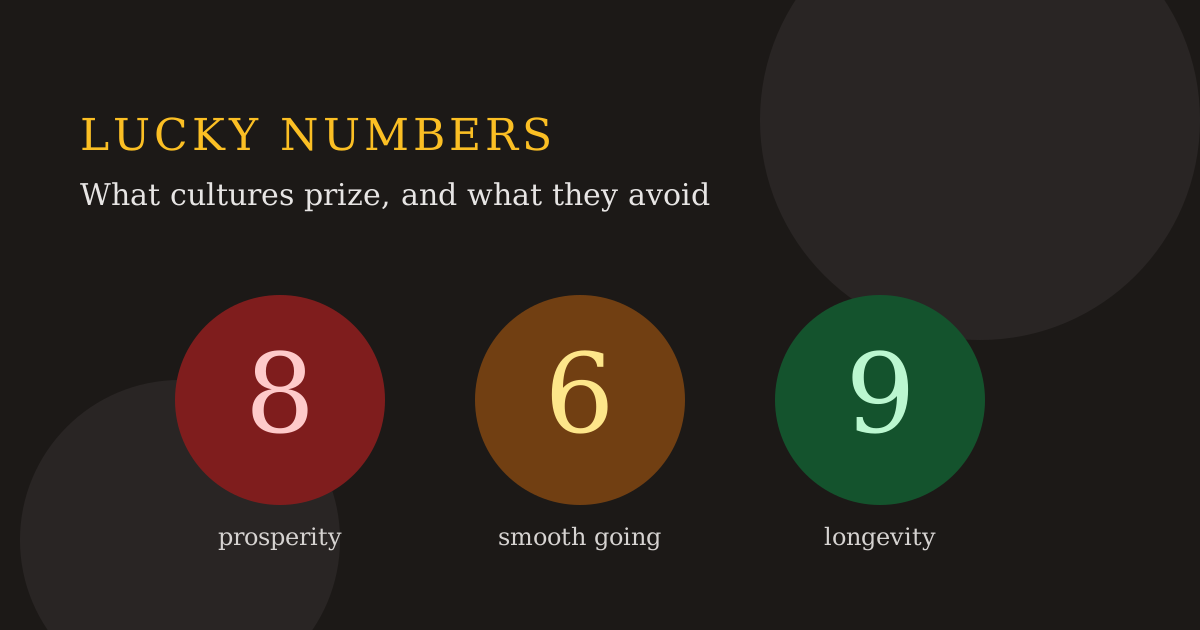
The same firmness applies to lucky number claims imported from other parts of this site subject. In Chinese tradition 8 carries a prosperity association and 9 a longevity one, which our guides to why number 8 is lucky and the number 9 meaning explain as cultural readings. A cultural reading can make a ticket feel right, a gift land warmly or a phone number read well to clients, as how to choose a lucky phone number sets out. What it cannot do is reach into a draw machine. Keep meanings in the meaning column and probabilities in the probability column, and both columns stay separate. Readers drawn to repeating patterns in daily life may also enjoy why do I keep seeing repeating numbers, which treats the experience itself with the same care.
The only strategy point in this territory
Here is the whole of it, with nothing held back for a paid sequel. You cannot improve the probability that your line is drawn. You can, if you wish, improve the expected size of your share conditional on winning, by choosing a line fewer other players are likely to hold. In practice that means: spread beyond the birthday band and include numbers above 31; distrust tidy sequences, multiples and shapes that a stranger could draw from memory; be relaxed about 7 but know it is company; and treat any published or found line, however charming its source, as a line you would be sharing by design. A Quick Pick achieves most of this by default. A hand picked line achieves it by deliberately choosing an unmemorable scatter, which some players find oddly satisfying once they understand the point.
Three cautions apply here. Expected share is not expected profit: tickets return less than they cost on average in every style, so a quiet line improves the terms of a very unlikely win without making the ticket an investment. Unpopular is not unique either, since you cannot audit the nation tickets and any scatter can still collide. And the difference only matters inside an event most players never experience; in almost every week, crowded and quiet lines are worth the same zero because neither is drawn. Spend no more effort on the choice than the ritual is worth. Seen clearly, that frees the choice: pick numbers because you like them, because they carry your people, because the pattern pleases your eye, with a clear note about who else is singing along.
A short checklist for choosing your company
- Name your method: dates, favourites, patterns, found numbers or machine. Each one chooses your crowd for you.
- If dates are your method, know the band. A line inside 1 to 31 is a line in the busiest neighbourhood in the game.
- If you would rather stand apart, include numbers above 31 and break any visible pattern before you hand over the slip.
- Read your finished line as a stranger. If a stranger could guess it, a stranger has probably played it.
- Never pay for hot, due or guaranteed systems. The draw has no memory and no seller has its ear.
- Decide the ticket price as entertainment, in advance, and let a quiet line be a bonus rather than a plan.
The balanced bottom line
Lottery number psychology is real, and it is entirely about the players. Crowds reach for birthdays and squeeze into 1 to 31. Cultures hand their members a favourite, and in the West that favourite is measurably 7. Eyes draw lines and diagonals on a grid, operators count the results in thousands, and once in a while a fortune cookie aligns a hundred strangers into one prize tier. None of it touches the draw, where every combination stands equal, every week, without exception. The jackpot maths that follows is plain division: pools split among matching tickets, so popular lines pay popular prizes, sometimes startlingly small ones, as the British, Australian and Philippine cases show. If those facts nudge you toward a quieter line, good: that is the one legitimate use of everything on this page. If they leave you happily playing your family dates, that is also good, because you now know exactly what you are buying, a ritual with company, at a fair and fully disclosed price.
A last word on playing itself, kept plain. A ticket is a small purchase of a daydream with a drawing attached, best priced as occasional, budgeted and never chased. Buy it like a film seat, enjoy the two minutes of wondering, and let the numbers be the least important decision of your week. The traditions across this site, from lucky numbers by culture to lucky business numbers and lucky house numbers, are about meaning people make together. Meaning is fine to buy cheaply and enjoy openly. It turns sour only when sold as a method for beating arithmetic.
A note on sources and restraint
The crowd figures in this article come from named, checkable places: Camelot reporting on 1, 2, 3, 4, 5, 6 as covered in the London Review of Books; selection counts and per winner calculations published by The Lott in Australia; the Multi State Lottery Association account of the March 2005 Powerball fortune cookie draw, reported by Reuters and the Associated Press at the time; Alex Bellos favourite number poll of about 44,000 respondents; and news reporting of the 1995 UK and 2022 Philippine multi winner draws. Where a beloved claim could not be tied to a source of that standard, it was left out rather than softened. The draw itself needs no sources at all. It is the one part of the subject that never changes, and it is the part worth building your expectations on.