A house at a Y junction sits where one road splits into two, or two merge into one. Practitioners read the pointed wedge of land as a split of qi, and the road aiming at the lot as the T-junction problem. On the practical side, check the headlights, the driveway sight lines and how fast cars take the fork, because intersections account for about half of US traffic injuries.
FHWA figures checked: 23 November 2026
If the road ends head-on at the house, the T-junction house guide is the one you want. Forks are covered here, with the rest of the buying process in our real estate and home buying guides.
| Measure | Figure | Source |
|---|---|---|
| Intersection injuries | Intersections are attributed to about one-half of all traffic injuries in the United States (no year given on the page) | FHWA, About Intersection Safety |
| Intersection-related deaths | 12,036 traffic fatalities involving an intersection in 2022 (coded Intersection, Intersection-Related, Driveway Access or Driveway Access-Related) | FHWA, using NHTSA FARS data |
| Trend | 10,148 in 2018 rising to 12,036 in 2022 | FHWA, using NHTSA FARS data |
| Scope | These are national figures and do not rate any single fork or lot | FHWA, About Intersection Safety |
On this page
- Where a Y junction lot sits
- What the tradition says
- What intersection data says
- The wedge lot
- The stem lot facing the split
- Scoring sheet: three Y junction lots
- Ways to soften a fork lot
- What buyers get wrong at a fork
- FAQ
Where a Y junction lot sits
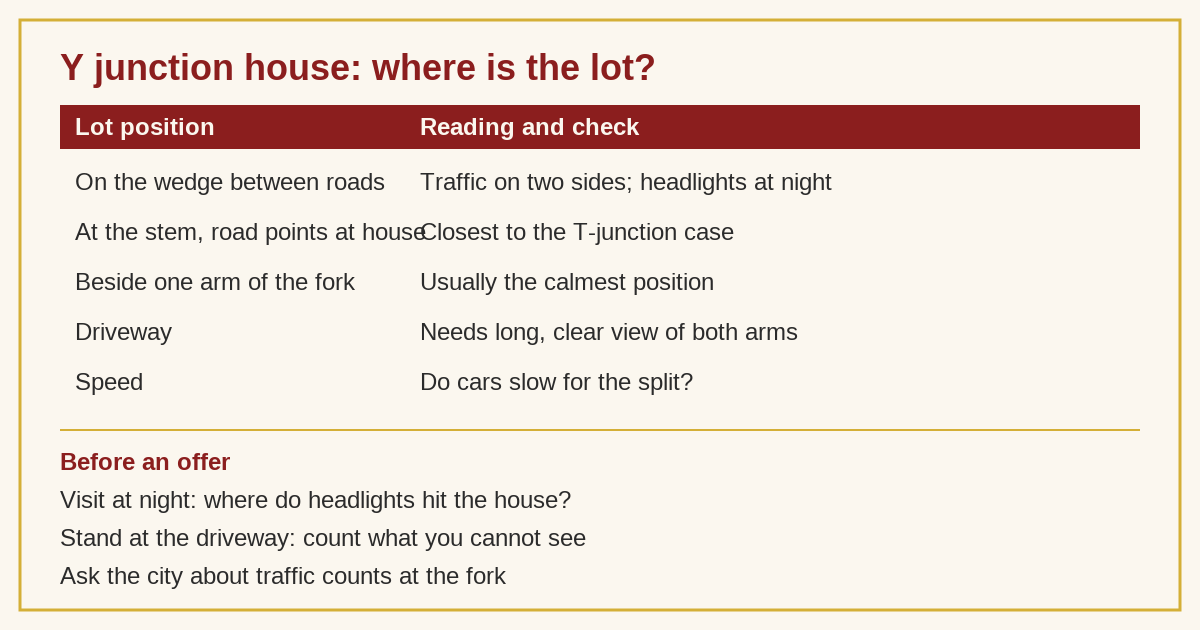
A Y junction (also called a fork, a wye or a Y intersection) has three legs. A lot can be in one of three places: on the wedge of land between the two arms, at the end of the stem where traffic from the stem points toward the lot, or beside one arm of the fork. The risks differ sharply between them, so find yours on a map first.
The road matters as well. A slow residential split is a different thing from a fast road that forks at a wide angle.
Advertisement
What the tradition says
Practitioners say qi follows roads like water. A road that forks is described as splitting that flow, so a house on the wedge is said to take the pull of two directions at once, which teachers call unsettled or divided. A house at the stem of the Y, where one road runs toward the lot and then splits, gets the T-junction reading: the road aimed at the door is a poison arrow. A house beside one arm, away from the point, is generally read as the calmest.
Teachers often suggest softening the line facing the road with a planted edge, a curved path or a visible gate. These are traditional design readings, not measured effects. Our T-junction house field audit sets out how to assess a road pointed at a house, and the poison arrows guide explains the idea.
What intersection data says
FHWA says intersections are attributed to about one-half of all traffic injuries in the United States. Its FARS-based table counts traffic fatalities involving an intersection, including intersection-related and driveway-access crashes: 10,148 in 2018, 10,273 in 2019, 10,720 in 2020, 11,799 in 2021 and 12,036 in 2022.
These are national totals, and they count all kinds of intersections. They do not say a Y is safer or worse than a T or a four-way. What a buyer can take from them is narrower: a lot at a junction faces more vehicles turning, braking and starting than a mid-block lot, and your own driveway is a potential conflict point. Ask your city for traffic counts and crash records at the fork rather than relying on a national number.
The wedge lot
A lot on the wedge between the two arms has road on two sides and a point toward the junction. Check how close the house sits to the point, whether headlights from the stem sweep the front windows, whether the point has a fence or planting that vehicles could hit, and whether the driveway has a view of both arms. The shape matters too. Our lot shape guide explains why a pointed lot is read as harder to settle than a square one.
Triangle and wedge shapes come up again in the corner lot, cul-de-sac and slope guide.
The stem lot facing the split
When the stem of the Y ends at your lot, cars approaching see your house straight ahead until they choose a side. Headlights come straight at the front windows at night. The checks are the same as for a T junction: how fast the traffic is, whether there are solid barriers, bollards or fences that would stop a vehicle that fails to turn, and whether there is a setback between the street and the house. Ask the city whether a barrier is allowed in the right of way before you plan one.
Scoring sheet: three Y junction lots
Each line scores 0 (bad), 1 (unclear) or 2 (good). The scores below are examples, not ratings of real lots.
| Check | Wedge lot | Stem lot | Beside one arm |
|---|---|---|---|
| Headlights on front windows | 1 | 0 | 2 |
| Driveway view of both arms | 1 | 1 | 2 |
| Vehicle speed at the split | 1 | 0 | 2 |
| Setback and barrier options | 1 | 1 | 2 |
| Tradition reading | 0 | 0 | 2 |
| Total | 4 | 2 | 10 |
A stem lot scoring under 4 usually needs a real barrier and a changed floor plan (bedrooms away from the road side) to be comfortable. If neither is possible, pass.
Ways to soften a fork lot
- Place bedrooms and the home office away from the road-facing side.
- Put up a fence, wall or planted edge within local height and sight-triangle rules.
- Lay a curved or offset path from the street to the front door.
- Light the entry well, so drivers see the house at night and it does not catch them by surprise.
- Ask the city about signs, markings or traffic calming at the fork.
What buyers get wrong at a fork
- Treating every Y the same: a slow residential split is not a fast arterial fork.
- Visiting only by day.
- Blocking your own driveway view with a hedge near the junction.
- Assuming a fence on the street edge is allowed. Right-of-way rules vary by city.
FAQ
Is a Y junction house bad feng shui?
That depends on where the house sits. Practitioners treat a house at the stem, with a road pointing at the door, as the same problem as a T junction. A house on the wedge is described as pulled in two directions, and a house beside one arm is generally read as calmer. These are traditional readings, not measured outcomes.
Is a house at a fork in the road more dangerous?
FHWA says intersections are attributed to about one-half of traffic injuries in the United States, but its national figures do not rate Y junctions or any one lot. Ask your city for traffic counts, speed and crash records at the specific fork.
What is the difference between a Y junction and a T junction house?
At a T junction a road ends head-on at the house. At a Y junction the road splits, so the lot may be on the wedge between the arms, at the stem facing the split, or beside one arm. The stem lot is closest to the T-junction case.
How can I reduce headlight glare at a Y junction house?
Move bedrooms away from the road-facing side, use a fence or planted edge within local rules, and check the front windows at night before you buy. Do not block your driveway view to cut glare.
Should I walk away from a fork lot?
Walk away if cars approach fast and straight at the house with no setback or barrier option, and the floor plan cannot move the bedrooms. A lot beside one arm of a slow residential fork is usually fine.
After dark at the lot
Visit the lot after dark and mark where the headlights hit, then compare it with the T-junction house guide if a road points at the door.
Sources
Checked November 2026.
We did not verify crash rates specific to Y junctions or local sight-triangle rules, so we state no figures from them.
Editorial note: Lucky Properties presents feng shui as a cultural and design tradition. This guide is educational. Confirm legal, financial and inspection questions with a licensed professional.