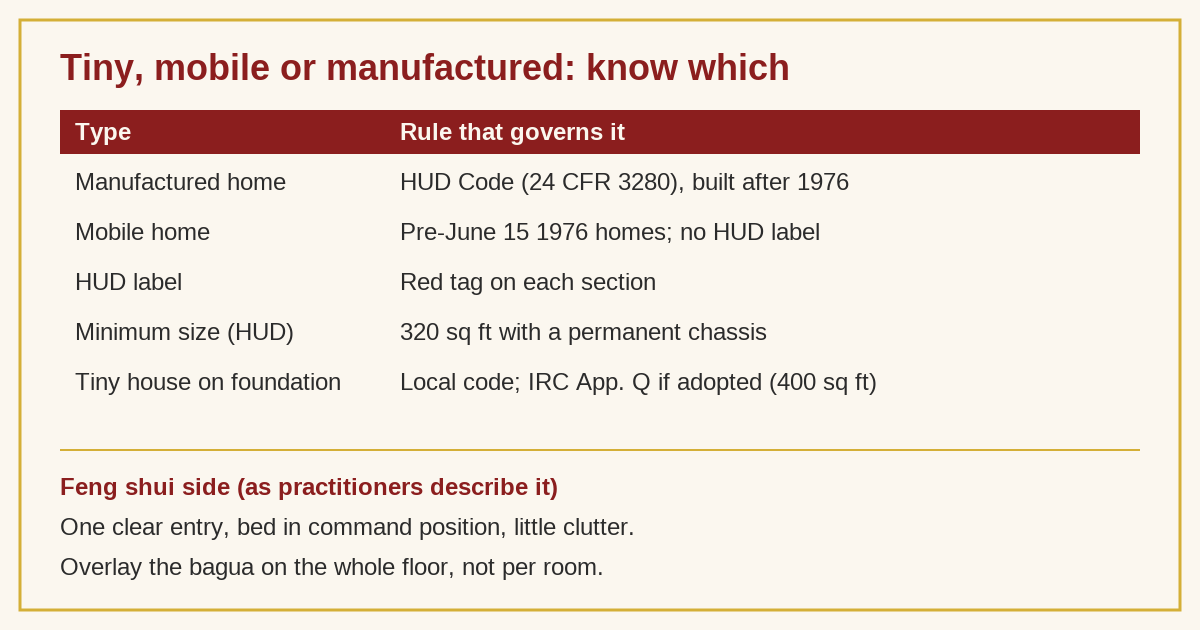
Feng shui applies to small homes by scaling down: one clear entry, a bed in the command position, and a bagua map laid over the whole floor. For a manufactured or mobile home, the HUD label and data plate matter more to a buyer than any layout rule. A tiny house is different again: whether it sits on wheels or a foundation decides everything.
HUD and code pages checked: 23 November 2026
Buyers often mix up tiny houses, mobile homes and manufactured homes, but each falls under different rules. We separate the three first and then turn to what practitioners suggest for small floor plans. For larger homes, start with our real estate and home buying guides.
| Item | What HUD or the code says | Source |
|---|---|---|
| HUD Code | Manufactured homes are built to the Manufactured Home Construction and Safety Standards (24 CFR Part 3280) | HUD |
| Certification date | Homes built in the U.S. after June 15, 1976 must be certified by the manufacturer | HUD |
| Label | A certification label (HUD Tag) must be on each transportable section; HUD describes it as a red label on the exterior | HUD |
| Size and chassis | A manufactured home is a dwelling unit of at least 320 square feet with a permanent chassis; it was formerly known as a mobile home | HUD |
| Zone maps | A home should not be placed in a more restrictive wind, thermal or roof load zone than its build zone | HUD |
| Tiny house scope (Appendix Q) | Applies to a dwelling of 400 square feet or less excluding lofts; not mandatory unless a jurisdiction adopts it | Tiny House Alliance USA quoting the IRC |
On this page
- Three kinds of small home
- What the tradition suggests for small floor plans
- The buyer checks that matter most
- Decision table: small home buyer sheet
- Where small home buyers go wrong
- FAQ
- Two things to do first
Three kinds of small home
- Manufactured home. It is built in a factory to the federal HUD Code and moved to the site. HUD says all manufactured homes built in the US after June 15, 1976 must be certified by the manufacturer, with a label on each transportable section.
- Mobile home. This is the older term. HUD says a manufactured home was "formerly known as a mobile home". Homes built before the June 15, 1976 date have no HUD label, and that gap is the first thing a buyer should check.
- Tiny house. There is no single federal definition. The International Residential Code's Appendix Q applies to dwellings of 400 square feet or less excluding lofts, but it binds only where a jurisdiction has adopted it. A tiny house on wheels and a tiny house on a foundation are treated differently.
Advertisement
What the tradition suggests for small floor plans
Modern practitioners do not change the principles for small homes. They compress them, as our micro condo feng shui guide also does:
- One clear entry. The door should open onto a spot to pause, even if that is only a hook and a mat.
- Command position for the bed. See the command position guide: a view of the door from bed, without lying in line with it.
- The map over the whole footprint. Our bagua map for a studio apartment works the same way.
- Less stuff. Practitioners describe clutter as the main problem in small homes. Built-in storage and lofts cut it down.
- Natural light. Windows at both ends of the home let light and air pass through.
A manufactured home on a chassis may be set on a pier foundation. Because practitioners care about stability, some mention skirting, a tied-down frame and a clear foundation. Here, though, the HUD data and installation rules count for more than the tradition.
The buyer checks that matter most
For a manufactured or mobile home:
- Find the HUD label and data plate. HUD says the red label is on the exterior of each transportable section. A home built after June 15, 1976 with no label is a red flag. A home with no label because it predates that date is a different case.
- Check the zone. HUD says a home should not be placed in a more restrictive wind, thermal or roof load zone than its build zone. Ask the seller for the data plate, which shows the zones, and compare it with your location.
- Ask about the land. Owning the home does not mean owning the lot, so read the land lease terms.
- Ask how it was installed. Foundation and anchoring affect both safety and financing.
- Ask lenders early. We found no sourced figure on lending rules, so we state none.
For a tiny house:
- Wheels or foundation? The category decides zoning, insurance and lending. A unit with an RV certification, one with a permanent foundation and one built to a local code are three different products.
- Zoning. Many places limit minimum house size or where a tiny house may sit. Ask the municipality in writing.
- Appendix Q. If your jurisdiction adopted it, it relaxes some size rules. A Virginia example allows 6 feet 8 inches ceilings in tiny homes of 400 sq ft or less instead of 7 feet, and 6 feet 4 inches in bathrooms. That example applies in Virginia only.
- Escape. Lofts need a way out. Appendix Q addresses lofts and escape openings, but we give none of its figures because the code text would not open when we checked.
Decision table: small home buyer sheet
| Check | Manufactured (post-1976) | Older mobile home | Tiny house |
|---|---|---|---|
| Governing standard | HUD Code | None federal | Local code, RV standard or IRC Appendix Q |
| What to find | Red label, data plate | Date of build | Certification or permit |
| Biggest unknown | Lot and installation | Safety and financing | Zoning |
| First question | Does the label match the home? | When was it built? | Is it legal to place here? |
Where small home buyers go wrong
- Calling every park home a mobile home. The label and date decide the category.
- Buying a "tiny home" with no certification. It may be hard to insure or to find a legal spot for.
- Letting the bagua drive layout over code. A loft bed that fails the escape rule is not an acceptable remedy.
- Moving a manufactured home to a harsher zone. The zones on the data plate are limits.
FAQ
Does feng shui work in a tiny house?
Practitioners say the principles scale down: a clear entry, the bed in command position, light, and little clutter. Lay the bagua over the whole floor rather than over each room.
What is the difference between a mobile home and a manufactured home?
HUD describes a manufactured home as a dwelling of at least 320 square feet on a permanent chassis, built to the HUD Code, and says it was formerly known as a mobile home. Homes built after June 15, 1976 must carry a HUD certification label.
Where is the HUD label on a manufactured home?
HUD says the certification label, called the HUD Tag, must be on each transportable section, and describes it as a red label on the exterior. The data plate inside shows the wind, thermal and roof load zones.
What does the HUD data plate zone mean?
HUD says a home should not be placed in a more restrictive wind, thermal or roof load zone than the one it was built for. Compare the data plate with your location before you buy or move a home.
Is a tiny house the same as a manufactured home?
Not necessarily. The IRC's Appendix Q covers dwellings of 400 square feet or less excluding lofts, but only where adopted. A tiny house on wheels, one on a foundation and a HUD-certified home are different legal categories, so confirm which one you are buying.
Two things to do first
Find the HUD label and data plate on any manufactured home you are considering. If it is a tiny house, ask the municipality in writing whether that type can be placed on the lot.
Sources
Checked November 2026.
- HUD, Manufactured Housing Homeowner Resources
- Tiny House Alliance USA, Appendix Q Tiny Houses (a secondary summary; the ICC page for the code text would not open)
The International Code Council text of IRC Appendix Q would not open when we checked, so we state no Appendix Q figure beyond the 400 square foot scope and the Virginia ceiling example. We also found no sourced figure on lending or insurance for these home types, and give none.
Editorial note: Feng shui is presented here as a cultural and design tradition. Confirm legal, financial and inspection questions with a licensed professional.