A death in a house does not decide the purchase on its own. Feng shui practitioners look at how the person died and how the house feels and flows today. What a seller must tell you is a legal question, and the answer changes from place to place. In California, Civil Code 1710.2 draws the line at three years.
Statute and sources checked: 23 November 2026
The full viewing routine is in our feng shui home buying checklist, one of our real estate and home buying guides.
| Topic | Rule | Source |
|---|---|---|
| California death disclosure | An owner or agent is not required to disclose an occupant's death on the property, or the manner of death, when it happened more than three years before the buyer's offer | California Civil Code 1710.2(a)(1)(A) |
| HIV and AIDS | An owner need not disclose that an occupant had HIV or died of AIDS-related complications | California Civil Code 1710.2(a)(1)(B) |
| Direct questions | The section does not protect an owner or agent from an intentional misrepresentation in answer to a direct question | California Civil Code 1710.2(d) |
| Physical condition | The section does not change the duty to disclose the physical condition of the premises | California Civil Code 1710.2(c) |
| Other states and provinces | Rules differ. We checked only California's statute, so no other place's rule is stated here | See the note below |
On this page
- What feng shui says about a house where someone died
- What the law says: the California example
- Questions to ask, and when to ask them
- Decision sheet: stay, adjust or walk away
- Remedies that practitioners suggest
- Mistakes buyers make with a death disclosure
- FAQ
- Before the second viewing
What feng shui says about a house where someone died
The tradition has a long-standing idea of the unlucky house, one marked by misfortune, but practitioners do not treat every death alike. They usually weigh three things:
- How the person died. Many practitioners describe a natural death, especially of an elderly occupant at home, as an ordinary part of a long-lived house. They describe a violent or sudden death as heavier, and they advise more care before moving in.
- How long ago. The longer other people have lived in the house since, the less weight practitioners usually give the event.
- The present layout. In Form School the working question is what the house does now: light, air, a clear entry, a bedroom that is not crowded by the front door or a beam. Our Form School versus Compass School guide explains why this matters more to many practitioners than the history.
None of this guarantees luck or harm. It is a cultural framework. Some buyers decide the history doesn't matter to them, and others find they cannot settle in. Both reactions are fair.
Advertisement
What the law says: the California example
California is the only jurisdiction we checked. Civil Code 1710.2 lists what a seller does not have to disclose. A death on the property, and the manner of death, falls in that group when the death happened more than three years before the buyer offers to buy, lease or rent. A death inside that three year window falls outside the exemption, and that is the case to take to a California agent or real estate attorney.
Three other points in the same section matter to a buyer:
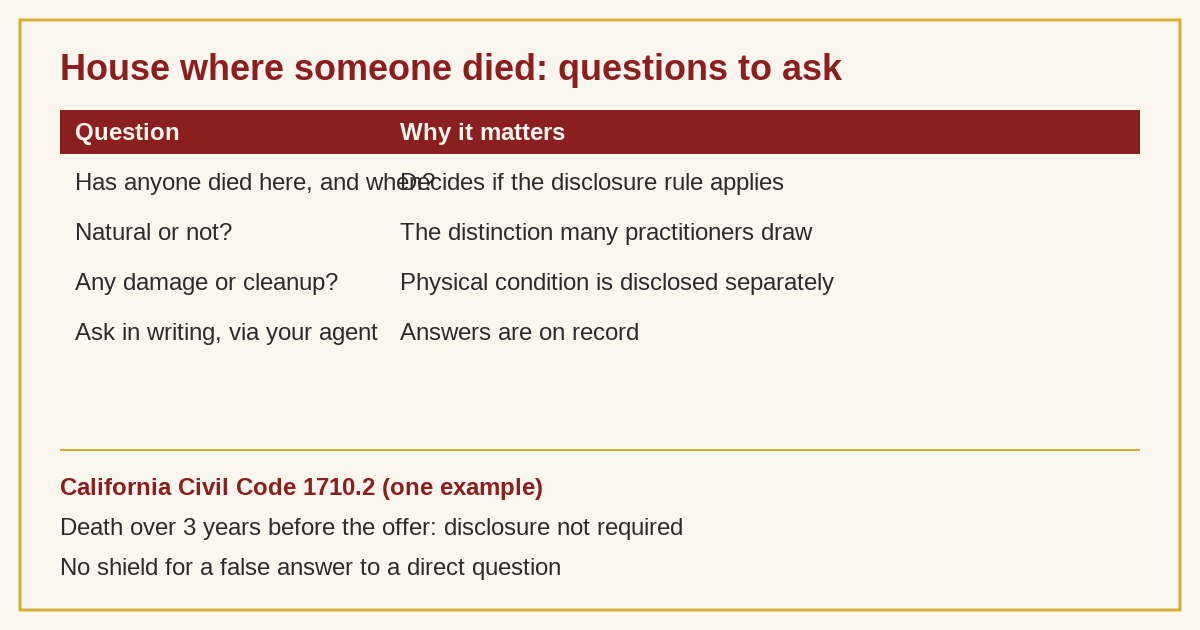
- The section says it does not excuse an intentional misrepresentation in answer to a direct question. If you ask in writing and get a false answer, the section does not shield the seller or agent.
- It does not change the duty to disclose the physical condition of the property. A death that left damage, a biohazard cleanup or a repair is a separate matter from the death itself.
- It names HIV and AIDS as something an owner need not disclose.
Everywhere else the answer depends on the state or province, and we have not covered their rules or time limits. Don't assume the California three year line applies where you live.
Questions to ask, and when to ask them
Since the duty to volunteer the information varies, the practical move is to ask. Put the question in writing through your agent, so the answer is on record.
| Question | Why it matters | What a worrying answer looks like |
|---|---|---|
| Has anyone died in the home, and when? | Tells you whether the question applies at all | A refusal to answer, or an answer that changes |
| Was it a natural death or not? | Many practitioners and many buyers draw their line here | Any violence, or a death that needed police or a coroner |
| Was there damage or cleanup, and was it repaired? | Physical condition is separate and is still disclosed | Stained subfloor, odour, unpermitted repair |
| Has the sale history changed since? | Several sales in a short time can mean owners left | Quick resales with no explanation |
| What does the seller's disclosure form say? | It is the written record | Blank boxes |
Then add the ordinary protections: a full home inspection, a title search, and a walk through the neighbourhood at different times of day. Our moving in guide covers the first weeks after you get the keys.
Decision sheet: stay, adjust or walk away
Score each line from 0 (no concern) to 2 (strong concern). We made the sheet as an aid; it is not a legal or industry standard.
| Line | 0 | 1 | 2 |
|---|---|---|---|
| Manner of death | Natural | Unclear | Violent or sudden |
| Years since | Over 3 | 1 to 3 | Under 1 |
| Physical damage left | None | Repaired, documented | Not repaired or unclear |
| How it feels to you at a second viewing | Fine | Unsure | Uneasy |
| Price against comparable homes | In line | Slight discount | Large discount that you would need to give up on resale |
A total of 0 to 3 suggests the history probably won't decide it for you. At 4 to 6, ask more questions and bring someone you trust to the second viewing. At 7 or more, walking away is a sensible choice even if the price is attractive. Think about resale as well, because a future buyer may ask the same questions you did.
Remedies that practitioners suggest
If you buy, practitioners usually suggest a mix of practical and symbolic steps:
- Deep clean, repaint and replace carpets or flooring that the previous owner used.
- Open every window for fresh air and let in daylight.
- Declutter and move furniture to new positions. See our decluttering reset guide.
- Some families hold a house blessing or use incense. Our space clearing page lists the common rituals and the plain move-in tasks beside them.
- Choose a date for moving in with the auspicious dates tool.
These are cultural practices and no substitute for repairs or a legal check.
Mistakes buyers make with a death disclosure
- Assuming the three year line is universal. It is a California rule. Check your own jurisdiction.
- Relying on rumour. Neighbours and online posts can be wrong. Ask through the agent and read the disclosure form.
- Skipping the physical inspection. A history question is not an inspection.
- Treating the seller's silence as a no. Silence is not an answer. Ask in writing.
- Buying only because of the discount. A big discount may be fair for the risk, but weigh it against what you could get when you sell.
FAQ
Do sellers have to tell you if someone died in the house?
It depends on where you are. In California, Civil Code 1710.2 says an owner or agent need not disclose an occupant's death on the property, or the manner of death, when the death happened more than three years before the buyer's offer. The exemption does not cover a death inside that window, and the section does not protect a false answer to a direct question. Other states and provinces have their own rules, so ask a local agent or attorney.
Is a house where someone died bad feng shui?
Not by rule. Practitioners usually distinguish a natural death from a violent one and look at how long ago it was and how the home works now. Many treat a natural death of an elderly occupant as ordinary. Others advise more caution after a violent death. It is a cultural framework, not a guarantee, and the decision is yours.
Does a death in a house lower its value?
We did not check any study on this, so we give no figure, and California Civil Code 1710.2 says nothing about value. Compare the price with similar homes nearby and ask your agent for recent sales. A future buyer may ask the same questions you did.
Can I ask the seller directly whether someone died there?
Yes. In California, the section does not shield an owner or agent from an intentional misrepresentation in response to a direct inquiry. Put the question in writing through your agent so the answer is on record, and check your own jurisdiction's rule.
What can I do to settle into a home with a difficult history?
Practical steps come first: a thorough clean, new paint and flooring where needed, fresh air and daylight, and a rearranged layout. Many families add a house blessing or a cleansing ritual. They are comfort measures drawn from tradition, and they do not replace an inspection or a legal check.
Before the second viewing
Write out the questions from the table and send them to your agent before you go back. Then run the feng shui home buying checklist on the property.
Sources
Checked November 2026.
We did not consult other states' or Canadian provinces' disclosure rules, so none is stated above.
Editorial note: Lucky Properties presents feng shui as a cultural and design tradition. This guide is educational and is not legal advice; confirm disclosure, legal, financial and inspection questions with a licensed professional in your area.