Feng shui practitioners object to a skylight in two places: directly over the bed and directly over the stove. A skylight that brings daylight to a windowless hall, a stairwell or the dark middle of a deep plan draws no objection in the sources we read. Once the spot is chosen, heat gain, leaks and the permit decide whether it works.
Last checked: 26 November 2026
| Key fact | Figure or rule | Source |
|---|---|---|
| Over the bed | Described as "not the greatest" placement; the remedy offered is a cover or a canopy | Feng Shui Dana, Q&A on skylights, 2012 |
| Over the bed (second view) | Said to invite "too much outside energy" into the place meant for rest | Happy House Feng Shui, bed positions |
| Over the stove | Called inauspicious by a practitioner, as reported by a forum poster; a moderator raised fire safety | Geomancy.net forum thread |
| Skylight size | No more than 5% of floor area in a room with many windows, up to 15% in a room with few | US Department of Energy, Skylights |
| Roof pitch | Latitude plus 5 to 15 degrees, so about 45 to 55 degrees at 40°N | US Department of Energy, Skylights |
| Ratings | Look for both NFRC and ENERGY STAR labels; ENERGY STAR limits depend on climate and come from NFRC ratings | ENERGY STAR; US Department of Energy |
The tradition has little to say beyond those two objections, so most of the decisions below are about money and the roof. This guide is part of the renovate and build pillar. If you are choosing between a skylight and a new window, the window replacement guide covers frames, glass and ratings in more detail.
On this page
- Why practitioners treat a skylight as an open window overhead
- Placement by room
- Over the bed, over the stove and over the entry
- Where a skylight is easiest to defend
- Orientation and heat
- Glass, flashing and the roof itself
- Permits and who to ask
- FAQ
- Sources
Why practitioners treat a skylight as an open window overhead
In the way many practitioners talk about houses, windows are the home's eyes: they see out, and they let light and air in. Feng Shui Dana puts it that way, and adds that an opening directly above lets that energy in right over the person underneath. Most skylight objections rest on that one idea. A wall window is in front of you. A skylight is overhead, out of sight and hard to shut.
The same source is relaxed about it. Its verdict on a skylight over a bed is that it is not ideal and also not the worst, and that you should only act if it is affecting your life. Skylights, it adds, are hard to clean and often give less clear light unless they are well made. A dirty skylight is a maintenance problem and, in this reading, a feng shui one too.
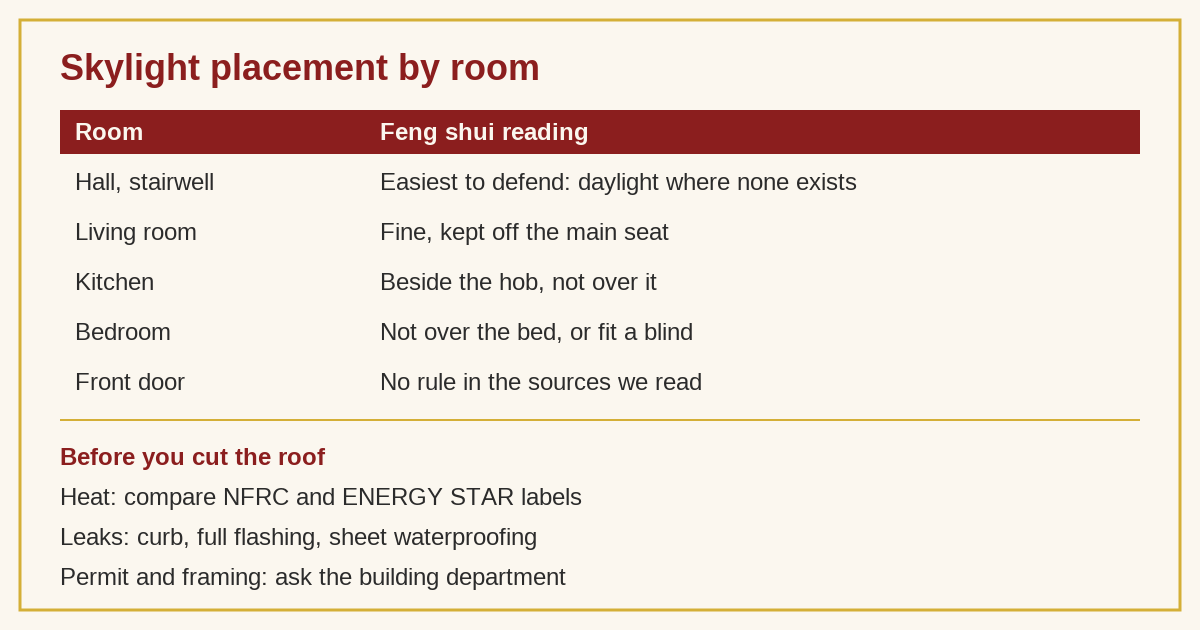
Placement by room
| Location | Feng shui reading | Practical check |
|---|---|---|
| Hallway or landing with no windows | No objection found; it brings daylight to a space that has none | Check that the shaft does not cross a beam or duct |
| Stairwell | No objection found; daylight on the stairs helps people see their footing | See the staircase placement guide for the stair itself |
| Living room | By the same logic as the bed, keep the main seat out from directly under it | Glare and summer heat on the seating area |
| Kitchen | Over the stove is objected to; beside the cooking zone draws no objection | A solid roof above the hob, and room for the vent hood |
| Bedroom | Over the bed is the objection practitioners raise most; over open floor or a dressing area is not mentioned | A blind you can close against early summer light |
| Bathroom | Not raised in the sources we read | Moisture and condensation on the glass |
| Above the front door | Not covered by the sources we read; see below | Rain and snow load on the entry |
| Home office or desk | Light from above is welcome; glare on the screen is not | Position the screen at right angles to it |
Only the bed and stove rows rest on practitioner sources we opened. The others are our reasoning from two ideas those sources do state, that an opening overhead lets outside energy in and that a home should get clear daylight, which our lighting guide discusses. No practitioner we read wrote them down as skylight rules.
Advertisement
Over the bed, over the stove and over the entry
The bed. Happy House Feng Shui says a skylight over the bed invites too much outside energy into the place where you want restful sleep and intimacy. Feng Shui Dana adds that a window overhead may make you feel unsafe, and suggests checking whether you sleep well. The remedies named are a cover over the skylight or a canopy over the bed. A ceiling beam over the bed is a separate concern with its own remedies, covered in the ceiling beams guide.
If you want daylight in the bedroom anyway, choose a skylight you can darken. Summer dawn comes early in northern latitudes, and a blind or shade deals with the early light and the tradition's objection at the same time.
The stove. A forum poster on Geomancy.net reported that a practitioner called a skylight directly above the kitchen stove inauspicious. A moderator on the same thread answered on safety grounds instead: fire rises, and glass over the cooking area can break in a fire. Whether or not you accept the tradition, glass beside the hob and a solid roof above it is the cautious layout.
The entry. None of the sources we opened mentions a skylight over the front door. The bed reasoning, an opening overhead, could be stretched to cover it, but no source we read does so. A covered porch or roof overhang makes the question moot. The roof shape guide has a section on overhangs and skylights in the context of the whole roof.
Where a skylight is easiest to defend
The strongest case is the room that has nothing else. A windowless hall, a stairwell or the centre of a deep floor plan gets daylight from above or not at all. A tubular skylight is the smaller option for a narrow hall or a closet-sized space, though the US Department of Energy points out that it gives no view and no ventilation.
For a deep plan, a skylight is one of a few ways to add light. The others are interior glazed doors, a borrowed-light window above a door, and lighter surfaces. Compare them on cost before you commit to a hole in the roof. If the problem is only an evening one, our lighting guide covers layers of artificial light.
Orientation and heat
The Department of Energy describes each direction plainly:
- North: fairly constant but cool light.
- East: the most light and solar heat in the morning.
- West: afternoon sun and heat, the hardest to live with in summer.
- South: the best potential for passive solar heat in winter, but often unwanted heat in summer.
Pitch matters too. A low slope admits more summer heat and less winter heat, the reverse of what you want. As a guideline, aim for latitude plus 5 to 15 degrees; the Department of Energy's example is 45 to 55 degrees for a south-facing skylight in Columbus, Ohio, at about 40°N. Deciduous trees can shade a skylight in summer, and exterior shades work better than interior ones at cutting summer heat gain.
Glass, flashing and the roof itself
Look for both an NFRC label and an ENERGY STAR label. ENERGY STAR sets its minimum performance by climate, based on NFRC ratings, so the right U-factor and solar heat gain figures depend on where you live. The Department of Energy points out that the criteria do not account for your own house design, so treat the skylight as part of the plan for the whole project. Our window replacement guide explains how to read those two numbers.
On the glass itself, the Department of Energy says glass is more durable and does not discolour, and that it must be safety glazing, meaning tempered or laminated. Plastic is cheaper and resists breakage but scratches and can yellow or turn brittle. Tints, low-e coatings and insulated glazing are the other options.
Most skylight complaints are leaks, so the installation matters more than the brand:
- Mount the unit above the roof surface on a curb, a raised watertight lip that deflects water.
- Flash it fully and seal the joints, following the manufacturer's instructions.
- Apply sheet waterproofing over the flanges and flashing, which helps against ice dams.
- Skip roof crickets and diverter strips; the Department of Energy says they often cause more problems than they solve.
Cutting a roof opening also cuts rafters or trusses, and the framing around the opening has to carry the load they carried. That is a job for a roofer or structural professional, not something to settle with a marker line from the attic.
Permits and who to ask
Roof openings usually need a permit because they change the structure and the weatherproofing, but the rule depends on the city, the roof type and whether you replace an existing unit or cut a new one. We did not open a local code for this guide, so no permit figure is given. Call your local building department first, and ask a licensed roofer or contractor to confirm the framing.
If the skylight is part of a larger project, the renovation dos and don'ts is a short place to check what else to settle before work begins.
FAQ
Is a skylight bad feng shui?
Not by itself. The objections in the practitioner sources we read are about two spots: directly over the bed and directly over the stove. None of them objects to a skylight that lights a hallway or stairwell with no other daylight.
Can I keep a skylight over my bed?
Practitioners who object say the opening lets too much outside energy in above a sleeper and can make some people feel exposed. The usual remedies are a blind or shade you can close at night, or moving the bed out from under the glass. If you sleep well with it, one practitioner we read says to leave it alone.
Is a skylight over the kitchen stove a problem?
A forum poster reported that a practitioner called it inauspicious. A moderator on the same thread raised fire safety instead, since glass over the cooking area can break in a fire. Putting the skylight beside the cooking zone, with a solid roof over the hob, answers both concerns.
Does a skylight make a room hotter?
It can. The US Department of Energy notes that skylights can add unwanted heat in summer and lose heat in winter. Orientation, glazing, a low-e coating and an exterior shade all change the result, so compare the NFRC label figures before you buy.
Do I need a permit to add a skylight?
Often, yes, because cutting a roof opening touches the structure and the weatherproofing. Rules vary by city and country, so ask your local building department before any cutting starts.
What size skylight is reasonable?
The US Department of Energy suggests keeping skylight area to no more than 5% of the floor area in a room with plenty of windows, and up to 15% in a room with few. Treat those as planning limits and ask your installer about your own climate.
Sources
- US Department of Energy, Energy Saver, "Skylights", checked 26 November 2026.
- ENERGY STAR, "Residential Windows, Doors, and Skylights: Key Product Criteria", checked 26 November 2026.
- Feng Shui Dana, "Feng Shui Q & A: Skylights in Feng Shui", 1 November 2012, checked 26 November 2026.
- Geomancy.net forum, "Skylight in Kitchen" thread, checked 26 November 2026.
- Happy House Feng Shui, "The Best and Worst Feng Shui Bed Positions", checked 26 November 2026.
Feng shui views here are traditions and opinions of the practitioners named, not outcomes anyone can promise. Building, safety and permit questions belong with your local building department and a licensed professional.