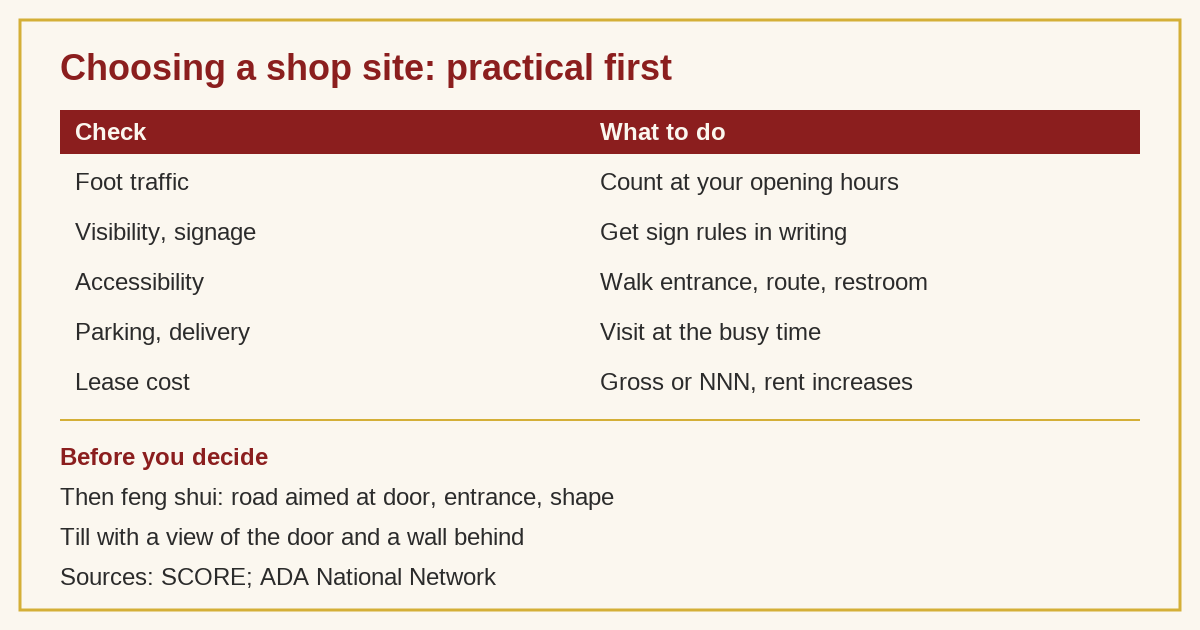
For a shop, practitioners read the street approach, the entrance, the shape of the floor and where the till sits. They steer clear of pointed corners, blocked doors and roads aimed at the entrance. Still, a shop lives or dies on foot traffic, visibility, sign rules, parking, lease cost and accessibility. Check those first.
Checked against SCORE and the ADA National Network: 23 November 2026
The address number is a separate question, answered in lucky business numbers and shop addresses. This guide is about the site, and it belongs with our real estate and home buying guides.
| What to check | What it covers | Source |
|---|---|---|
| Customers | Check whether the area has enough target customers, including daytime and total population and pedestrian and vehicle traffic | SCORE |
| Visibility | Check visibility from inside the centre, to pedestrians and to passing traffic, plus signage restrictions | SCORE |
| Space | Square footage, shape, interior obstacles such as columns, and in-line, freestanding or corner and end-cap position | SCORE |
| Infrastructure | HVAC, plumbing and restrooms, electrical, internet, building code and ADA compliance | SCORE |
| Parking | Free or paid, storefront spaces, delivery access | SCORE |
| Cost | Triple net or gross, how often and by how much rent can rise, plus utilities, insurance and property taxes | SCORE |
| ADA | Landlord and tenant both stay legally responsible in leased public accommodations | ADA National Network |
On this page
- What practitioners look at
- Practical checks that decide first
- Site scoring table
- Shape, entrance and till
- Worked example
- Five ways to pick the wrong unit
- FAQ
What practitioners look at
Form School practitioners read a street the way they read a house. A shop, they say, should be easy to reach and easy to see. The points they raise most often:
- Street approach. A road that runs straight at the door, as at a T-junction, is read as a poison arrow (see T-junctions and poison arrows). They would rather see a gentle curve or an open frontage.
- Entrance. The door should be visible, unblocked and well proportioned, with no pole, tree or stairwell directly in front.
- Shape. A square or rectangular floor is preferred to a narrow or pointed one.
- Till and desk. The till goes where it can see the door, with a wall behind it; see command position.
- Address number. Many shopkeepers favour certain numbers; see the lucky business numbers guide.
Advertisement
Practical checks that decide first
We use SCORE's checklist as the backbone here.
- Foot traffic and customers. SCORE files pedestrian and vehicle traffic under demographics. Are there enough of your target customers nearby, both by day and in total? Count passers-by yourself during the hours you would be open.
- Co-tenants. Look at the anchor and the other tenants, and weigh what the mix does for you and against you.
- Visibility and signage. Can people see your frontage from inside the centre, from the pavement and from passing cars? What signage do the landlord or the town restrict? Get the sign rules and the permit process in writing. Sign sizes and fees are set locally, so we give none here.
- Accessibility. According to the ADA National Network, landlord and tenant both stay legally responsible for accessibility in a leased place of public accommodation, even when the lease says who pays. Walk the entrance, the route and the restroom. That is US law; in Canada or elsewhere, ask a local professional.
- Parking and delivery. Is parking free or paid, are there spaces near the storefront, and can deliveries get in?
- Cost. Find out whether the lease is gross or triple net and how the rent can rise, then add utilities, insurance and property taxes.
SCORE's list leaves out zoning. Before you sign, ask the town's planning office whether your use is allowed in the unit.
Site scoring table
Give each line 0, 1 or 2 points. The practical lines count double.
| Line | Check | Weight |
|---|---|---|
| Target customers and foot traffic | Count at your opening hours | x2 |
| Visibility and signage allowed | Written sign rules | x2 |
| Accessibility of entrance and route | Walk it, ask for written answers | x2 |
| Lease cost and escalation | Read the lease | x2 |
| Parking and delivery | Visit at peak | x1 |
| Street approach (feng shui) | No road aimed at the door | x1 |
| Entrance clear and well proportioned | Look at the door | x1 |
| Regular shape, no pointed corners | Walk the floor | x1 |
| Till can face the door | Check layout | x1 |
| Address number preference | Your call | x1 |
Shape, entrance and till
In a narrow, deep shop, practitioners use lighting and mirrors to open the space so that energy, they say, can travel through to the back. Good lighting also lets shoppers see the whole floor. See mirror placement and lighting, and for how a desk relates to the door in a home or office, the command position guide. Columns matter for plain reasons too. SCORE counts interior obstacles such as columns as a factor when you compare spaces.
Worked example
Inputs (assumed for illustration): two units rent for the same amount. One is a corner unit at a T-junction with strong morning foot traffic and wide pavements. The other sits in-line, mid-block, with half the foot traffic.
Scoring: the junction unit does well on foot traffic and visibility, but the road aims at its door, which is a feng shui concern. Practitioners would soften that with a screen, a planter or an angled display. The mid-block unit loses points on traffic, and traffic is a line that counts double. So take the junction unit if its sign rules and accessibility pass, and treat the road as a design problem. If the sign rules fail, take the other one.
Five ways to pick the wrong unit
- Choosing on the address number alone.
- Never counting foot traffic during your own opening hours.
- Assuming the landlord has dealt with accessibility.
- Signing before the sign rules and zoning are confirmed.
- Taking a lucky unit whose rent increases will price you out.
FAQ
What does feng shui say about a shop location?
Practitioners favour an easy approach, a visible and unobstructed entrance, a regular shape, and a till placed with a view of the door. They avoid roads pointing at the entrance and pointed corners. These are traditional preferences, not guarantees of sales.
What is the most important thing to check before leasing a shop?
Foot traffic and customers, visibility and signage, accessibility, parking and the total lease cost, going by SCORE's checklist. Feng shui comes after these, because a lucky site that cannot cover its rent still fails.
Is a corner unit better for feng shui?
Practitioners disagree. A corner is often easy to see, but it may also face roads aimed at it, so judge the actual street approach and entrance. SCORE lists corner and end-cap as one of the space types to compare on foot traffic and cost.
Does the address number matter?
Many shopkeepers prefer certain numbers and avoid four, but it is a preference, not a lease term. See the lucky business numbers guide, and weigh it last.
Who is responsible for accessibility in a leased shop?
In the US, the ADA National Network says both landlord and tenant hold the legal obligation, and the lease can decide who makes the changes. Get the allocation in writing and check your own jurisdiction.
Comparing your shortlist
Spend two days counting foot traffic during your opening hours and ask each landlord for the sign rules in writing. Then run every unit through the scoring table. The address itself is covered in lucky business numbers and shop addresses.
Sources
Checked November 2026.
- SCORE, choosing the perfect commercial location
- ADA National Network, responsibility for ADA compliance in leased places of public accommodation
Not verified for this guide: a municipal signage-permit source and a zoning source. No figures from them are stated.
Editorial note: Lucky Properties presents feng shui as a cultural and design tradition. This guide is educational; confirm lease, zoning, signage and accessibility questions with a licensed professional.