Practitioners say the top floor gets views and light but lacks the support of a solid mass behind and above it, so they ask for strong back walls and grounded furniture. The buyer's side of the question is cost and risk. Check the roof, the summer heat, how much you depend on the lift, the wind and the building's reserve fund.
Figures and rules rechecked: 23 November 2026
Lucky floor numbers and unit digits have their own condo floor and unit number buying guide. What follows is only about living at the very top, and it sits with our other real estate and home buying guides.
| What sets the top floor apart | Figure or rule | Source |
|---|---|---|
| Roof upkeep | In a condo the owners usually pay for roof replacement through the reserve fund or a special assessment | Condominium declaration and reserve fund study; ask for both |
| Reserve fund study | Ontario and BC require periodic studies of common elements; ask for the latest one (not verified since November 2026) | Ontario Condominium Act; BC Strata Property Act |
| Heat | The top floor sits under the roof, so summer heat gain depends on roof insulation and glazing | US Department of Energy, Energy Saver guidance |
| Lift dependence | When the lift is out, the top floor has the longest climb, so ask about the service contract and outage history | Building management records |
| Fire access | Sprinklers, protected stairs and how far the fire service can reach matter more than the floor number | Local fire code and fire department |
| Feng shui reading | Form School wants support behind and above a home; a top floor is said to lack it | Traditional teaching, no scientific test |
On this page
- What the tradition says about the top floor
- What a buyer can verify first
- Lift, wind and fire
- Top floor checklist
- Remedies that help without renovation
- Where top floor buyers go wrong
- FAQ
What the tradition says about the top floor
In Form School the ideal site has a solid hill behind it, sometimes called the Black Tortoise, and open ground in front. Practitioners carry that idea into a building. A home on a middle floor has mass above and below it; a top-floor home has only the roof. They read this as less "support" and more exposure. For a penthouse they often recommend a solid wall behind the bed and the desk, heavy low furniture, and earth-toned finishes to counter the feeling of floating.
There is an upside in the same teaching. Light, air and a clear outlook make up the "bright hall" in front of the home, which the tradition prizes. So the layout decides it. A sealed bedroom walled in glass is a harder case than a top floor with solid walls and a covered terrace.
Advertisement
What a buyer can verify first
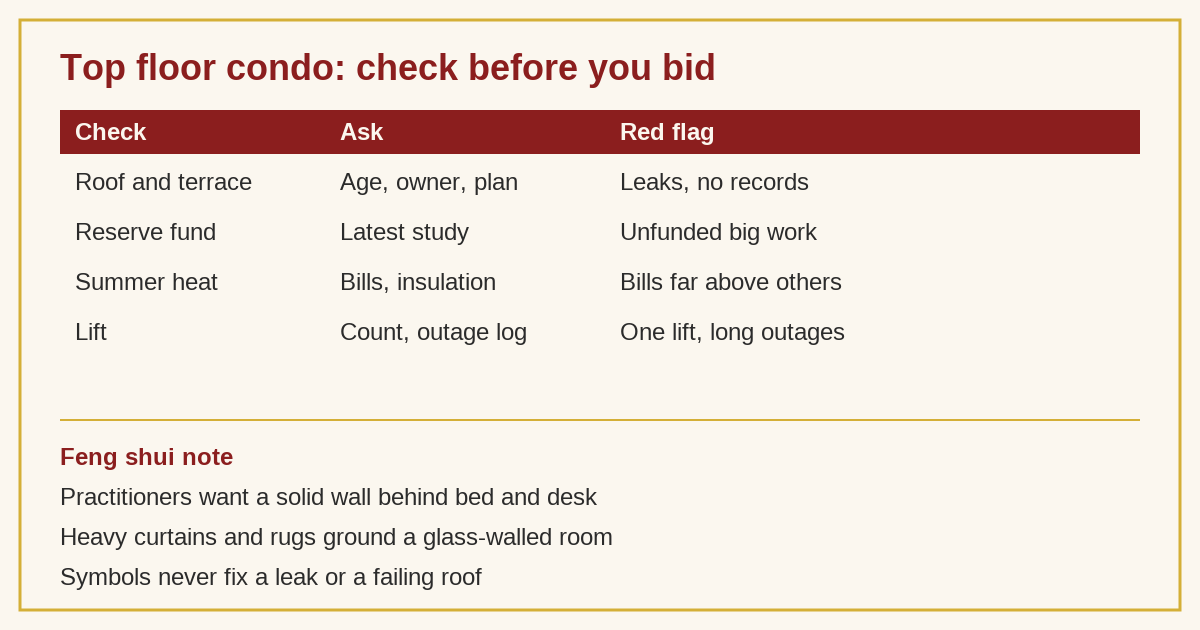
Start with the roof, because a leak lands in your living room. Ask who owns the roof membrane and the terrace waterproofing, when each was last replaced, and whether a replacement is planned. Then read the latest reserve fund study and the last two years of meeting minutes for any special assessment. In a small building a new roof can mean a large bill per unit. Each owner usually pays a share set by the declaration or strata plan, often by unit size. The top floor still feels a leak first, which is why the timing of that work matters most to you.
Heat and cooling come next. Get utility bills for a hot month and a cold one, find out what insulates the roof, and look at the glazing. Book a viewing for the afternoon of a warm day and notice whether the unit holds heat. Ask whether the air conditioning is in-unit or shared, and who maintains any rooftop equipment that may sit right over your bedroom.
Lift, wind and fire
No unit leans on the lift more than the top floor. Ask how many lifts serve it, who services them and how long the longest outage lasted. If someone in the household is elderly, pushes a stroller or has a bad knee, count the flights they would climb during an outage.
Up here you also hear things the lower floors don't. Stand on the terrace or at an open window and listen for wind whistling round the corner, rooftop fans and the lift motor room. On fire safety, ask whether the building is sprinklered and where the protected stairs are. How high the fire service can reach differs by city, so ask the local fire department rather than assume.
Towers raise the same glare and heat questions, which we cover in feng shui in glass condo buildings.
Top floor checklist
| Check | What to ask or look for | Walk away if |
|---|---|---|
| Roof | Age, owner, replacement plan | Active leaks, no records |
| Reserve fund | Latest study, funding level | Large unfunded work, repeated assessments |
| Heat | Utility bills, roof insulation | Summer bills far above the floors below |
| Lift | Count, service contract, outage log | One lift, repeated long outages |
| Terrace | Waterproofing, drainage, rules | Pooling water, cracks, no permit for changes |
| Noise | Roof fans, wind at the corner | Mechanical room above the bedroom |
| Fire | Sprinklers, stair protection | Unprotected single stair in a tall building |
| Feng shui | Solid wall behind bed and desk | Floor-to-ceiling glass behind the bed, no fix possible |
Remedies that help without renovation
Practitioners suggest a solid headboard against a solid wall, heavy curtains or blinds over any glass behind the bed, and a rug under the bed or desk to ground the room. All three also cut glare, heat and night-time light, so they earn their place for practical reasons too. Terrace plants can break the wind. Check the weight limits and the building bylaws for the terrace before you buy planters.
Where top floor buyers go wrong
- Paying extra for the word "penthouse" without reading the reserve fund study.
- Treating the roof as the building's problem. Owners share the cost.
- Viewing only in winter and never feeling the summer heat.
- Forgetting to ask about lift outages.
- Expecting a symbolic cure to deal with a leaking terrace.
FAQ
Is a top floor condo good feng shui?
The tradition is mixed. Practitioners value the light and view but say the home lacks the support of mass above it, so they ask for a solid wall behind the bed and grounded furniture. Use that as a prompt to check the layout, not as a rule.
Is a penthouse more expensive to own?
Often, but check the actual numbers: strata or condo fees, insurance, utility bills and your share of roof work. Ask for the reserve fund study and recent meeting minutes before bidding.
Do top floor condos have more leaks?
They sit under the roof, so a failing roof or terrace membrane reaches them first. Ask when the roof was last replaced and whether any claim or repair has been logged.
Are top floor condos hotter in summer?
They can be, depending on roof insulation, glazing and shading. Ask for summer utility bills and view the unit on a warm afternoon.
Is it safe to live on a high floor?
Safety depends on sprinklers, protected stairs and the fire service in your city, not the floor number alone. Ask the building manager and the local fire department.
Before you make an offer
Book a second viewing on a warm afternoon and take the checklist with you. Ask the manager for the roof history and the latest reserve fund study.
Sources
Checked November 2026. A rule marked "not verified since November 2026" may have changed, so read the current text at the source before relying on it.
- Ontario Condominium Act, 1998, reserve fund study provisions
- British Columbia Strata Property Act, depreciation report and special levy provisions
- US Department of Energy, Energy Saver, insulation and air sealing guidance
- Local fire code and fire department guidance for your city (ask the department)
- Traditional Form School teaching on support and the bright hall, as described by practitioners
Editorial note: Feng shui is presented here as a cultural and design tradition. Confirm legal, financial and inspection questions with a licensed professional.