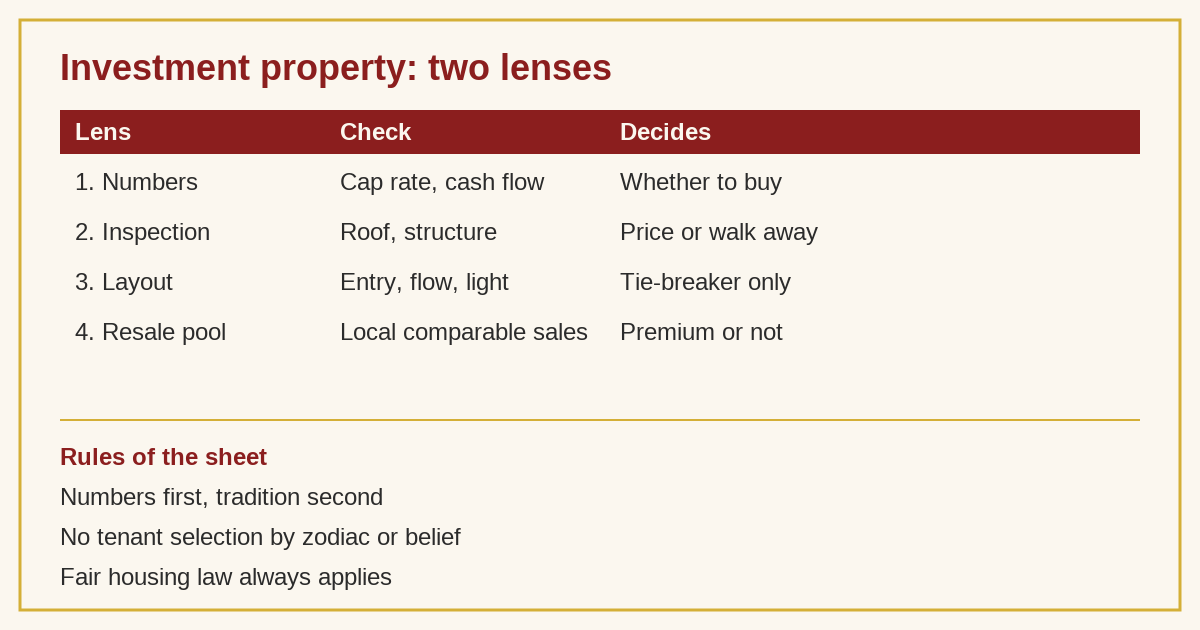
Run the numbers first. Rent, expenses, cap rate and cash flow decide whether a rental works, and feng shui comes in afterwards, as a tie-breaker between properties that have already passed. It gives you a useful check on layout and light and may widen your resale pool. It will not make a weak yield profitable or get a unit in a poor location rented.
Tax and legal points checked: 23 November 2026
The arithmetic has its own pages, rental yield explained and cap rate explained. Start there, then come back to see where the tradition fits. More buying topics are in our real estate and home buying guides.
| Rule or measure | Figure or rule | Source |
|---|---|---|
| Cap rate | Net operating income divided by purchase price; it ignores financing | Standard real estate formula, see our cap rate guide |
| Rental depreciation (US) | Residential rental buildings depreciate over 27.5 years for tax; land is not depreciable (not verified since November 2026) | IRS Publication 527, Residential Rental Property |
| Passive loss allowance (US) | Up to $25,000 of rental loss may be offset for active participants, phasing out between $100,000 and $150,000 MAGI (not verified since November 2026) | IRS Publication 925, Passive Activity and At-Risk Rules |
| Fair housing | US federal law bars discrimination by race, color, religion, sex, national origin, familial status and disability (not verified since November 2026) | US Fair Housing Act (HUD) |
| Feng shui reading | Practitioners judge layout, light, entry and surroundings, and promise no return | Traditional teaching, no scientific test |
On this page
- Numbers first, tradition second
- What the tradition adds to a rental screen
- Worked example: two lenses on two properties
- Tax and legal facts the tradition does not change
- Red flags that override any tie-breaker
- Where investors overpay for the tradition
- FAQ
Numbers first, tradition second
A rental is judged on income, costs and risk. Before anyone opens a compass, take the rent and subtract vacancy, taxes, insurance, repairs, management and reserves. That gives net operating income. Divide it by the price and you have the cap rate, as worked through in cap rate explained. Bring in the financing and the cash you actually put down and you get cash-on-cash return. A property that fails here cannot be saved by moving a door.
Feng shui earns its place after that, as a tie-breaker and a layout check. A bright, calm, well-organised home with an easy entry tends to show well, to tenants now and to buyers later. In some markets buyers ask about facing, house number and shape directly, so paying attention to the tradition can widen your resale pool. Count that as a possible benefit, not a forecast.
Advertisement
What the tradition adds to a rental screen
Practitioners look at five things, and each one has a plain-language version a tenant would recognise.
- Entry. They want a clear, well-lit approach and a door that is not blocked or cramped. Tenants and buyers notice an awkward entry just as quickly.
- Layout. No bedroom door facing the front door, no long straight corridor from the entry to the back door, no stairs rushing down at the entry. See front door and back door alignment.
- Light and air. Windows on more than one wall, and no dark, stuffy rooms.
- Surroundings. A road pointing at the door, a glaring building edge, power equipment or a busy junction. Each of these also brings noise or puts people off.
- Shape. Regular rooms and floor plans are preferred to irregular ones or missing corners.
Our feng shui home buying checklist covers these in detail.
Worked example: two lenses on two properties
The inputs here are made up. Property A is a two-bedroom condo priced at 400,000, renting for 2,400 a month, with operating costs of 9,600 a year including a vacancy allowance. Its net operating income is 28,800 less 9,600, or 19,200 a year, a cap rate of 4.8 percent. Property B is a townhouse, also 400,000, renting for 2,300 a month with costs of 8,400 a year. Its net operating income is 27,600 less 8,400, again 19,200, and again 4.8 percent. On the numbers, they tie.
The second lens scores each line from 1 to 5:
| Line | Property A (condo) | Property B (townhouse) |
|---|---|---|
| Entry and approach | 3 (shared corridor beside lift) | 4 (own door, clear path) |
| Layout flow | 4 | 3 (long corridor to back door) |
| Light and air | 3 (one-sided) | 4 (two sides) |
| Surroundings | 3 | 3 |
| Repairs risk found by inspection | 4 | 3 (older roof) |
| Total | 17 | 17 |
Still a tie. That is a useful answer, because it tells you the decision now rests on the inspection, the reserve fund and how much managing you are willing to do. If tenants in your market care more about parking or transit, change the weights. The sheet shows you your assumptions. It will not choose for you.
Tax and legal facts the tradition does not change
In the United States, residential rental buildings depreciate over 27.5 years (not verified since November 2026) and the passive-loss rules limit how much loss a rental can offset against other income. For active participants a special allowance of up to $25,000 phases out between $100,000 and $150,000 of modified adjusted gross income (not verified since November 2026). Canadian rules are different, so ask an accountant in your province. Layout and direction change none of this, and all of it changes your actual return.
Fair housing law applies too. You may not choose or reject tenants on protected grounds, whatever a chart says. Our page on feng shui for landlords shows how to apply the tradition to the home and leave the tenant out of it.
Red flags that override any tie-breaker
Walk away or renegotiate the price if you find any of these, however good the layout: a negative cash flow with no plan, an unfunded reserve in a condo, an inspection with structural or roof findings, rents that rely on a single large employer, or a price that only works with optimistic rent. Read renting out a property: a landlord guide before you commit.
Where investors overpay for the tradition
- Paying extra for a "lucky" number or facing without checking local comparable sales.
- Treating a feng shui consultant's opinion as if it were an inspection.
- Paying up for a layout that suits your beliefs but not your tenants.
- Turning down a profitable property over a small layout point you could fix.
- Skipping the reserve fund study on a condo.
FAQ
Should I use feng shui when buying an investment property?
Yes, as a tie-breaker once the numbers pass. It helps you judge entry, layout and light, and it may widen resale appeal where buyers care about it. It does not replace the cap rate, the cash flow or the inspection.
Does feng shui increase rental income?
We know of no reliable study showing that it does. A clear entry, good light and a well-kept home help a unit show well, but rent depends on location, condition, price and demand in your market.
Which feng shui factors matter most for a rental?
Practitioners focus on the entry, a calm layout, light and the surroundings. Tenants notice much the same things: a clear approach, good light and a quiet street.
Is a lucky house number worth paying extra for?
Only if local comparable sales show that buyers pay for it. Look at recent sales on the same street, and never pay a premium on belief alone.
Can I choose tenants by feng shui or zodiac?
No. Fair housing law bars selection on protected grounds such as religion and national origin, and a zodiac or birth-year screen can become a proxy. Apply the tradition to the home, not the applicant.
Running your own shortlist
Work out the cap rate for each property with the formulas in cap rate explained. Only the ones that pass go on the two-lens sheet above.
Sources
Checked November 2026. Where a rule on this page is marked "not verified since November 2026", read the current text at the source before you rely on it.
- IRS, Publication 527, Residential Rental Property
- IRS, Publication 925, Passive Activity and At-Risk Rules
- US Department of Housing and Urban Development, Fair Housing Act overview
- Our guides on cap rate, rental yield and cash-on-cash return for the formulas
- Traditional teaching on entry, layout and light, as described by practitioners
Editorial note: Feng shui is presented here as a cultural and design tradition. Confirm legal, financial and inspection questions with a licensed professional.