Feng shui will not fill a vacancy by itself. Price, condition, photos and location do that. What a landlord can do is use the tradition to prepare the home: a clear, well-lit entry, good light and air, an uncluttered layout and quick repairs. Apply it to the property and nothing else. Using it to pick or reject people breaks fair housing law.
Law references checked: 23 November 2026
Lease terms, deposits and the rest of the landlord's work are in renting out a property: a landlord guide and our other real estate and home buying guides. Here the subject is getting the unit ready.
| Area | The rule or practice | Source |
|---|---|---|
| Fair housing (US) | Federal law bars discrimination in renting by race, color, religion, sex, national origin, familial status and disability (not verified since November 2026) | US Fair Housing Act (HUD) |
| Agent ethics | Article 10 of the NAR Code of Ethics bars REALTORS from discriminating on protected grounds (not verified since November 2026) | National Association of REALTORS, Code of Ethics |
| Screening | Apply the same written criteria to every applicant, such as income, rental history and references | See our tenant screening guide |
| Habitability | Landlords must keep rentals habitable under local law, with rules and remedies that differ by state and province | Local landlord-tenant law (ask your regulator) |
| Feng shui reading | Practitioners judge the home (entry, light, flow, clutter and repair) and promise no result | Traditional teaching, no scientific test |
On this page
- What feng shui can and cannot do for a vacancy
- The entry and the first minute
- Light, air and repairs
- Turnover checklist
- Fair housing: the tradition applies to the home, never to tenants
- Where landlords waste money or take risks
- FAQ
What feng shui can and cannot do for a vacancy
A rental fills when the price fits the market, the home is in good condition, the listing has clear photos and honest details, and the location suits the people looking. Feng shui changes none of that, and we know of no reliable study showing that it speeds up a lease-up.
What the tradition does give you is a disciplined way to see the home as a visitor does. Practitioners ask whether the entry is clear and welcoming, whether there is light and fresh air, whether the layout flows, and whether anything is broken or blocked. An applicant notices every one of those in the first minute of a showing. The value lies in the preparation.
Advertisement
The entry and the first minute
Practitioners treat the entry as the place where the home first meets a visitor. Give it a working light, a number you can read, a lock that turns easily, a door that does not stick, a clean mat and an empty hall. Inside, keep the first few steps clear so the eye travels on to the best room. If the front door faces the back door or a staircase directly, a plant, a console or a hanging curtain can soften that, as described in front door and back door alignment. All of these cost little, and because they are decor rather than alterations, a landlord can use them freely.
Light, air and repairs
Open every blind and replace dead bulbs so each room shows its daylight. Fix drips, clean the vents and run the extractor fans. Damp and smell lose a showing faster than any compass reading. Practitioners link broken things to stuck energy, but an applicant reads a leaking tap or a cracked window more simply: this landlord may be slow with repairs. Repair first, stage second. To stop these problems coming back, follow the rental property maintenance schedule.
If you stage with rented or neutral furniture, keep it light and easy to move. Our feng shui for renters guide shows what tenants can do for themselves without altering anything.
Turnover checklist
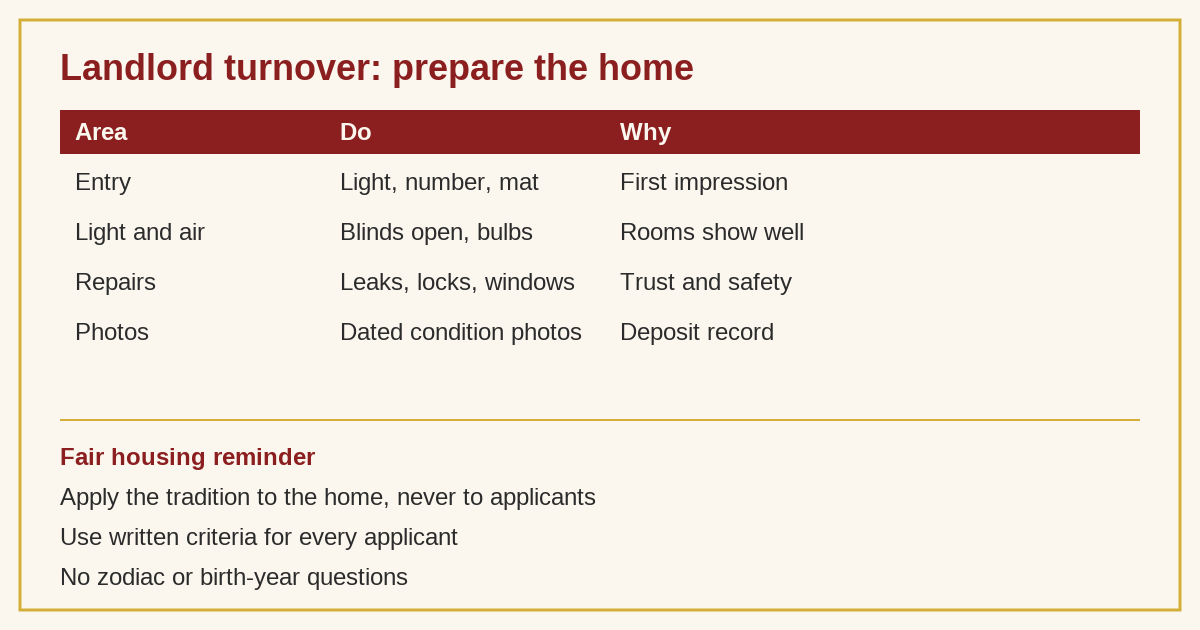
| Area | What to do between tenants | Why |
|---|---|---|
| Entry | Clean it, check the light works and the number shows | It is the first thing applicants see |
| Hall and living area | Clear the floor, wipe surfaces, keep decor neutral | Shows the size of the room |
| Kitchen | Deep clean, check the hood and drain | Smell and hygiene |
| Bathroom | Re-caulk, fix leaks, test fans | Prevents damp and mould |
| Bedrooms | Keep the bed wall clear and check the window opens | Comfort for sleeping |
| Windows | Open freely, locks work | Light and safety |
| Walls and floors | Touch up paint, clean carpets | Looks right in condition photos |
| Safety | Test smoke and carbon monoxide alarms as local law requires | Legal and life safety |
| Photos | Take dated condition photos | A record if the deposit is disputed |
Fair housing: the tradition applies to the home, never to tenants
Some feng shui teaching links birth years, zodiac animals or elements to who "suits" a home. A landlord must not choose or reject applicants that way. In the United States the Fair Housing Act forbids discrimination in renting based on race, color, religion, sex, national origin, familial status and disability (not verified since November 2026). Sorting applicants by zodiac, birth year or assumed background can become a proxy for those grounds, and agents are also bound by Article 10 of the NAR Code of Ethics (not verified since November 2026). In Canada, each province's human rights code sets its own protected grounds, so check yours.
The safe method is the one in how to screen tenants: write your criteria down, apply them to every applicant in the same way, and keep records. Arrange the home for good flow by all means, but never rent by belief.
Where landlords waste money or take risks
- Money goes on charms or cures while the repairs wait.
- The listing calls the home "lucky" or promises a result.
- An application form asks for birth year or zodiac sign.
- A new door or wall goes in before anyone checks the lease, local rules and the building board.
- Staging pieces are too fragile to survive a tenant's move.
FAQ
Does feng shui help rent a property faster?
We know of no reliable study that shows it does. Price, condition, photos and location decide how fast a unit rents. Feng shui is useful as a way to prepare the home: clear entry, light, flow and repairs.
What feng shui changes are safe for a landlord?
Changes that stay at the level of decor: a clear entry, working light, clean surfaces, fresh paint, a plant or a mirror placed to bounce light. Avoid anything that alters the structure without checking the lease, local rules and the building board.
Can I use zodiac signs to choose tenants?
No. In the US, federal fair housing law bars discrimination by race, color, religion, sex, national origin, familial status and disability, and a zodiac screen can act as a proxy. Use written, consistent screening criteria.
Should I place cures or charms in a rental?
They are optional and cost little, but they do not replace repairs or a clean unit. Do not advertise them as a benefit, and follow the lease on anything fixed to a wall.
What should I fix before showing a vacant unit?
Leaks, broken windows or locks, dead bulbs, damp, smells and anything that fails a safety check. Then clean, repaint scuffs and take dated photos.
Before the next vacancy
Print the turnover checklist above and walk your next vacant unit with it. Finish the repairs, then write down your screening criteria before the first showing.
Sources
Checked November 2026. For any rule marked "not verified since November 2026", read the current text at the source before relying on it.
- US Department of Housing and Urban Development, Fair Housing Act overview
- National Association of REALTORS, Code of Ethics, Article 10
- Your state or province landlord-tenant statute and human rights code (check the regulator)
- Our guides on renting out a property, tenant screening and rental maintenance
- Traditional teaching on entry, light and flow, as described by practitioners
Editorial note: Feng shui is presented here as a cultural and design tradition. Confirm legal, financial and inspection questions with a licensed professional.