Living near a church, temple or mosque is not bad feng shui by rule, though many traditional writers urge caution about a home directly in front of or behind one. The reading turns on direction, distance and whether the building faces your door. A buyer's questions are more down to earth: event traffic, parking, sound, and what the site is approved to do.
RLUIPA and zoning sources checked: 23 November 2026
Choosing the house itself is covered across our real estate and home buying guides; here the focus is the building next door.
On this page
- The law and local rules
- What the feng shui tradition says
- What buyers should check
- Worship site buyer scoring sheet
- Screens, bedrooms and hearings
- When to pass on the house
- Wrong assumptions about worship sites
- FAQ
- Go to a service first
- Sources
The law and local rules
| Rule | What it says | Source |
|---|---|---|
| US federal law on religious land use (RLUIPA, 2000) | Zoning may not impose a substantial burden on religious exercise without meeting a strict test, may not treat religious assemblies on less than equal terms with comparable secular ones, and may not totally exclude them from a jurisdiction | US Department of Justice |
| Local zoning for new religious uses | Often decided case by case at a hearing, and approval conditions can cover hours and occupancy | Local law; one legal commentator argues communities should be able to set hours and occupancy limits |
| Noise from bells or amplified sound | Your city or county noise ordinance sets the limit | Local code; check yours |
In practice, a worship site is usually allowed. Neighbours win limits through local approvals, not blanket bans.
What the feng shui tradition says
Views differ. Many traditional Chinese writers caution against a home directly in front of or right behind a temple. The folk warning is often given as "in front of the gods, behind the temple", and the idea is that such a site gathers concentrated energy which a house beside it does not share. Other practitioners see a quiet, well-kept place of worship as a settled neighbour. Most of them agree on three points:
- Direction and distance matter more than the label. A large building directly facing your door, with a hard roof line pointing at it, can be read like any large structure aimed at a house. See poison arrows and sha qi.
- Right next door is the stronger concern. Practitioners who caution about worship sites mostly mean a home that shares a wall line, faces the main entrance or sits directly behind the building, not one a few streets away.
- Crowds bring yang. Event days fill the area with people, cars and sound, and practitioners say the home then needs a calmer back and bedroom to balance it.
None of this predicts luck or money. It is a reading of design and setting.
Advertisement
What buyers should check
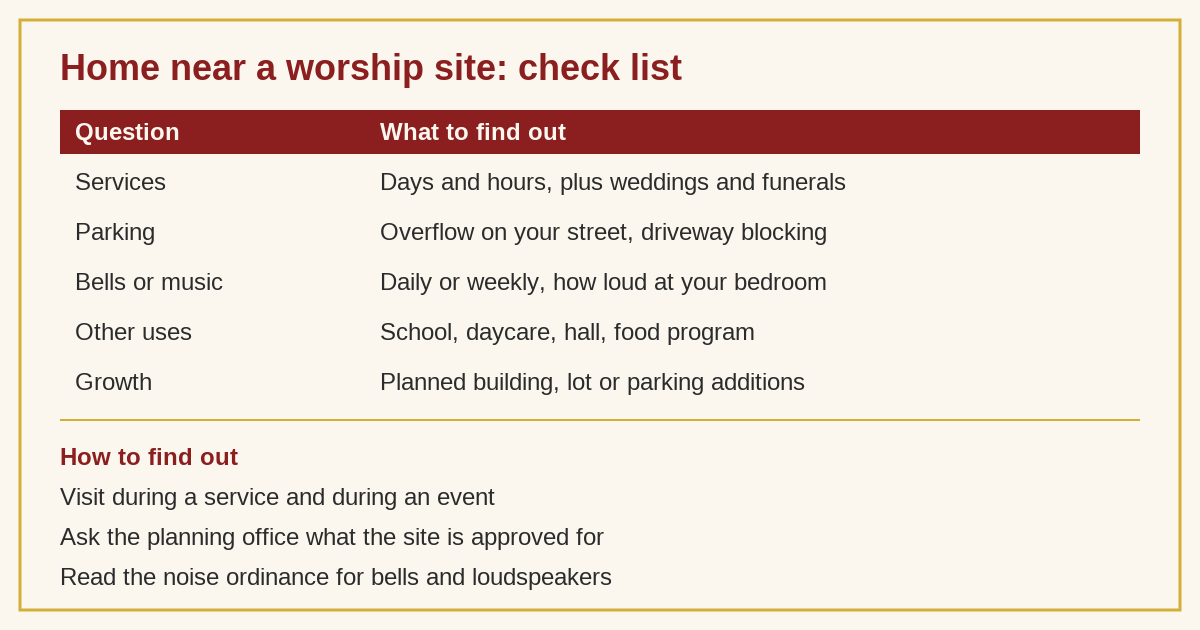
- The schedule. Find out about services, weddings, funerals, festivals, youth programs and classes. Many sites have more than one use, and a church that also runs a school, a daycare or a food program is a different neighbour from a quiet chapel.
- Parking. Ask where the overflow cars go. If the answer is your street, ask whether the city offers resident parking permits.
- Sound. Bells, chanting, music and amplified speech all carry. Visit during a service with the windows open and listen from the bedroom.
- What it is approved for. The city planning office can tell you which uses the site has permission for and whether any application is pending.
- Legal context in the US. The Department of Justice describes RLUIPA as barring zoning that substantially burdens religious exercise, treats religious assemblies on less than equal terms, or totally excludes them. One legal commentator argued that localities can still place limits on hours and occupancy for intensive uses in residential districts. Taken together, the fair route for neighbours runs through the local hearing, not a refusal on sight. Canada has no RLUIPA, and the rules there come from municipal zoning. We found no source on them that we could open, so ask a local professional.
A building on a corner or at the end of a road changes the reading, and our corner lot, cul-de-sac and slope field guide explains how that changes the reading.
Worship site buyer scoring sheet
Give each line 0, 1 or 2. Higher totals mean more to sort out before an offer.
| Item | 0 | 1 | 2 |
|---|---|---|---|
| Door or bedroom faces the building | No | Angled | Direct |
| Event days per week | One | Several | Daily |
| Overflow parking on your street | None | Some | Often blocks driveways |
| Bells or amplified sound heard in bedroom | None | Audible | Loud |
| Other uses (school, hall, food program) | None | Unknown | Yes |
| Planned expansion | None | Unknown | Yes |
Here is a worked example with stated inputs. A house scores 1 (angled view), 1 (several event days), 2 (blocked driveways at weddings), 0 (no bells), 1 (unknown uses) and 0 (no expansion), for 5 out of 12. The driveway comes first. Ask the city about permit parking, and ask the congregation for its event schedule.
Screens, bedrooms and hearings
- Plant a screen. Where local rules allow, a hedge or fence on the side facing the building softens the sightline and takes the edge off some of the sound.
- Sleep at the back. Choose a bedroom on the far side of the house.
- Ask for a neighbour contact. Many sites name someone to handle neighbours' concerns, and the seller may know who it is.
- Know the hearing process. If an expansion is pending, you can often comment at the public hearing.
When to pass on the house
Pass if event parking blocks your driveway, if amplified sound reaches the bedroom and you can't fix it, or if a large expansion is pending and the city won't give you details. A quiet chapel across the street is a very different case from a large complex with events every day.
Wrong assumptions about worship sites
- Assuming a house near a church is automatically quiet, or automatically noisy.
- Visiting on a weekday when nothing is happening.
- Ignoring other uses on the same lot, including a churchyard or columbarium. If graves are part of the view, read feng shui house near a cemetery as well.
- Believing that legal protection for religious sites stops neighbours from raising parking or noise problems.
FAQ
Is it good or bad feng shui to live near a church?
Not by rule, but views differ. Many traditional writers caution against a home directly in front of or behind a temple or church; others read a quiet, well-kept site as a calm neighbour. Direction, distance and whether the building faces your door matter most.
What about a house near a temple or mosque?
The same checks apply: schedule, parking, sound, what the site is approved for and whether the building faces your door. The tradition treats the building's form and distance, not the faith.
Can neighbours stop a church or temple from expanding?
In the US, RLUIPA limits zoning that burdens religious exercise, treats religious assemblies on less than equal terms or excludes them. Neighbours can still raise concerns about traffic and noise at local hearings. Confirm details with a local land use professional.
How do I check noise from bells or loudspeakers?
Visit during a service with the windows closed and open and listen from the bedroom. Then read your city's noise ordinance and ask the planning office about conditions on the site.
Will a nearby place of worship hurt resale?
We found no source we could open that gives a reliable figure, so we state none. Compare recent sales on your own street and ask your agent about days on market.
Go to a service first
Visit during a service, then work through the feng shui home buying checklist. If you plan to sell later, see feng shui for selling a house. The wider set is in our real estate and home buying guides.
Sources
Checked November 2026.
- US Department of Justice, RLUIPA
- FindLaw, Struggling with churches as neighbors (a 2002 opinion column)
We looked for a peer-reviewed price study of homes near religious sites and for Canadian zoning guidance, and could confirm neither, so no figure from them appears here.
Editorial note: Lucky Properties presents feng shui as a cultural and design tradition. This guide is educational. Confirm zoning and legal questions with a licensed professional and your local planning office.