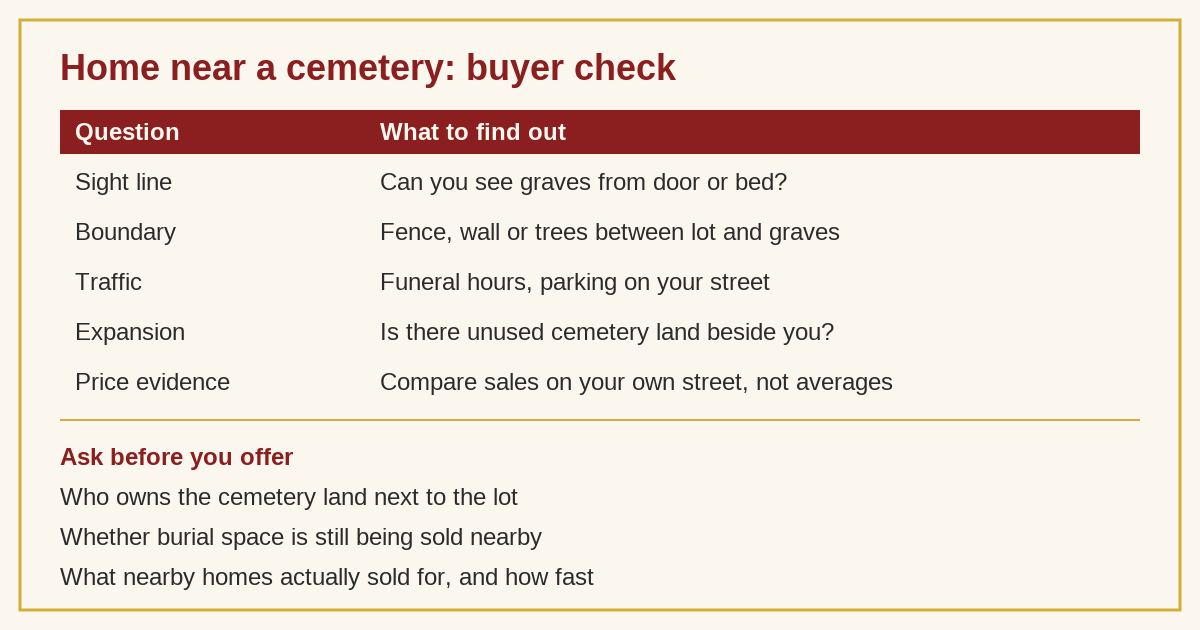
A house near a cemetery does not fail in feng shui by default. Practitioners call a cemetery a yin place and look at how close it is, whether the house faces it, and what stands between the two. A buyer has a second list: the sales evidence, the boundary, funeral traffic and what the cemetery plans to do with its land.
Sales study and disclosure law reviewed: 23 November 2026
Half of what follows is about the tradition and half about the purchase. For the rest of the buying process, see our real estate and home buying guides.
On this page
- The sales figures in brief
- What the feng shui tradition says
- What the sales evidence shows
- Cemetery buyer scoring sheet
- Remedies you can actually do
- When to walk away
- Five mistakes near a cemetery
- FAQ
- Before you make an offer
- Sources
The sales figures in brief
| Measure | Figure or rule | Source |
|---|---|---|
| Median price, homes less than 50 feet from a cemetery (90 US metros, Redfin, reported 2013) | $235,000, or $162 per square foot | NAR REALTOR Magazine |
| Median price, homes less than 100 yards away | $219,900, or $147 per square foot | NAR REALTOR Magazine |
| Average days to sell, homes less than 50 feet away | 48 days | NAR REALTOR Magazine |
| Average days to sell, homes 500 yards away | 39 days | NAR REALTOR Magazine |
| California: death on the property more than 3 years before the offer | No duty to volunteer it; a seller still cannot lie if asked directly | California Civil Code 1710.2 |
The sales study is old, it comes from a brokerage, and it compares medians rather than like-for-like houses. It hints that a cemetery does not automatically cut a price. It promises nothing about your street.
What the feng shui tradition says
The tradition counts a cemetery as strongly yin: quiet, still and tied to the dead. Even so, practitioners rarely tell buyers to avoid one outright. They ask three questions instead.
- Do you face it? In Form School thinking, a front door or main window looking straight at graves is the stronger concern, because the view is what enters the home each day.
- Is it close and unscreened? A cemetery across a road with trees and a wall is read very differently from graves just beyond your fence.
- How does the house feel to the people living in it? Some practitioners treat comfort as part of the reading. A view that bothers you every day is a real cost, whatever the theory says.
Many traditional writers also warn against buying a home where the family would feel uneasy. For some buyers, that settles it. Nothing here is a guaranteed effect on health, wealth or luck. For the school of thought behind these readings, see Form School vs Compass School.
Advertisement
What the sales evidence shows
The Redfin study reported by NAR in October 2013 covered 90 US metro areas. Homes less than 50 feet from a cemetery had a median sale price of $235,000, while homes less than 100 yards away had a median of $219,900. That puts the closest homes $15,100 ahead. They also took longer to sell, 48 days on average at under 50 feet against 39 days for homes 500 yards away.
Read those numbers with two cautions. A median is not a controlled comparison, so bigger or newer houses could explain the gap. And a slower sale costs you something real if you plan to sell. The study is most useful as a prompt to pull recent sales on your own street and the next one, then compare price per square foot and days on market for houses that face the cemetery and houses that don't.
The other things to inspect on the same visit are in our feng shui home buying checklist.
Cemetery buyer scoring sheet
Score each line 0 (fine), 1 (worth a question) or 2 (serious), and add them up before you make an offer. Note that here a higher score is worse.
| Item | 0 | 1 | 2 |
|---|---|---|---|
| Front door or main bedroom window faces graves | No view | Partial view | Direct view |
| Separation | Road, wall and trees | Fence only | Shared boundary, no screen |
| Funeral or visitor traffic on your street | None | Occasional | Parking on your street often |
| Unused cemetery land next to you | None | Unknown | Yes, still being sold |
| Nearby sales faster or similar to others | Same days on market | Slower | Clearly slower |
| How you feel standing in the yard | Calm | Unsure | Uneasy |
A worked example, with stated inputs: a house scores 0 on view, 1 on separation (fence only), 0 on traffic, 1 on unused land (unknown), 0 on sales and 0 on feeling. That totals 2 out of 12, an ordinary result. Ask your two questions and carry on. At 7 or more, read the next two sections closely.
Remedies you can actually do
- Screen the view. Evergreen planting or a solid fence along the boundary changes what the door and windows look out on. Check the height rules with your local planning office first.
- Move the sightline, not the house. Put frosted film or a blind on the one window that faces the graves, and keep the bed out of that line of sight.
- Add yang in ordinary ways. Practitioners suggest light, warm colour and activity at the front of the home. Good outdoor lighting is the practical half of that advice.
- Find out the cemetery's plans. Ask the operator or the city whether the land next to you will take new burials, and whether any building or road is planned.
When to walk away
Walk away if you score 7 or more and the cemetery is unscreened and right next to the lot. Walk away too if anyone who will live in the house is uneasy and no remedy will change that. Whatever the sales data says, a house you resent every morning is a poor buy.
Five mistakes near a cemetery
- Treating one study as the price for your street.
- Assuming a seller must disclose a cemetery. Disclosure forms differ by state and province, and we found no source that sets a universal cemetery rule. Ask your agent and read the local form.
- Confusing a cemetery next door with a death in the house. A death on the property is a separate disclosure question, and California's rule on it is in the table above.
- Never visiting while a funeral is on.
- Forgetting the churchyard. A burial ground beside a church or temple brings service-day traffic and sound as well; those checks are in feng shui house near a church or temple.
FAQ
Is it bad feng shui to live near a cemetery?
Not automatically. Practitioners describe cemeteries as strongly yin and focus on whether your door or main windows face them, how close they are and what screens the view. Distance, a wall or trees and your own comfort usually matter more than the label.
Do houses near cemeteries sell for less?
One Redfin study across 90 US metros, reported by NAR in 2013, found homes within 50 feet of a cemetery had a median price of $235,000, higher than the $219,900 median for homes less than 100 yards away. The closest homes took longer to sell: 48 days on average, against 39 days for homes 500 yards away. Check sales on your own street.
Must a seller disclose a nearby cemetery?
It depends on your state or province and the form used. We found no source that sets one universal rule, so ask your agent to check the local disclosure form and ask the seller directly. California's rule on deaths in the home is a different question.
What can I do if my door faces a cemetery?
Screen the view with evergreen planting or a solid fence where local rules allow, and add good outdoor lighting at the entry. Practitioners also suggest keeping the bed out of any direct sightline to the graves.
Should I buy if my family is uneasy about it?
If anyone who will live there is uneasy and a screen or remedy does not help, do not force it. Comfort is part of the reading in the tradition and a daily cost in practice.
Before you make an offer
Run the visit through our feng shui home buying checklist, then check the street layout with the poison arrows and sha qi guide. If you plan to sell later, see feng shui for selling a house. The wider set is in our real estate and home buying guides.
Sources
Checked November 2026.
- NAR REALTOR Magazine, homes near cemeteries (Redfin study, October 2013)
- California Civil Code section 1710.2 (Justia)
We looked for a state-by-state rule on disclosing a nearby cemetery and could not confirm one, so we state no figure or rule about it.
Editorial note: Lucky Properties presents feng shui as a cultural and design tradition. This guide is educational. Confirm disclosure, legal and financial questions with a licensed professional.