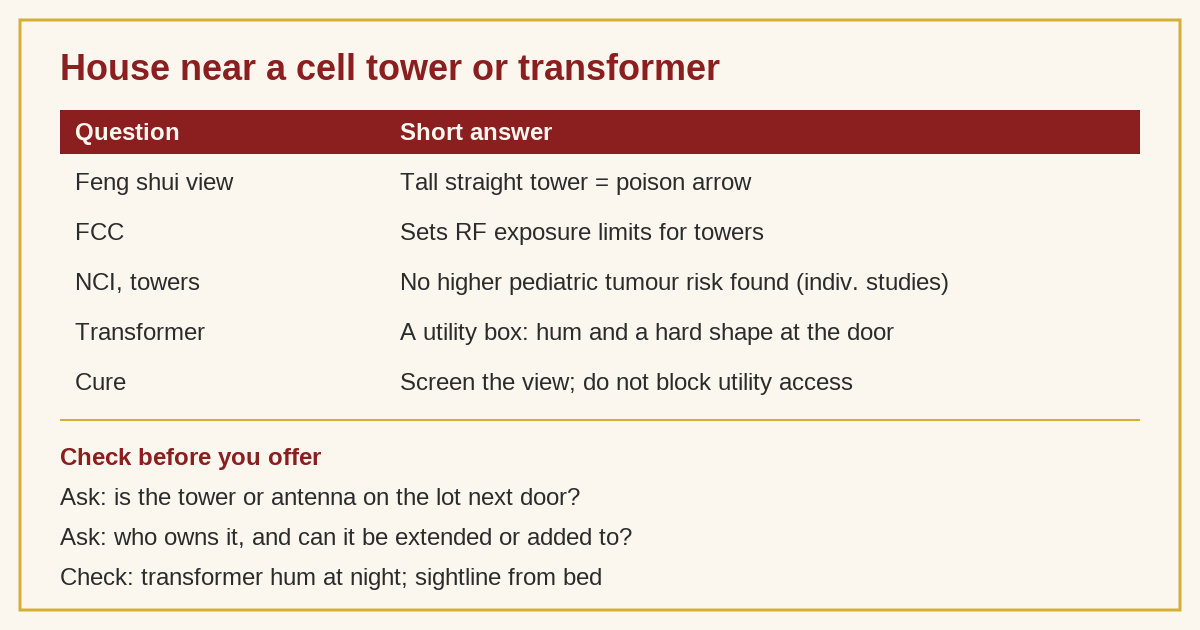
Feng shui reads a cell tower or utility transformer near the house as a hard, tall or boxy shape pointed at you. Practitioners call that sha qi (harsh energy) and soften it with screening. As for health, FCC radio-frequency exposure limits apply to US towers, and the National Cancer Institute says no consistent evidence links any source of non-ionizing EMF to cancer. What's left to judge is distance, the view, any hum and how the house will resell locally.
FCC and NCI pages read: 23 November 2026
Here we look at cell towers and the transformers on poles or pads near a house. High-voltage lines have their own guide, feng shui house near power lines, as do substations in feng shui house near an electrical substation. Both belong to our real estate and home buying guides.
| What agencies say | Figure, rule or finding | Source |
|---|---|---|
| FCC exposure limits | FCC adopted Maximum Permissible Exposure limits for transmitters from 300 kHz to 100 GHz | FCC |
| What the 1996 guidelines cover | Transmitting antennas such as those used for cellular radio | FCC |
| Phone limit is separate | 1.6 watts per kilogram SAR applies to handsets, not base stations | FCC |
| Child cancer studies near base stations | "None of the studies that estimated exposures on an individual level found an increased risk of pediatric tumors" | NCI |
| Overall EMF and cancer | "No consistent evidence for an association between any source of non-ionizing EMF and cancer has been found" | NCI |
| Field strength and distance | Magnetic field strength decreases rapidly with distance from its source | NCI |
On this page
- What feng shui says
- Cell towers: what the FCC and NCI say
- Transformers outside the house
- What to ask before you offer
- Rooftop and neighbouring antennas
- Remedies that help
- Mistakes with towers and transformers
- FAQ
- Photograph the view first
- Sources
What feng shui says
Form School practitioners read tall, narrow, straight objects aimed at a home as "poison arrows", a type of sha qi. A cell tower, one hard vertical line, is the textbook case. A pole transformer is judged by where it sits instead. A grey drum on the pole right in front of the door, or a green pad box beside the entrance path, is said to put a hard, humming object where qi should enter. The full idea is in our sha qi and poison arrows guide.
Practitioners usually draw a simple line. A tower glimpsed through trees from a window you rarely use is minor. One that fills the view from the front door or the bed, or a transformer in the same spot, is serious. Their remedies are visual. Plant a tree, a hedge or a lattice screen, move the bed or desk, or add a solid canopy over the front door so the object is not the first thing a visitor sees. For how the schools differ, see Form School vs Compass School.
Advertisement
Cell towers: what the FCC and NCI say
In the US the Federal Communications Commission set limits on human exposure to radio-frequency (RF) fields from transmitters, based on the National Council on Radiation Protection and Measurements recommendations. The FCC page says the 1996 guidelines apply to transmitting antennas such as cellular radio, and that the separate phone limit of 1.6 watts per kilogram does not apply to base stations. The FCC page we read gives no typical ground-level readings and no single safe distance, so we state none.
The National Cancer Institute reviews the research. No study that estimated exposure for individual children found a higher risk of tumours near base stations. In its words: "None of the studies that estimated exposures on an individual level found an increased risk of pediatric tumors." Its overall statement is that "no consistent evidence for an association between any source of non-ionizing EMF and cancer has been found", and that no mechanism by which radio-frequency radiation could cause cancer has been identified.
That is as far as the agencies go. They give no safe distance and make no promise about any one site. If the tower bothers you, that is a fair reason to pick another house.
Our feng shui home buying checklist ranks outside shapes like this one by how much they matter.
Transformers outside the house
A transformer steps utility voltage down for the homes on the street. The utility owns it, and it usually sits on a pole, in a green steel box on a pad, or in a vault. A buyer should look at three things:
- Hum. Many transformers hum faintly. Before you decide, visit at night or on a quiet morning and open the window.
- Access. The utility needs to reach the box, so you can't fence it in, plant against it or build over it. Clear-space rules differ by utility; ask yours rather than guess.
- Where it sits against the door and bed. Here the feng shui concern and the everyday annoyance agree. Nobody wants a hard, humming box at the entry or against the bedroom wall.
A pad or pole transformer is not a cell tower. It carries power, not a radio signal, so the FCC RF discussion above does not apply to it. Its magnetic field falls off quickly with distance, as the NCI describes for any source, but we found no source we could open that gives a distance for a case like yours. If you are worried, ask the utility whether it can take a reading.
What to ask before you offer
- Is the tower on a lot next door, a rooftop, a church or a utility corridor, and who owns it?
- Can the owner add antennas or extend the structure? Ask the local planning department what approvals apply, because the rules vary by city.
- Is the transformer on the pole in front of the house, or on a pad on this lot? A pad on your lot usually comes with an easement, which the title will show.
- Does the seller's disclosure mention it? Disclosure rules differ by state and province, so ask your agent what applies.
- How visible is it from the front door, the main bedroom and the garden?
Rooftop and neighbouring antennas
Not every antenna is on a tall tower. Small ones sit on rooftops and utility poles, and the same questions about view and ownership apply. We found no source we could open that gives typical distances for them, so we state none.
Remedies that help
- Screen the view with an evergreen tree or a lattice, placed so it does not block the utility's access.
- Put the bed and desk on the side of the house away from the structure.
- Draw the eye elsewhere with a front-door canopy or a change of colour near the entry. See feng shui exterior house colors.
- If a hum disturbs sleep, ask the utility to check the unit before you assume it is normal.
Mistakes with towers and transformers
- Treating a phone's SAR limit as a rule for towers. The two limits are separate.
- Hemming in a transformer with a fence or planting. The utility may remove whatever is in the way.
- Assuming a tower far down the street will stay as it is. Ask what can be added.
- Paying for shielding paint or gadgets that have no evidence behind them.
FAQ
Is a cell tower bad feng shui?
Practitioners read a tall straight tower as a poison arrow, a form of sha qi, especially when it fills the view from the front door or bedroom. They suggest screening it with trees or a lattice and moving the bed or desk. It is a tradition about shapes, not a measured effect.
Are cell towers dangerous to live near?
The FCC sets exposure limits for transmitters, and the National Cancer Institute reports that no individual-level study found a higher risk of tumours in children near base stations. It also says no consistent evidence for an association between any source of non-ionizing EMF and cancer has been found. It gives no safe distance, so if a tower bothers you, choosing another house is a fair call.
Is a transformer outside my house a problem?
A transformer is a utility box that steps down power. It can hum and it needs clear access. In feng shui it is judged by position: a hard box at the front door or beside the bedroom wall is the concern. It carries power, not a radio signal, so the cell tower RF limits do not apply to it.
Can I hide a pole or pad transformer?
You can screen the view, but you must not block access. The clear-space rules vary by utility, so ask your utility before you plant or build.
What should I ask the seller about a nearby cell tower?
Ask who owns it, whether more antennas can be added, whether the seller's disclosure mentions it, and how visible it is from the door and bedroom. Disclosure rules differ by state and province, so ask your agent what applies.
Photograph the view first
Stand at the front door and at the bedroom window and photograph what you see. Then call the planning department about the tower, or the utility about the transformer, and note the answers beside your home buying checklist.
Sources
Checked November 2026.
The FCC page gives no typical ground-level exposure values, so we state none. None of the sources we opened gave utility clearance distances or a price effect near towers.
Editorial note: Feng shui is presented here as a cultural and design tradition. Confirm legal, financial, health and inspection questions with a licensed professional, and ask your utility for site-specific field readings.