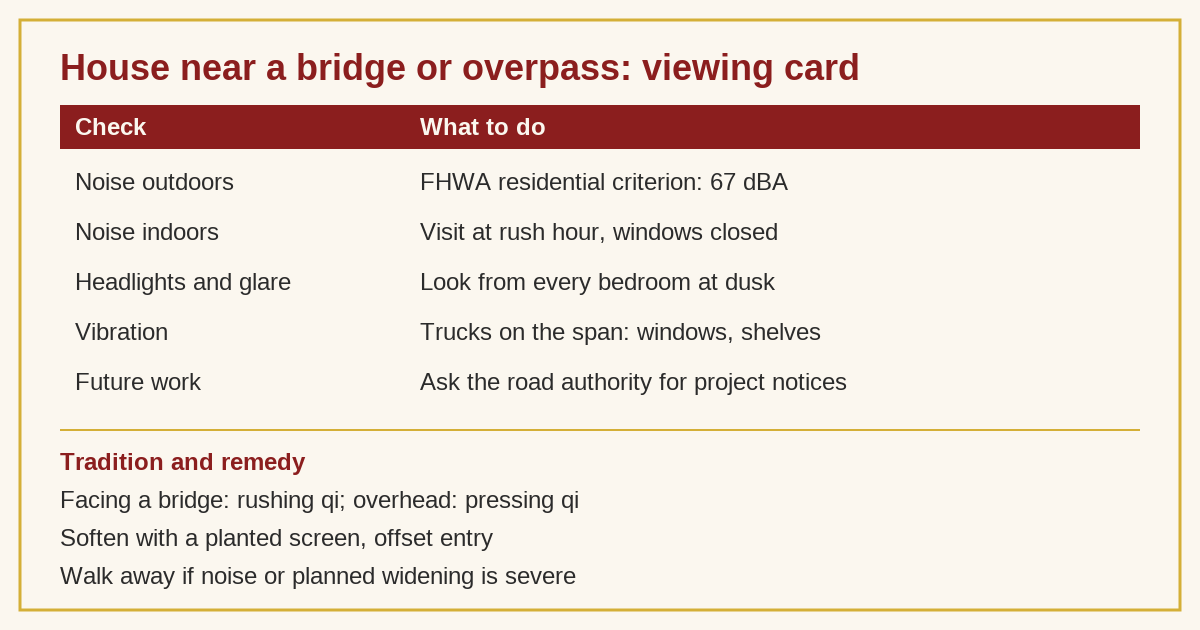
Practitioners say a bridge or overpass facing the front door sends qi rushing at the house, and a structure looming overhead presses down on it. For a buyer, the test that counts is noise. FHWA's criterion for homes on federal highway projects is 67 decibels outdoors. Visit at rush hour with the windows closed, and ask the road authority what work is planned.
FHWA and Colorado DOT pages read: 23 November 2026
A road that points straight at a house is a related case with its own T-junction house guide. The rest of the buying process is in our real estate and home buying guides.
| Noise measure | Figure or rule | Source |
|---|---|---|
| FHWA residential noise criterion | Activity Category B (residential): 67 dBA Leq(h), measured outdoors | FHWA, Highway Traffic Noise guidance |
| Interior criterion (schools, hospitals and similar) | 52 dBA Leq(h), measured indoors (Category D); no interior figure is given for homes in that table | FHWA, Highway Traffic Noise guidance |
| What the criteria are for | Used for impact determination on federal-aid highway projects, not design standards for noise barriers | FHWA, Highway Traffic Noise guidance |
| Hearing a change | Changes of 3 decibels or less are not normally detectable; a 10-decibel increase is usually felt as twice as loud | Colorado DOT, Noise FAQs |
| Traffic doubling | Doubling traffic raises noise by about 3 decibels, usually not noticeable by itself | Colorado DOT, Noise FAQs |
On this page
- Three different situations
- What the tradition says
- Noise: what the numbers mean
- Light, vibration and other effects
- Ask the road authority
- Related reading
- Viewing checklist
- Scoring sheet: three bridge situations
- Four mistakes near a highway
- FAQ
Three different situations
"Near a bridge" covers three different layouts. The structure can face the house across a gap, like a bridge at the end of the street. It can pass overhead or beside the lot, as a highway overpass does when it crosses a neighbourhood. Or the house can sit under or next to the approach ramp. Noise, light and vibration differ in each case, and so does the traditional reading, so work out which one you are looking at first.
Advertisement
What the tradition says
Practitioners describe a long bridge or elevated road facing the front door as a rushing line of qi aimed at the house, a close cousin of the poison arrow pattern in the poison arrows guide. A structure that rises above the roofline is said to press down on the house, and teachers say that makes the home feel crowded or oppressive. A bridge over water below a house is read differently. Many teachings count the water side as a plus.
The tradition's remedies are gentle ones. It suggests a planted screen, a solid fence or hedge that blocks the direct view, an offset entry path, and bedrooms placed away from the structure. These are design suggestions, not measured fixes.
Noise: what the numbers mean
FHWA's Noise Abatement Criteria, used when highway agencies decide whether a federal-aid project affects homes, set 67 dBA (hourly equivalent sound level, Leq(h), measured outdoors) for residential land use (Activity Category B). The interior criterion in that table, 52 dBA, applies to places such as auditoriums, day care centers, hospitals and schools, not to homes. FHWA states these values are for impact determination only and are not design standards for noise abatement measures.
So 67 dBA is not a legal limit for a house, and a house below it is not necessarily quiet. It is a benchmark agencies use, and it helps you read a noise study if one exists for the highway.
Colorado DOT's FAQ explains how a change is heard: changes of 3 decibels or less are not normally detectable, a 10-decibel increase is usually felt as twice as loud, and a doubling of traffic raises noise by about 3 decibels. Say you can already hear the road clearly at the viewing. A widening that adds lanes may or may not make an audible difference, but a new ramp, or the road shifting toward the house, can.
Light, vibration and other effects
Sound is not the only thing that reaches the house. Headlights from the bridge or ramp can shine into upper-floor windows. Heavy trucks on a span can set up a vibration you feel through the floor, and de-icing salt and road runoff can reach the lot. No general figures exist for these, so check them at the house yourself. Sit in the bedroom at dusk, then again after dark with the lights off.
Ask the road authority
A state or provincial transportation department, a city or a railway manages each overpass. Find out which one owns this structure, whether any work is planned (widening, ramp changes, noise walls) and whether a noise study exists. Project notices and environmental documents are usually published, and your lawyer or agent can request them. For the value of the house, that answer counts for more than any reading of qi.
Related reading
A house at the end of a road faces a similar line of traffic, which our T-junction guide covers. For the other viewing checks, use the home buying checklist.
Viewing checklist
- Visit at rush hour, at night and on a weekend. Stand outside first, then listen inside with the windows closed.
- Compare the noise in each bedroom. A phone decibel app is a rough guide at best, because phones are not calibrated meters.
- Look from each window toward the structure for glare, direct views and headlights.
- When a heavy truck passes, put a hand on the floor and watch a glass on a shelf.
- Ask the road authority for its project list and any noise study.
- Check the windows. Double or triple glazing and good seals make a large difference to indoor noise.
Scoring sheet: three bridge situations
Each line scores 0 to 2, and higher is better. The scores below are examples, not measurements.
| Check | Bridge faces the door | Overpass beside the lot | House under an approach |
|---|---|---|---|
| Outdoor noise at rush hour | 1 | 0 | 0 |
| Indoor noise, windows closed | 1 | 1 | 0 |
| Headlights and glare | 0 | 1 | 0 |
| Tradition reading | 0 | 1 | 0 |
| Planned work known | 1 | 1 | 1 |
| Total | 3 | 4 | 1 |
A total under 4 suggests a firm price discount or a pass, unless you can verify low indoor noise.
Four mistakes near a highway
- Visiting on a quiet Sunday and signing without ever hearing rush hour.
- Treating the FHWA 67 dBA figure as a safe limit for your bedroom.
- Overlooking a planned widening or a new ramp.
- Using a phone app as if it were a sound meter.
FAQ
Is a house near an overpass bad feng shui?
Practitioners describe an overhead structure as pressing on the house and a bridge facing the door as rushing qi at it. These are traditional readings, not measured effects. The practical risks are noise, glare and future road work, which you can check.
What noise level is acceptable for a house near a highway bridge?
FHWA's criterion for residential land use on federal-aid highway projects is 67 dBA outdoors (hourly equivalent sound level). FHWA says the criteria are for impact determination only, not design standards. It is a benchmark, not a legal limit for your home.
How loud is a 10 decibel increase?
According to Colorado DOT, a 10-decibel increase is usually felt as twice as loud, while changes of 3 decibels or less are not normally detectable and a doubling of traffic adds about 3 decibels.
Should I buy a house facing a bridge?
Judge it by noise at rush hour with the windows closed, glare at night and planned road work. Practitioners suggest a planted screen and an offset entry. Walk away if the noise is severe and the layout cannot move bedrooms away.
How do I find out about planned road work near a house?
Ask the transportation department or city that owns the structure for its project list and any noise study. Project notices and environmental documents are usually public.
Book the rush-hour visit
Book a rush-hour visit with the windows closed and ask the road authority for its project list. Then run through the home buying checklist.
Sources
Checked November 2026.
- Federal Highway Administration, Highway Traffic Noise: Analysis and Abatement Guidance
- Colorado Department of Transportation, Noise FAQs
We did not verify any figures for vibration or glare from bridges, or any measured effect of overpasses on home prices, so none are stated.
Editorial note: Lucky Properties presents feng shui as a cultural and design tradition. This guide is educational. Confirm legal, financial and inspection questions with a licensed professional.