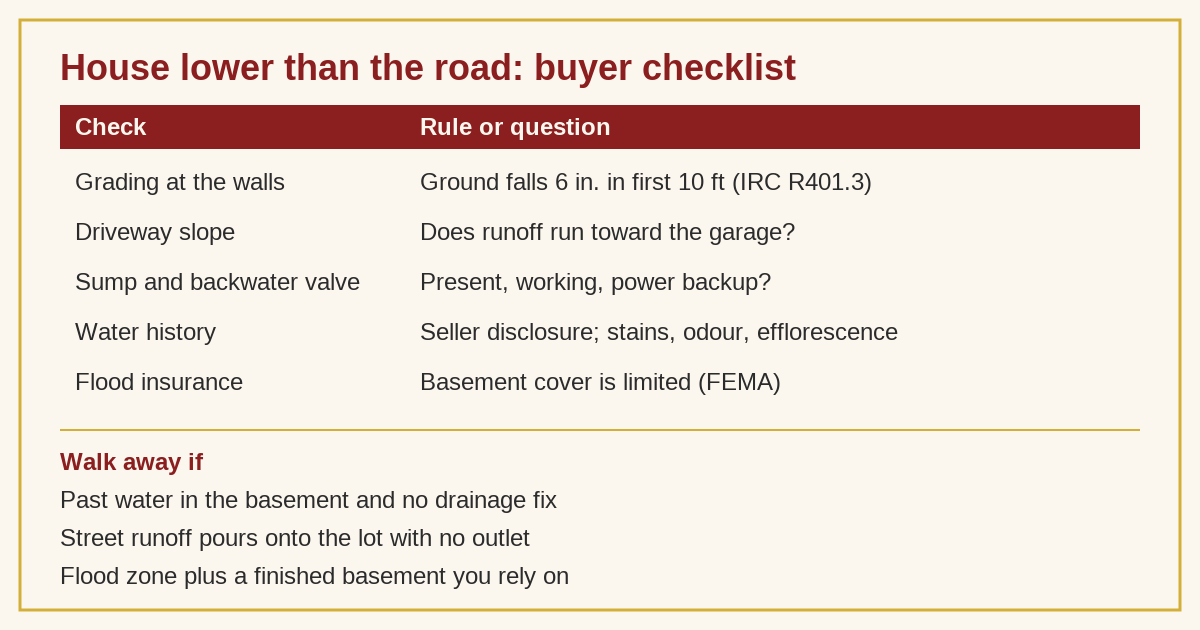
Practitioners say a house below the road collects qi and water and feels pressed down, while a house above the road is supported. For a buyer, the question is drainage. Model codes want the ground to fall at least 6 inches in the first 10 feet away from the foundation, and flood insurance covers little in a basement. So check the grading, the sump and the water history.
Code text and FEMA fact sheet read: 23 November 2026
Lots on hills and other slopes are covered in the corner lot, cul-de-sac and slope guide, and the wider purchase in our real estate and home buying guides.
| Drainage and insurance point | What the rule says | Source |
|---|---|---|
| Grading away from the house | The grade shall fall not fewer than 6 inches within the first 10 feet; lots shall be graded to drain surface water away from foundation walls (IRC R401.3, as in Massachusetts 780 CMR) | Massachusetts 780 CMR R401.3 via Cornell LII |
| Basement building coverage (NFIP) | Covers items such as furnaces, water heaters, sump pumps, circuit breaker boxes, and unfinished untaped drywall | FEMA basement flooding fact sheet |
| Not covered in a basement (NFIP) | Finished walls and flooring, bathroom fixtures, belongings such as couches and TVs, generators, most dehumidifiers | FEMA basement flooding fact sheet |
| Code adoption | The IRC is a model code; states and cities adopt their own version with changes | Massachusetts 780 CMR R401.3 via Cornell LII |
On this page
- Below the road versus below the neighbours
- What the tradition says
- The grading rule
- Flood insurance and basements
- What to inspect at a viewing
- Disclosure and what to ask
- Worked example
- Fixes for a low lot
- Four mistakes with a sunken house
- FAQ
Below the road versus below the neighbours
"Lower than the street" can mean a front yard that slopes down to the house, a driveway that dips to the garage, or a lot sitting in a hollow along the whole street. A house at the bottom of a hill is a different case, with its own runoff from above. Here we deal with the house that sits below the road in front of it.
What the tradition says
Practitioners read the ground in front of and behind a house for the support it gives. A house above the road is said to have command, with a view of whatever approaches. One below the road is called sunk. Qi and water pour down toward it and gather, and teachers read that as stagnant, pressed down, hard to rise. The usual cure is to lift the line of approach with steps, a planted terrace or a raised entry path, and to keep water moving away from the house.
All of this is traditional reading, not measurement. Our lot shape guide explains how the tradition treats site shape, and the basement and attic guide covers living below ground level.
Advertisement
The grading rule
In practical terms, the question is where the water goes. The International Residential Code, section R401.3, says lots shall be graded to drain surface water away from foundation walls, and that the grade shall fall not fewer than 6 inches within the first 10 feet. The text we checked was Massachusetts's adoption of the IRC (780 CMR R401.3), which carries that wording. The IRC is a model code. Your state or city may change it, and houses built before the rule are not required to meet it.
The code also has exceptions for walls and lot lines that leave no room for 10 feet of fall. We don't go into those here, so ask the local building department or an inspector how they apply to your lot.
On a house below the road, the street side is where the rule counts most. If the lawn, driveway or walkway slopes down toward the foundation, rain and snowmelt from the street run to the house unless a swale, a drain or a retaining wall turns them aside.
Flood insurance and basements
FEMA's basement flooding fact sheet says National Flood Insurance Program building coverage in a basement includes items such as central air conditioners, fuel tanks, furnaces and water heaters, sump pumps, electrical outlets and switches, circuit breaker boxes, stairways attached to the building, foundation elements and unfinished, untaped drywall. It does not cover finished walls, finished flooring, bathroom fixtures and other built-ins, belongings such as couches, computers and televisions, generators, or most dehumidifiers. Contents coverage for items such as washers, dryers and food freezers is optional.
In a house that sits low, then, a finished basement is expensive to lose and the policy won't pay for the finishes. Private flood policies and sewer-backup endorsements vary, so ask an insurance broker what is covered and what it would cost before you offer. FEMA's Flood Map Service Center shows whether a US lot is in a mapped flood zone, and that lookup belongs before the offer too. The NFIP is a US program. In Canada, private insurers sell overland flood cover, so ask a broker there.
What to inspect at a viewing
- Grading. Stand at each wall and see which way the ground falls. For a rough check, lay a long level or a ball on the ground.
- Driveway. Does it slope down to the garage, and is there a drain across it?
- Window wells and stairwells (basement entries). They should be clean and covered, with a drain.
- Gutters and downspouts. Where do they discharge, and how far from the foundation?
- Basement. Look for stains on the walls or floor, white mineral deposits, new paint on one wall only, and any musty smell. If there is a sump pit, check that the pump works and ask whether it has a battery backup.
- Neighbouring lots. Watch for water from higher lots draining onto this one.
- After rain. If you can, view the house after rainfall as well as in dry weather.
Disclosure and what to ask
Put your questions to the seller and agent in writing. Has water entered the basement or crawl space? When, and what was done about it? Are there repair receipts, and was an insurance claim made for water damage? Disclosure rules differ by state and province, and some places require sellers to disclose known water intrusion. There is no single national rule, so check the local one with your agent or lawyer.
The home buying checklist has the other viewing checks.
Worked example
Inputs: a house with a front yard that slopes 3 inches in the first 10 feet toward the porch, a driveway dipping to the garage with no drain, a finished basement, a sump pump with no backup, and a seller who says there was damp once.
What the checks show: on the street side the grading falls short of the 6 inch model-code figure, the driveway sends water to the garage, and basic flood coverage largely excludes the finished basement. Before an offer, get a drainage contractor's quote for a swale or a drain across the driveway and a sump with battery backup, and get the water history in writing. If the quote is high or the seller can't say what happened, lower the price or walk away.
The tradition would add three things: raise the approach with steps or a planted terrace, keep the downspouts clear, and point the water away from the house.
Fixes for a low lot
- Regrade the soil to fall away from the foundation, or add a swale or French drain.
- Put a drain across the bottom of a sloping driveway.
- Extend the downspouts away from the foundation.
- Fit a sump pump with battery backup, plus a backwater valve where sewers can back up (a plumber can advise).
- Build raised entry steps or a planted terrace, which is the tradition's way of lifting the approach.
- Keep stored things off the basement floor.
Four mistakes with a sunken house
- Judging the basement in dry weather without looking for stains.
- Assuming flood insurance will pay to replace a finished basement.
- Piling soil against the siding to fix the drainage.
- Taking a fresh coat of paint as proof the basement is dry.
FAQ
Is a house lower than the road bad feng shui?
Practitioners describe it as sunk, with qi and water pouring toward it and gathering, and they suggest lifting the approach with steps or a planted terrace. It is a traditional reading. The measurable issue is drainage, so check grading and basement water history.
What slope should the ground have away from the house?
The International Residential Code, as adopted in Massachusetts (780 CMR R401.3), says the grade shall fall not fewer than 6 inches within the first 10 feet away from the foundation. Your state or city may adopt the code with changes, and older houses may predate it.
Does flood insurance cover a finished basement?
Mostly not. FEMA's basement flooding fact sheet says National Flood Insurance Program coverage does not include finished walls, finished flooring, bathroom fixtures, belongings such as couches and televisions, or generators. It does cover items like furnaces, water heaters, sump pumps and unfinished, untaped drywall.
How can I tell if a basement has had water?
Look for stains on the walls and floor, white mineral deposits, a musty smell, fresh paint on one wall only, and a sump pit that has water marks. Ask the seller in writing about any past water and repair receipts.
Can I fix a house that sits lower than the street?
Often yes, with regrading, a swale or drain, extended downspouts, and a sump with backup. Get a contractor's written quote before you offer. If street runoff has no outlet and the basement has flooded before, consider passing.
Before you make an offer
Get a drainage contractor's quote and the seller's written water history before an offer, then use the home buying checklist for the rest of the viewing.
Sources
Checked November 2026.
- Massachusetts 780 CMR Chapter 51, R401.3 (IRC drainage), Cornell Legal Information Institute
- FEMA, Basement Flooding fact sheet (Utah Floodplain Management copy)
We did not verify FEMA's Flood Map Service Center, state and provincial disclosure rules for water damage, or Canadian drainage code figures, and we state no figures from them.
Editorial note: Lucky Properties presents feng shui as a cultural and design tradition. This guide is educational. Confirm legal, financial and inspection questions with a licensed professional.