In feng shui tradition, open green space behind a house can read as a calm, protected back. A steep drop or a busy fairway reads quite differently. Whether to buy comes down to plainer facts: ravine and tree rules, how stable the slope is, stray golf balls, and what comparable homes sold for.
Study, bylaw and safety sources checked: 23 November 2026
We stick to homes whose back yard meets a park, ravine or golf course. For a full walk-through of a house, take the feng shui home buying checklist, and for the purchase itself see our real estate and home buying guides.
| Topic | The figure or rule | Source |
|---|---|---|
| Price premium near a park (Baltimore) | 8.54% within 1/8 mile, 11.01% at 1/8 to 1/4 mile, 7.73% at 1/4 to 1/2 mile, each against homes more than 1/2 mile away | Land 14(3):483 (2025), MDPI |
| What that study shows | The premium peaked a short walk away, not at the fence line. It is a correlation in one city, and the authors note noise and heavy use as negatives | Land 14(3):483 (2025), MDPI |
| Ravine rules (Toronto) | A permit is needed to injure or remove a bylaw-protected tree, or to work in a ravine or natural feature; the city's tree bylaws changed on 1 September 2026 | City of Toronto |
| Landslide warning signs | New cracks or bulges, water flowing or ponding on a slope, leaning trees or poles, sticking doors and windows, structures pulling from foundations | USGS |
| Fire on a slope | Fire travels faster up a slope; a home above a vegetated slope can sit in a "chimney"; homes within 15 feet (one storey) or 30 feet (two storeys) of a slope need extra precautions | FireSafe San Mateo County |
On this page
- What the tradition says
- Park, ravine or golf course: three different backs
- What it does to the price
- Ravine lots: rules and slope checks
- Golf course lots
- Fire and access at the back
- Back-yard scoring sheet
- Remedies and when to walk away
- FAQ
What the tradition says
Form School, the branch of feng shui that reads land and buildings by shape, likes a house with support behind it. Its classic picture is the armchair: a higher "backing mountain" behind, lower arms to each side, open space in front. Practitioners say a solid back makes the household feel held. Without one, the house feels exposed.
A park, ravine or golf course is open land, not a mountain, and practitioners disagree on how to read it. Some count a wide green space as a pleasant, quiet back that brings in light and air. Others say open ground offers no backing at all; they want tall trees, a rise in the land or a hedge to stand in for the mountain. Neither view is a measurement. On two points the tradition agrees. A steep fall or fast water behind the house makes a weak back, and the support should be felt from inside the home (at the bed and the desk, say), not just seen on a map.
Advertisement
Park, ravine or golf course: three different backs
| Back yard meets | Tradition's reading | Real-world question that matters most |
|---|---|---|
| Public park or green belt | Open and calm, but not a "mountain", though trees at the boundary can stand in for support | Who uses it, at what hours, and is there a gate, path or play area at your fence? |
| Ravine or wooded slope | A drop behind the house is read as an unsupported back, while stable, wooded ground is read more kindly | Is the slope stable, and what does the law let you do on it? |
| Golf course | Wide, bright, open view; fairway lines aimed at the house can read as fast, hard movement | Are balls landing in the yard, and what does netting or the club allow? |
What it does to the price
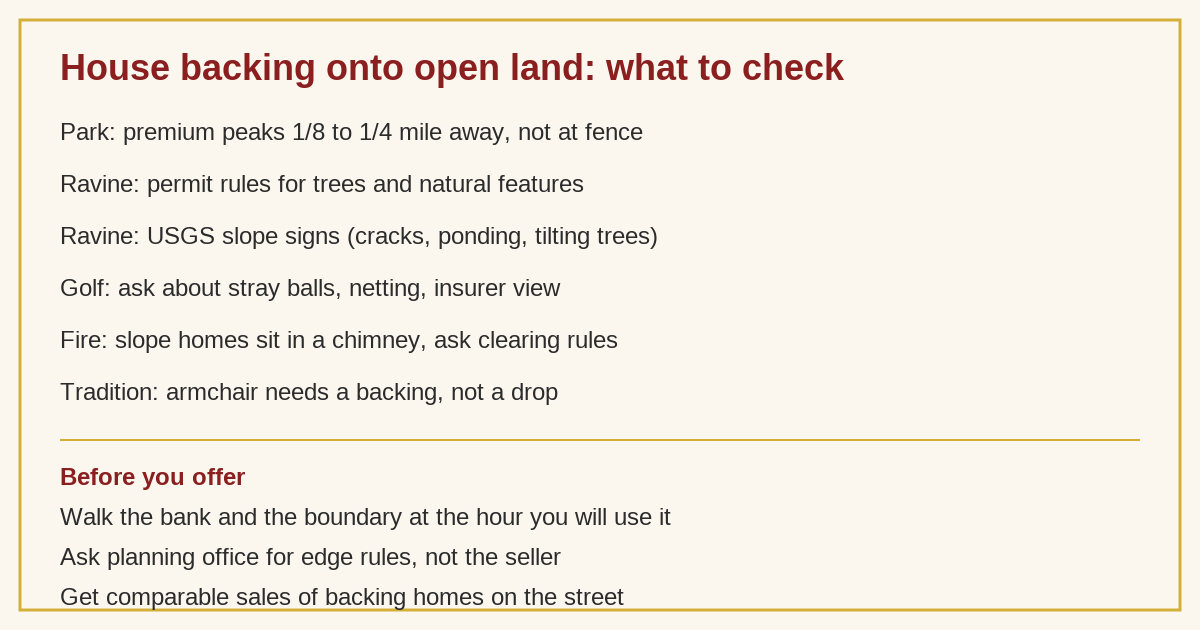
People asking whether backing onto a park adds value usually want a single percent. One recent study shows why that is hard to give. A 2025 paper in Land (14(3):483) compared sale prices in Baltimore with distance to parks. Homes within 1/8 mile sold for 8.54% more than homes over half a mile away, homes at 1/8 to 1/4 mile for 11.01% more, and homes at 1/4 to 1/2 mile for 7.73% more. So the premium peaked a short walk away, not at the fence. The paper treats noise and heavy use as downsides of living right beside a park. And it is a correlation in one city, not a promise.
We checked no comparable study for ravine lots or golf course frontage, so we give no figure for them. To test value on a real lot, ask your agent for recent sales of backing and non-backing homes on the same street, and ask an appraiser how they adjusted for the view.
Ravine lots: rules and slope checks
A ravine behind the house brings rules about what you can change. In Toronto, a permit is required to injure or remove a bylaw-protected tree, or to do work in a ravine or natural feature, and the city's tree bylaws changed on 1 September 2026, so read the current version. Other cities and conservation authorities set their own rules. Ask the local planning office and the conservation authority which ones cover this lot; the seller is not the person to ask.
Next, read the ground. The US Geological Survey lists the signs that a slope may be moving: new cracks or bulges in the ground, water flowing or ponding on the slope, tilting trees or poles, doors and windows that start to stick, and structures pulling away from foundations. If you see them, it recommends calling a geologist or engineer. At a viewing, walk the back yard and the top of the bank looking for each one. Find any, and ask for a geotechnical report before you make an offer, not after.
A slope in front of or beside the house is read differently; see feng shui for corner lots, cul-de-sacs and slopes.
Golf course lots
The tradition has no special rule for fairways. The practical risks are stray balls, noise from early mowing and events, and who pays for damage. We found no neutral figure for golf ball damage and give none. Ask the seller and the neighbours three plain questions. How often do balls land in the yard? Has a window, car or person been hit? Does the club or the municipality require netting or trees at the boundary? Then call your insurer and ask whether the policy treats ball damage or a lot beside a course any differently.
Stand in the yard at the hour you would use it. If the tee or green is within sight and hearing, you will know in ten minutes whether the open view is a quiet back or a busy front.
Fire and access at the back
FireSafe San Mateo County explains that fire moves faster up a slope, and that a home above a vegetated slope can sit "in a chimney". Its guide says homes within 15 feet of the slope (one storey) or 30 feet (two storeys) need extra precautions. If the back yard sits on a ravine rim or a wooded bank, ask the local fire department which clearing and building rules apply and whether a hose or truck can reach the back of the house.
Back-yard scoring sheet
Give each line 0 for a problem, 1 if it is unclear and 2 if it is clear and documented. A back yard scoring below 8 of a possible 12 needs more answers before an offer.
| Check | 0 | 1 | 2 |
|---|---|---|---|
| Support felt from inside | Wide open or a drop right behind | Partly shielded | Trees, rise or hedge at the back |
| Slope signs (USGS list) | One or more present | Not checked | Walked the bank, none seen |
| Local rules for the edge | Unknown | Seller says fine | Planning office or conservation authority confirmed |
| Ball, noise or foot traffic | Daily problem | Occasional | None at your boundary |
| Fire clearing and access | Dense fuel to the fence | Unknown | Cleared and reachable |
| Comparable sales | None found | Few | Several backing sales on the street |
Remedies and when to walk away
- Plant or keep a dense row of trees or a tall hedge along the back boundary. Practitioners would call it a backing mountain. It also blocks the view in and some of the noise, but check the rules first if the trees stand on a protected edge.
- Keep the back of the house solid, with a closed wall behind the bed and the desk rather than glass facing open ground.
- On a golf lot, ask about netting and put the seating out of the line of play.
- If a park path runs close, add a fence with a latch.
Walk away when the slope shows the USGS signs and the seller has no engineering report, when the edge rules would stop you from doing basic yard work, or when the lot floods or slides in the seller's own disclosure.
Four ways to misjudge a green back yard
- Pricing the lot from one study's percent. The Baltimore figures come from one city, and they peak away from the fence.
- Reading the park as a mountain and ignoring the drop. A back that falls away gives no support.
- Trusting a listing line like "backs to greenbelt" without asking who owns the land and whether it can be built on.
- Cutting a tree on the rim before reading the bylaw.
Advertisement
FAQ
Is it good feng shui to back onto a park?
Practitioners are split. Some read a park as a calm, open back, while others say open ground gives no support and prefer trees or a rise as the "backing mountain". Judge how the back feels from the bed and desk, and check noise, use and access at the boundary.
Does a house backing onto a park sell for more?
One 2025 study of Baltimore found homes within half a mile of a park sold for about 7.7% to 11% more than homes farther away, with the peak at 1/8 to 1/4 mile, not at the fence. It is a correlation in one city. Ask for local comparable sales.
Is a ravine lot bad feng shui?
Many practitioners read a steep drop behind the house as an unsupported back. Stable, wooded ground is read more kindly. The legal and safety checks matter more: edge rules, tree protection and the landslide warning signs the USGS lists.
What should I check before buying a house backing onto a golf course?
Ask how often balls land in the yard, whether anything has been hit, whether netting or boundary trees are required, and how your insurer treats the lot. How often balls land depends on the hole layout, so the neighbours' experience is the best guide.
Can I cut trees on a ravine property?
Not always. In Toronto a permit is needed to injure or remove a bylaw-protected tree or to work in a ravine or natural feature. Rules differ by city, so ask the local planning office before you plan any clearing.
Start at the bank
Walk the back yard and the edge of the bank with the USGS warning signs in hand, then ask the planning office what the edge rules allow. After that, read feng shui lot shape analysis to place the house on the lot.
Sources
Checked November 2026.
- Land 14(3):483 (2025), MDPI: study of park proximity and home prices in Baltimore
- City of Toronto: permit page for trees, ravines and natural features (bylaws changed 1 September 2026)
- US Geological Survey: landslide warning signs
- FireSafe San Mateo County: topography and wildfire guidance
We did not consult a neutral study of golf course frontage prices, any golf ball damage data or a Canadian conservation authority's rules, so no figure from them appears above. Toronto's rules and the Baltimore results are examples, not national rules.
Editorial note: Lucky Properties presents feng shui as a cultural and design tradition. This guide is educational. Confirm slope stability, local edge rules, insurance and price with a geotechnical engineer, the local planning office, your insurer and a licensed professional.