Practitioners read a garbage chute as a source of stale qi and a lift as fast-moving qi, so they advise against a bedroom wall on either. In practice the problems are noise, vibration, smell and pests. Visit at peak hours, check which room shares the wall, and treat a bedroom against a shaft or chute room as a reason to bargain or walk.
Sources checked: 23 November 2026
If it is your front door that faces the lift, read apartment door facing the elevator or corridor instead. What follows deals with the shared wall and what sits behind it. More buying questions are in our real estate and home buying guides.
| Question | What the rule or record says | Where it comes from |
|---|---|---|
| Sound between homes | The US model building code sets a minimum sound rating (STC 50) for walls between dwelling units; it is a floor, not a guarantee of quiet (not verified since November 2026) | International Building Code, sound transmission provisions |
| Night noise guidance | The WHO guideline for night noise outside the bedroom window is 40 dB Lnight (not verified since November 2026) | WHO, Night Noise Guidelines for Europe (2009) |
| Chute doors | Refuse chute intake doors are fire-rated and self-closing in code-built high-rises (not verified since November 2026); check they close and latch | Local fire code and building manager |
| Pest records | Ask for the pest-control log and any complaints about the garbage room and your floor | Building management |
| Feng shui reading | Stale qi from waste areas and fast qi from lifts are both said to disturb rest near a bedroom | Traditional teaching, no scientific test |
On this page
Advertisement
What the tradition says
Practitioners treat waste areas as the home of stale, heavy qi and lifts as places of rapid, restless movement. A unit beside either is said to feel unsettled, with poor sleep, a sense of being "pushed" at the door, or a smell that lingers. The usual advice is the same for both: do not put a bedroom, desk or stove against that wall, keep the door well closed, and bring in clean light and fresh air.
The tradition measures nothing. Still, the complaints it points to are ones buyers raise often: noise at night, vibration, smell and people passing in the corridor. You can check every one of them on a viewing.
Noise and vibration: what to check
A lift shaft carries the hum of the motor, the clank of the doors and the vibration of the car travelling. A chute carries a crash each time something drops, plus fan noise from the refuse room. The two behave differently, so check both.
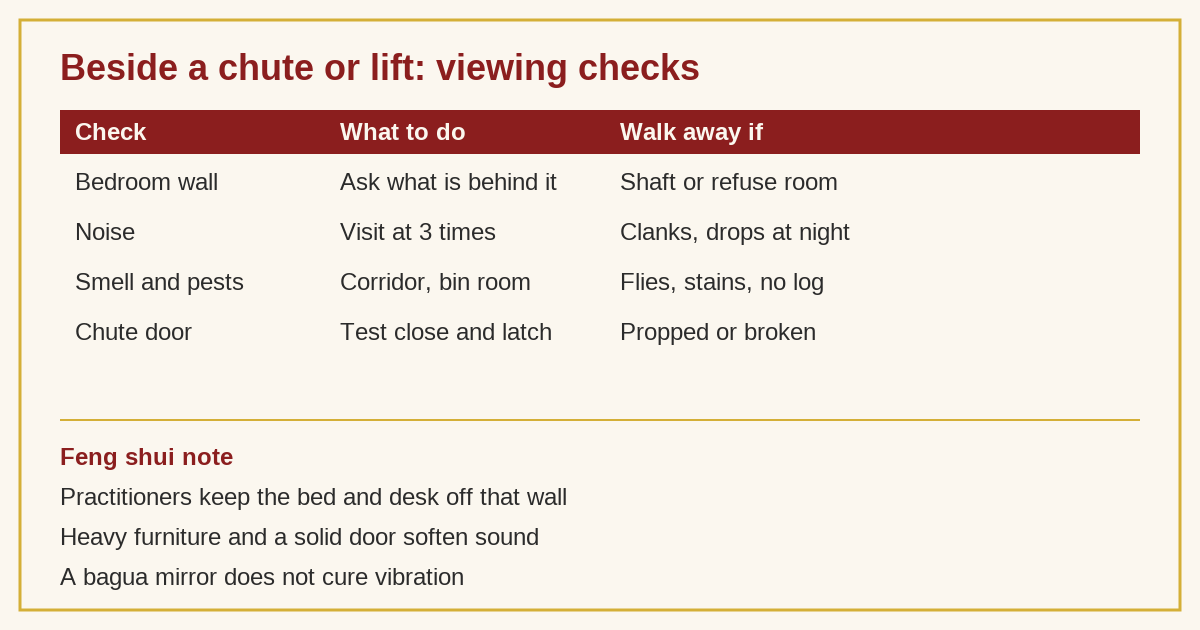
Visit three times: early evening when residents return, late evening when the last bags are dropped, and morning when people leave. Each time, shut the bedroom door and windows and listen for 10 minutes, with a hand on the shared wall to feel for vibration. Floor plans do not always mark the chute or shaft, so ask the agent what is behind each wall.
Building codes set a minimum sound rating for walls between homes. That is a floor, not a promise of quiet (not verified since November 2026). The World Health Organization's 2009 night noise guidance for Europe names 40 dB outside the bedroom window as the level to aim for (not verified since November 2026). A phone decibel app is too crude to prove a standard is met, but it is fine for comparing two units.
Smell, pests and hygiene
Stand at the chute room door, then in the corridor, and notice what you smell. Ask how often the refuse room is cleaned and whether a pest-control company is on contract, and ask to see its log. Sticky floors, stains and flies tell you more than the answers. A well-run building with a closed chute door and a bin room with a sealed floor drain is a different place from one with an open door and bags piled up.
Then check whether the corridor smell leaks under the unit's own door. A door sweep and a proper weather strip cut that down. They will not fix a badly run refuse room.
Our apartment viewing checklist has the questions to ask about the corridor and lift doors.
Walk away or bargain: a decision table
| What you find | Typical response |
|---|---|
| Bedroom wall shares a lift shaft | Bargain hard or walk; sound and vibration are hard to cure |
| Bedroom wall shares a refuse room | Walk unless the wall is insulated and the room is well run |
| Living room wall shares the shaft | Often livable; a bookcase and heavy furniture soften the sound |
| Front door sits opposite the chute door | Check smell and pests, and fit a door sweep |
| Unit is 2 or more doors away | Usually fine, but listen to the corridor at night |
| Price is well below similar units | Ask why, because other buyers may have noticed something |
Fixes that make a difference
Practitioners suggest keeping the bed and desk off the shared wall and bringing in clean light and fresh air. The practical versions are heavy bookcases against that wall, thick curtains, rugs, a solid-core door with a sweep, and a white-noise machine to mask the occasional crash from the chute. Moving the bed to a quieter wall costs nothing. Try it first. A second layer of drywall is a bigger job, and the condo board has to consent.
Where buyers of these units go wrong
- One visit at midday, when the building is quiet, tells you very little.
- Floor plans often leave out what is behind a wall, so ask.
- The end of the corridor is not automatically quiet. Check whether the chute room is there.
- Some buyers take the discount and only then learn the board will not allow soundproofing work.
- A bagua mirror or a plant will not fix a bedroom on a shaft wall.
FAQ
Is living next to a garbage chute bad feng shui?
Practitioners say it brings stale qi and recommend keeping bedrooms and desks away from the shared wall. Whatever you think of the tradition, noise, smell and pests are real reasons to check the unit carefully.
Is a condo next to the elevator bad?
Practitioners describe lift energy as fast and restless. The practical issues are motor hum, door noise and vibration. Visit at busy hours and check which rooms share the wall.
How loud is a unit next to an elevator?
It varies by building, lift type and wall construction. Stand in the bedroom with the door shut at peak hours and listen; compare it with a unit further from the shaft.
Can I soundproof a wall against a lift shaft?
You can reduce it with heavy furniture, curtains, a solid door and, with board consent, extra drywall layers. Vibration through the structure is much harder to cure.
Should a unit near the chute cost less?
Buyers often expect one, but there is no general figure. Compare it with recent sales of similar units in the building and ask your agent how long they sat.
Before you talk price
Go back to the unit at 9 pm on a weekday, stand in the bedroom with the door shut for ten minutes, and write down what you hear and smell before you discuss price.
Sources
Checked November 2026. Where a rule above is marked "not verified since November 2026", read the current text at the source before you rely on it.
- International Code Council, International Building Code, sound transmission provisions for walls between dwelling units
- World Health Organization, Night Noise Guidelines for Europe, 2009
- Local fire code on refuse chute doors and fire separations (ask the fire department or building manager)
- Traditional Form School teaching on stale and moving qi, as described by practitioners
Editorial note: Feng shui is presented here as a cultural and design tradition. Confirm legal, financial and inspection questions with a licensed professional.