Lie in a bed that sits under an exposed ceiling beam and look up. The beam is doing real work: it carries the floor or the roof above, and the room would be worse off without it. It is also, in visual terms, a heavy stripe drawn across the ceiling directly over your body, and you are about to spend a third of your life under it. Feng shui tradition noticed that stripe a long time ago, and beams over beds, desks, and sofas remain one of its most repeated complaints.
This guide covers the beam on its own terms. It separates the beam from the poison arrow, which is a different judgement covered in this site's poison arrows guide. It sets out how tradition grades a beam by position and by time spent under it. It then does the part most beam guides skip: how to tell a structural beam from a hollow decorative box or a duct soffit, because the correct remedy depends entirely on which one you have, and one of the three must never be cut. Every tradition reading here is presented as tradition. Where a checkable fact sits beside it, the guide says which is which.
Pressure, not arrows: how tradition files the beam
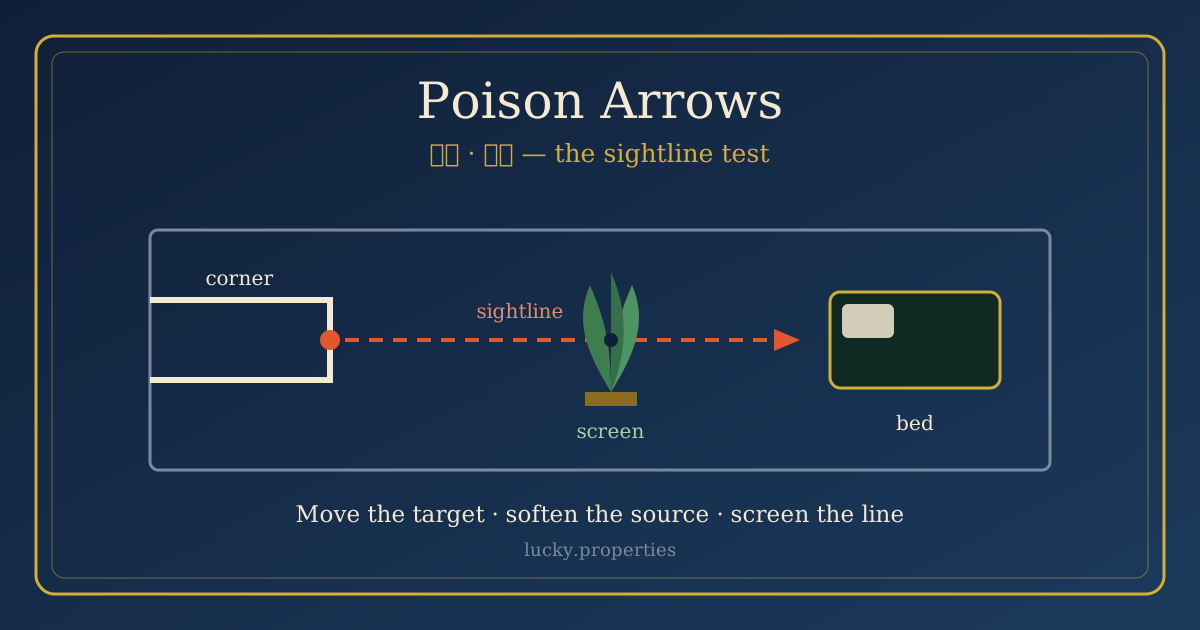
Feng shui keeps two different overhead and sightline judgements, and mixing them up produces bad advice. A poison arrow is a point or a straight rush aimed along a sightline at a person: a corner edge, a road, a corridor. A beam sends nothing along a line. It sits overhead and presses down. Practitioner writing describes the beam's quality as weight, heaviness, and division, and the remedies differ accordingly: arrows are answered by breaking a line, beams by moving out from under a load or putting a flat plane between the load and the person.
That filing matters for expectations. A beam is not read as an attack on a specific fortune or a specific person. It is read as a condition of the place where someone stays: the longer and stiller the stay, the stronger the reading. This is why the same beam can be a real item in a bedroom and a non-item over a hallway in the same audit. Form School practice, the branch that reads the shapes of a building before any compass work, owns this judgement, and this site's form versus compass school guide explains that division of labour. No compass reading changes what a beam is. The beam is form, all the way down.
One more distinction does real work. Sloped ceilings, ceiling fans, and large pendants over a bed attract similar practitioner comments about pressure, and the bedroom chapter of this topic often lumps them together. This guide stays on beams: the straight, load-shaped, ceiling-crossing member. Slopes are a placement problem of a different geometry, fans are moving objects with their own safety rules, and neither is fixed by anything in the remedy order below.
How tradition reads beam position
Tradition does not treat a beam as a yes or no feature. It reads the beam's line against the furniture under it, and the standard readings are positional.
Lengthwise over a shared bed. A beam that runs along the bed, head to foot, crossing the middle of the mattress is the most quoted case in practitioner writing. It is read as a dividing line between the two sleepers, and the couples bedroom layout guide on this site meets the same reading from the furniture side. A lengthwise beam that crosses one edge of the bed, or the space beside it, is read much more mildly: the line falls on one sleeper's margin or on nobody.
Crosswise over a bed. A beam that runs across the bed is read against the band of the body it crosses: over the head end, over the middle, or over the feet. Practitioner writing attaches different complaints to each band, and the specifics vary by school, which is a sign the reader should hold them loosely. The structural point the schools share is narrower and more defensible in plain terms: a heavy visual line crossing the sleeper, anywhere along the body, at the height of a normal ceiling, is the case they are describing. A crosswise beam beyond the foot of the bed crosses nothing and is not a case.
Over a desk chair. The reading is the same pressure logic moved to work: hours seated in one position, head and shoulders under the line. Tradition links it to concentration and to a working day that feels heavier than it should, and again this site reports that as the tradition's language, not as a measured effect. The checkable neighbour fact is ergonomic and ordinary: a low beam over a desk often travels with a low ceiling, dim light under the beam's shadow, and a seat placed where the room's structure forced it rather than where the worker would choose it.
Over a sofa or dining table. An evening seat under a beam is a milder case than a bed or a desk, because the stay is shorter and the sitter moves around. A beam over a dining table is milder still: meals are short, seats rotate, and nobody sleeps there. Many audits note these beams and deliberately leave them, which is worth copying. A tradition that requires action on every beam in the house is the commercial version, not the careful one.
Over a doorway. Practitioner writing sometimes objects to a beam directly over an entrance, on the reasoning that the doorway is where the room receives people and, in the tradition's vocabulary, qi. This is the weakest case in the catalogue: nobody stays in a doorway. Note it, and spend the effort on the bed and the desk first.
Advertisement
First, find out which beam you have
Every remedy discussion in the popular versions of this topic floats above a question they never ask: what is the beam made of, and what is it holding up? There are three common cases, and they have opposite rules.
| Beam type | What it usually is | Clues you can check | What may be done with it |
|---|---|---|---|
| Structural beam | A load-bearing member in timber, steel, or engineered wood carrying joists, a floor, or a roof to walls and posts | Runs perpendicular to the joists it supports; spans from a wall to a wall or post; lines up with a post, a wall, or a beam on the floor below; appears on original plans | Never cut, notch, or remove it on a reading. Changes belong to a structural engineer, who will usually design a substitute support that still leaves a beam, often a shallower steel one |
| Hollow box or faux beam | A decorative cover: a thin timber box, MDF, or foam profile with nothing inside, or a box built around a much smaller member, a pipe, or wiring | Evenly spaced as a repeating pattern across one ceiling; sounds hollow to a knock; very light sections at any exposed end; no load path continuing below | Can be removed or reshaped by a contractor once what is inside is confirmed. Expect a ceiling repair and repaint, not a structural job |
| Duct or services soffit | A dropped section of ceiling hiding ductwork, plumbing, or a soil pipe, common in flats and conversions | Runs from a bathroom or kitchen toward an outside wall or a vertical stack; often wider and shallower than a beam; may have a vent grille or an access panel | The services inside still need their space. A contractor can sometimes narrow or reroute, at renovation cost. Treat as fixed for any furniture-level fix |
The clues are clues, not proof. Fine Homebuilding's long-running guidance on identifying load-bearing elements makes the point that applies here exactly: you judge by looking at what the member supports and what supports it, plans beat guesses, and removal questions belong to professionals because the cost of a wrong guess is structural. Two checks are safe for any householder. Look at direction: a beam that carries joists normally runs at right angles to them, so if the joists above run front to back and the beam runs side to side while picking up their ends, suspicion rises. Then look down: trace the beam's ends and its line to the floor below and see whether posts, a wall, or another beam continue the path toward the ground. A load path you can trace is a strong warning to leave the member alone.
There is also a plain safety point that outranks every reading in this guide. Beams in older houses can hide problems a reading will never find: a sagging line, cracked plaster along one face, staining from a slow leak above. If a beam looks wrong in the ordinary physical sense, the next step is a builder, not a remedy from the list below. Tradition has nothing useful to say about a beam that is actually failing, and it should not be asked to.
The remedy order tradition prefers
Popular writing reaches for objects first: flutes, crystals, chimes. The older order works on the geometry and the eye before any object is bought, and it stops at the first step that resolves the case.
Step 1: Move the furniture out from under the line. The strongest step, and usually free. The beam stays; the relationship ends. Slide the bed along its wall until the beam crosses the foot end or misses the mattress entirely. Shift a desk so the chair sits clear, even if the desk's far edge remains under the beam. The command position guide helps here, because a bed or desk placed for command position, door visible, solid wall behind, frequently lands away from the room's beam line anyway. Where a room is small, a partial move still counts in the tradition's own grading: a beam that crosses the foot third of a bed is a milder case than one crossing the pillow third, and a lengthwise beam pushed to the mattress edge no longer divides two sleepers.
Step 2: Take the stripe out of the ceiling visually. Paint the beam the same colour as the ceiling. A dark timber or stained beam against a pale ceiling is the strongest visual version of the problem, a heavy band your eye registers every time you lie down. Matched paint demotes it to a shadow line. Practitioners who recommend this step are usually plain about its level: it fixes the sight of the beam, and for mild cases, a beam over a sofa or a dining table, the sight is most of what there was. Light colours do the same work at ceiling scale that the lighting guide describes for a room: they reduce contrast, and contrast is what the eye tracks.
Step 3: Put a flat plane between the beam and the sleeper. The traditional answer for a bed that cannot move: a canopy. A four-poster with fabric over the top, a frame with a stretched cloth ceiling, or fabric dressed across the beams themselves all create the flat plane the tradition asks for, and the sleeper looks up at cloth instead of a crossing member. In a renovation the same step is a false ceiling: a new flat ceiling under the beams. Check two practical limits before pricing one. Ceiling height after the drop has to stay legal and comfortable, since local building rules set minimum ceiling heights for habitable rooms and a beam room often starts low. And in flats, sprinklers, smoke alarms, and duct soffits may all live in the same ceiling zone, which turns a simple ceiling into a coordinated job. Owners renovate; renters canopy.
Step 4: Soften the line with light and company. Uplighting washes the shadow groove under a beam and flattens its relief. A second, parallel element can also demote a single beam: in rooms where beams repeat as a pattern, the pattern reads as a ceiling design rather than one line aimed at one bed, which is why coffered and multi-beam ceilings attract less complaint than a lone beam. This step concedes the geometry and works on attention. It is a reasonable stopping point for desks and sofas.
Step 5: Symbolic objects, last and contested. The classic citation is a pair of bamboo flutes hung from the beam at an upward angle, mouthpieces up, sometimes tied with red thread. Other schools hang a faceted crystal, and some practitioners refuse all of it and hold that a beam is a form problem with form answers only. This site's cures guide sets out how cure claims are usually framed and where they overreach, and its caution applies here in full: an object hung on a beam does not change the sightline, the ceiling height, or the load path. If flutes please you as decoration, hang them as decoration, after the geometry steps have done the work they can do.
A worked audit: one schematic bedroom and one desk
The following rooms are invented in the open to show the method. A bedroom, 3.6 metres by 4 metres, has one exposed timber beam running across the room at the ceiling, passing over the bed so that its line crosses the mattress about a third of the way down from the pillows. The beam runs perpendicular to the attic joists visible above it and its ends land on the two load-bearing side walls. A study next door has a wide, shallow dropped section running from the bathroom wall to the outside wall, passing over the desk chair.
Run the checks. Bedroom beam: direction at right angles to the joists, ends on structural walls, so treat as structural; removal is off the table and no remedy in this guide touches the member itself. Position: crosswise, crossing the upper third of the bed, eight hours a night underneath. This is the house's one real beam case. Study soffit: wide and shallow, bathroom to outside wall, so read as a services soffit; also effectively fixed. Position: over a desk chair used three evenings a week. A mild case by duration.
Apply the order. Bedroom, step 1: the bed slides 70 centimetres toward the window wall, which moves the beam line to the foot end of the mattress; the crossing case ends there, cost zero. The beam then gets step 2 anyway at the next repaint, matched to the ceiling, because the resident disliked the stripe from the doorway, an ordinary design reason. Study: no move is available, the desk fits one wall only, so the audit takes step 4, an uplight behind the monitor shelf that washes the soffit's shadow line, and stops. No objects were bought. That shape, one real fix, one cosmetic fix, most features left alone, is what a careful beam audit usually produces, and it rhymes with the audit in the poison arrows guide because the discipline is the same.
Renters, low ceilings, and beams you cannot paint
Renters lose step 3's renovation version and sometimes step 2, where a lease forbids painting. What survives is the order's strong end: step 1, moving the bed or desk, needs no permission and resolves the graded case outright. A canopy frame that stands on the floor around the bed, rather than fixing to the ceiling, is the renter's version of the flat plane. Fabric colour does the rest of the visual work from below: pale bedding and a light throw lower the contrast between the dark room at night and the pale ceiling's one dark stripe.
Low ceilings sharpen the trade-offs. A beam in a room with a 2.4 metre ceiling is closer to the sleeper, reads stronger in the tradition and in plain visual terms, and leaves no room for a false ceiling at all. In those rooms the answers are step 1 and, where allowed, step 2, plus attention to the things that make a low room feel lower: dark paint above, a pendant hanging into the space, clutter at eye level. Condo conversions and attic bedrooms concentrate all of this, low and sloped ceilings, soffits, and real structural members in one small room, and they reward the audit order precisely because so few of the features can change. Work the targets in duration order, bed first, and let the rest be.
Where the tradition stops
A beam is structure first and symbol second, and the order of those two facts is the whole safety content of this guide. No reading in the tradition justifies cutting, notching, or removing a member that carries a floor, and no practitioner worth paying will ask for that. If a consultation ends with a recommendation to remove a beam, the consultation, not the beam, is the problem.
The reading also stops at the body. Practitioner writing attaches complaints to the band of the body a beam crosses, and those claims are not findings: no checkable evidence shows a beam causing headaches, digestive trouble, or a separation. What is checkable sits nearby and is worth acting on for its own sake. A low beam over a bed often means a low ceiling and a stuffy room. A heavy stripe overhead is a real visual feature that some sleepers genuinely dislike looking at. A desk forced under a soffit is often a desk in the room's worst light. Fix those because they are real, place the bed where you sleep best, and let the tradition be what it is good at being here: a vocabulary that made generations of households look up, notice the line over the bed, and do the simple moves first. The beam will still be there in the morning. It was holding the house up all night. The question the tradition actually asks is only whether you need to sleep directly under its line, and most rooms, audited this way, let you answer no.