Every animal on the Chinese zodiac wheel has exactly one opposite. Stand on your birth animal and count six places around the twelve-branch wheel, and you land on the one animal that sits directly across from you. For a Rat, that is the Horse. For an Ox, the Goat. The tradition calls these pairings the six clashes, Liu Chong, 六冲, and treats them as the wheel strongest tension relationship: two branches pulling in opposite directions.
In 2026, a Fire Horse year, the clash is live in the calendar. Anyone born in a Rat year is, in the traditional reading, sitting in a clash year right now. That single fact is the reason clash charts get pinned to refrigerator doors and passed around family chats every February: people want to know where they stand against the year. This guide gives the full picture. It names all six pairs with their branch characters and fixed elements, shows how clashes sit beside the other two relationship systems, works out the clash years from 2026 through 2031, and explains how a traditional reader uses a clash in a birth chart, a relationship reading, and a Tai Sui year. Everything here is presented as cultural practice, the way teachers describe the system, not as prediction.
The twelve-branch wheel, in brief
A clash is a property of positions on the wheel, so the wheel comes first. Twelve Earthly Branches, each carrying one animal, one yin or yang force, one fixed element, and one trine group, arranged in the fixed order that every calendar and every chart in the tradition shares. The table below follows the standard ordering used on the English Wikipedia Chinese zodiac page, read for this guide.
| No. | Branch | Animal | Yin / Yang | Fixed element | Trine group |
|---|---|---|---|---|---|
| 1 | 子 zi | Rat | Yang | Water | 1st |
| 2 | 丑 chou | Ox | Yin | Earth | 2nd |
| 3 | 寅 yin | Tiger | Yang | Wood | 3rd |
| 4 | 卯 mao | Rabbit | Yin | Wood | 4th |
| 5 | 辰 chen | Dragon | Yang | Earth | 1st |
| 6 | 巳 si | Snake | Yin | Fire | 2nd |
| 7 | 午 wu | Horse | Yang | Fire | 3rd |
| 8 | 未 wei | Goat | Yin | Earth | 4th |
| 9 | 申 shen | Monkey | Yang | Metal | 1st |
| 10 | 酉 you | Rooster | Yin | Metal | 2nd |
| 11 | 戌 xu | Dog | Yang | Earth | 3rd |
| 12 | 亥 hai | Pig | Yin | Water | 4th |
Two things in this table do half the work of the whole guide. First, the fixed element column: each animal has an element that never changes, separate from the year element that turns with the sixty-year stem cycle. A Rat is always a Water animal at the branch level, even in a Fire Rat year. The zodiac elements guide on this site covers how the two element layers, branch-fixed and year-stem, sit together. Second, the trine group column: animals sharing a group number belong to one of the four harmony trines, which the next sections compare against the clashes.
The six clash pairs
Opposites are six apart. Branch 1 faces branch 7, branch 2 faces branch 8, and so on around the wheel. That is the whole derivation, and any reader can check it against the table above. The six pairs, with their characters and the traditional temper contrast teachers describe:
| Clash pair | Branches | Fixed elements | The contrast, in tradition terms |
|---|---|---|---|
| Rat and Horse | 子 zi, 午 wu | Water vs Fire | The cautious strategist against the open sprinter. Rat is read as careful, private, planning in the dark hours; Horse as direct, visible, moving in daylight. Water and Fire are the wheel sharpest element opposition. |
| Ox and Goat | 丑 chou, 未 wei | Earth vs Earth | The steady plough against the sensitive artist. Both are Earth, so this clash comes from position, not elements: two Yin earth branches six apart, read as stubbornness meeting sensitivity, routine meeting feeling. |
| Tiger and Monkey | 寅 yin, 申 shen | Wood vs Metal | The bold striker against the clever tinkerer. Tiger is read as direct action and appetite; Monkey as analysis and maneuver. Metal controls Wood in the five-element cycle, which the tradition reads as a built-in friction line. |
| Rabbit and Rooster | 卯 mao, 酉 you | Wood vs Metal | The gentle avoider against the outspoken critic. Rabbit is read as softness and retreat; Rooster as precision and public speech. Metal over Wood again, and the temperaments face opposite directions. |
| Dragon and Dog | 辰 chen, 戌 xu | Earth vs Earth | The visionary against the guardian. Both Earth, both strong-willed, read as big-picture ambition meeting loyal watchfulness. Teachers describe this as the clash of two certainties. |
| Snake and Pig | 巳 si, 亥 hai | Fire vs Water | The cool observer against the warm enthusiast. Snake is read as contained and calculating; Pig as generous and expressive. Fire and Water oppose directly, the mirror image of the Rat and Horse pair. |
A pattern worth noticing: four of the six pairs oppose through elements, Water against Fire twice and Wood against Metal twice, while two pairs, Ox with Goat and Dragon with Dog, are same-element clashes. In the same-element pairs, the tension is positional. The branches stand six apart and the tradition reads opposition into the geometry itself. This is why a clash cannot be reduced to element arithmetic. The wheel does the work, and the elements colour it.
Three relationship systems on one wheel
Clashes are one of three branch relationship systems, and readers confuse them constantly. Set them side by side and each one stays clear.
The three harmonies, San He, 三合, are the four trines. Animals in one trine are four places apart, forming an equilateral triangle on the wheel. Tradition reads them as the easiest company: shared outlook, similar pace.
| Trine | Animals | Traditional reading |
|---|---|---|
| 1st trine | Rat, Dragon, Monkey | The thinking triangle: strategy, vision, and method |
| 2nd trine | Ox, Snake, Rooster | The working triangle: endurance, calm, and precision |
| 3rd trine | Tiger, Horse, Dog | The action triangle: courage, drive, and loyalty |
| 4th trine | Rabbit, Goat, Pig | The feeling triangle: gentleness, artistry, and warmth |
The six harmonies, Liu He, 六合, are the secret-friend pairs. Six pairings, each read as the quietest, most supportive match on the wheel:
| Harmony pair | Branches |
|---|---|
| Rat and Ox | 子, 丑 |
| Tiger and Pig | 寅, 亥 |
| Rabbit and Dog | 卯, 戌 |
| Dragon and Rooster | 辰, 酉 |
| Snake and Monkey | 巳, 申 |
| Horse and Goat | 午, 未 |
Then the six clashes, Liu Chong, 六冲, the opposites, six places apart, as tabulated above.
A useful check falls out of putting all three on one wheel. Take your animal. Your trine gives you two allies. Your harmony pair gives you one close friend. Your clash gives you one opposite. And the friend of your opposite is, in the traditional matchmaking notes, your worst pairing after the clash itself. For a Rat: allies Dragon and Monkey, friend Ox, opposite Horse, and the Horse friend, Goat, is the pairing teachers warn about most. The same arithmetic serves all twelve animals. The full master table:
| Animal | Trine allies | Harmony friend | Clash opposite | Opposite friend (traditionally the hardest pairing) |
|---|---|---|---|---|
| Rat | Dragon, Monkey | Ox | Horse | Goat |
| Ox | Snake, Rooster | Rat | Goat | Horse |
| Tiger | Horse, Dog | Pig | Monkey | Snake |
| Rabbit | Goat, Pig | Dog | Rooster | Monkey |
| Dragon | Rat, Monkey | Rooster | Dog | Rabbit |
| Snake | Ox, Rooster | Monkey | Pig | Tiger |
| Horse | Tiger, Dog | Goat | Rat | Ox |
| Goat | Rabbit, Pig | Horse | Ox | Rat |
| Monkey | Rat, Dragon | Snake | Tiger | Pig |
| Rooster | Ox, Snake | Dragon | Rabbit | Dog |
| Dog | Tiger, Horse | Rabbit | Dragon | Rooster |
| Pig | Rabbit, Goat | Tiger | Snake | Monkey |
Every row of this table is checkable from the wheel positions. Count four around for trines, find the harmony list, count six for the clash, then take the clash partner row and read off its harmony friend. Nothing here needs a teacher to verify; it needs the table in the previous section and a finger on the wheel.
Advertisement
Clash years: 2026 through 2031
A clash year is the year whose animal opposes your birth animal. The year branch sits six places from your branch, and the tradition reads that as a Tai Sui clash year, 冲太岁, chong tai sui, a year in which your branch knocks against the Grand Duke of the year. The Tai Sui annual afflictions guide on this site covers the full annual-affliction map; the clash is one relationship on that map, alongside the own-year, the harm, the break, and the punishment relationships.
The animal for each year turns at Chinese New Year, with the usual boundary caution: a January or early February birthday belongs to the previous year animal. The birth-year chart on this site works the exact cutovers. Year spans below follow the sixty-year cycle table on the English Wikipedia Chinese zodiac page, read for this guide:
| Year | Year animal and stem | Span | Clash animal (opposite) | Clash birth years, recent |
|---|---|---|---|---|
| 2026 | Fire Horse, 丙午 | Feb 17, 2026 to Feb 5, 2027 | Rat | 1960, 1972, 1984, 1996, 2008, 2020 |
| 2027 | Fire Goat, 丁未 | Feb 6, 2027 to Jan 25, 2028 | Ox | 1961, 1973, 1985, 1997, 2009, 2021 |
| 2028 | Earth Monkey, 戊申 | Jan 26, 2028 to Feb 12, 2029 | Tiger | 1962, 1974, 1986, 1998, 2010, 2022 |
| 2029 | Earth Rooster, 己酉 | Feb 13, 2029 to Feb 2, 2030 | Rabbit | 1963, 1975, 1987, 1999, 2011, 2023 |
| 2030 | Metal Dog, 庚戌 | Feb 3, 2030 to Jan 22, 2031 | Dragon | 1964, 1976, 1988, 2000, 2012, 2024 |
| 2031 | Metal Pig, 辛亥 | Jan 23, 2031 to Feb 10, 2032 | Snake | 1965, 1977, 1989, 2001, 2013, 2025 |
The birth-year lists are plain twelve-year arithmetic from the animal years and are checkable against the birth-year chart. Note the stem element in each row, Fire, Earth, Metal, because the full stem-branch of a clash year flavours the traditional reading. A Fire Horse clash year and a Water Horse clash year are both Horse-against-Rat, but teachers read the Fire stem as adding heat to the opposition and the Water stem as adding weight. The branch clash is the structure; the stem is the weather.
Two distinctions matter here, because mixing them up produces most of the confusion around clash years.
First, a clash year is not ben ming nian. Ben ming nian is your own animal returning: your year branch sitting on top of your birth branch. A clash year is the opposite animal arriving: the year branch sitting six places away. A person born in 1996, a Rat year, had ben ming nian in 2020 and sits in a clash year in 2026. Tradition treats the two differently and gives them different customs, which the ben ming nian guide sets out in full. Do not merge them.
Second, the clash reading is about the year branch against your birth branch, not about the whole year being bad. A clash year in the tradition is a year to move carefully, keep commitments modest, and avoid starting fights, not a sentence. Teachers describe it the way a weather report describes a windy week: worth knowing about, worth dressing for, not worth cancelling life over.
What tradition says about a clash year
Households that observe the customs treat a clash year as a low-key year. The customs are widely shared and plainly stated, and they are customs, not prescriptions:
- Big moves get extra care. Starting a business, changing jobs, moving house, or signing large commitments in a clash year is traditionally done slowly, with more checking and less rushing. The custom is about pace, not prohibition.
- New commitments stay modest. Where a non-clash year might invite expansion, a clash year invites consolidation: finish what is open, maintain what exists, defer what can wait.
- Red is worn through the year. Red clothing, red string bracelets, red underwear, following the same logic as the ben ming nian red custom: red is read as protective colour in the tradition.
- A temple or ancestral hall visit around the New Year. Many households pay respects and ask for a smooth year, which in the tradition settles the Tai Sui relationship for the months ahead.
- Arguments are not started. The clash is read as ambient friction, so the custom is to refuse the first provocation: let the sharp email sit overnight, take the longer route around a known disagreement.
None of this is mandatory in any lineage, and none of it is advice. It is what the tradition says, presented the way teachers present it. The decisions that matter in a clash year, money, health, legal, property, still belong to professionals, documents, inspections, and arithmetic. A clash year never licenses ignoring a real problem, and no custom in these pages substitutes for a doctor, a lawyer, or an accountant.
Clashes in relationship readings
Between two people, a clash between year animals is read as a temper contrast to manage. The Rat and Horse row in the pair table is the template: one partner plans in the dark hours and one moves in daylight, and the friction is real but nameable. Traditional matchmakers describe clash pairings as high-maintenance rather than doomed: more negotiation, more explicit agreements, more repair work, same possibility of a good relationship.
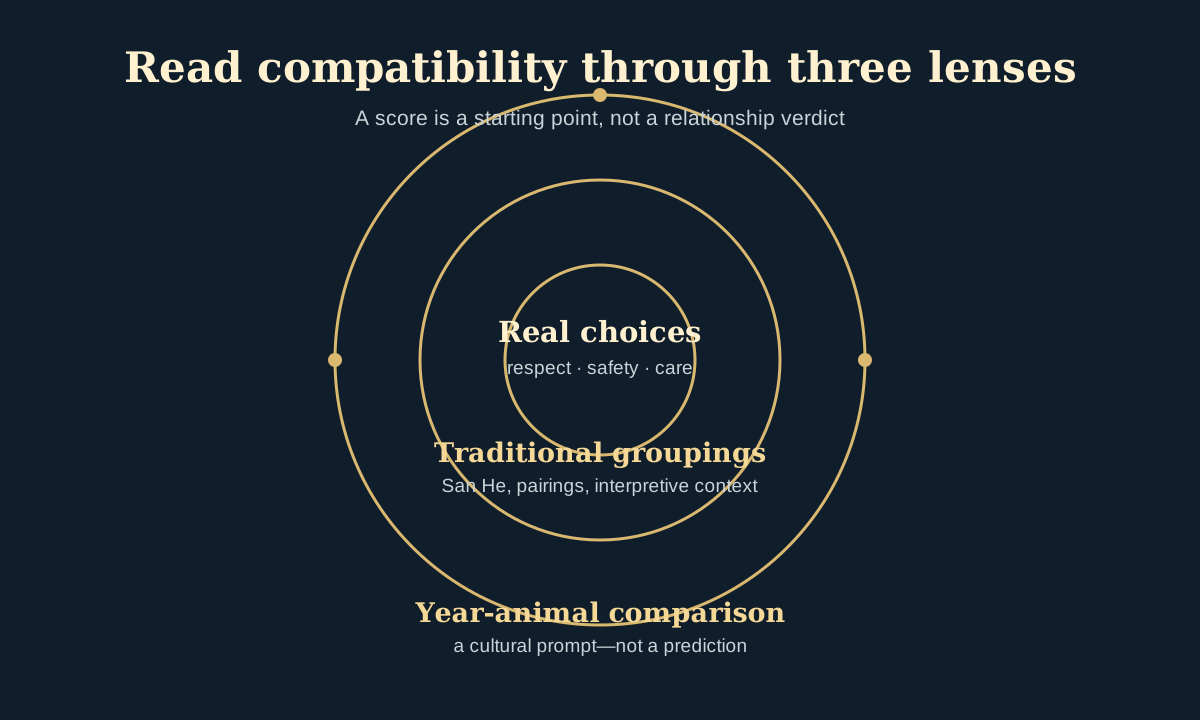
The site love compatibility guide works the full method at relationship length, including how to read a clash result as a set of questions rather than a verdict. This guide adds the structural point that method assumes: the clash is one cell in a larger grid. Two people bring trine alignments, harmony friendships, and clashes all at once, and a serious traditional reading weighs the whole pattern. A clash between year animals with a harmony friendship between month animals reads, in the system, very differently from a clash standing alone.
One more traditional note, because it surprises people: the hardest pairing in the old matchmaking notes is usually not the clash itself but the friend of your opposite. A Rat and a Goat, the Rat opposite Horse and the Goat the Horse secret friend, is the pairing teachers historically flagged most. The reasoning inside the system is that the clash at least names its tension, while the opposite-friend pairing slides past it. Whether that reasoning persuades is up to the reader; it is reported here because it is part of the tradition, and because it shows the system is subtler than clash-equals-bad.
Clashes inside a birth chart
Branches do not only mark years. In a BaZi chart, the four pillars, year, month, day, and hour, each carry a branch, and a clash can appear between any two of them. A person born in a Rat year with a Horse month has a year-month clash inside the chart. A Horse day with a Rat hour has a day-hour clash. Traditional readers treat these internal clashes as lifelong themes rather than annual events: a standing tension between, say, the family pillar and the career pillar, or between the public self and the private hours.
The BaZi chart reading guide on this site walks the four pillars at full length, including how readers weigh a clash against the day master strength and the ten gods. Two cautions from that guide apply double here. First, a clash in a chart is never read alone; the stems, the season of birth, and the luck pillars all qualify it. Second, the month branch sets the seasonal frame of the whole chart, so a clash touching the month pillar gets more weight in a traditional reading than one between day and hour. These are reading habits, not rules of nature, and the guide presents them as the tradition own grammar.
A worked schematic
What follows is a teaching sketch, not a reading of any real person. The people are supposed, the dates are round numbers, and the point is to show the grammar in motion.
Take two supposed people. Person A was born in 1996, a Rat year, in a month whose branch is Dragon. Person B was born in 1990, a Horse year, in a month whose branch is Dog. A traditional reader lays the three systems over the pair:
- Clash: Rat year against Horse year, 子 against 午, six apart. The year pillars clash directly. In the temper language of the pair table, the cautious strategist meets the open sprinter.
- Trine: A month Dragon sits in the 1st trine with Rat and Monkey. B month Dog sits in the 3rd trine with Tiger and Horse. The month pillars do not clash and do not harmonise; they sit in different trines, which the tradition reads as different native paces.
- Harmony: Rat secret friend is Ox, absent here. Horse secret friend is Goat, absent here. No secret-friend softening in the supposed pillars.
- The year: in 2026, a Fire Horse year, B sits in ben ming nian while A sits in a clash year. One supposed person meets their own branch, the other meets the opposite branch, in the same twelve months.
A careful reader, working in the tradition, would describe this as a high-contrast pairing in a high-contrast year, and then stop. The description is the product. What the two supposed people do with it, which agreements they make about pace, planning, and disagreement, is outside every chart. The love compatibility guide method section says the same thing at greater length: use the pattern as a set of questions, not a verdict.
Limits, stated plainly
The branch wheel is a calendar that acquired a psychology. Its history is real: twelve Earthly Branches as a timekeeping system standardised in the Han dynasty, animals attached to branches, stems and branches combined into the sixty-year cycle, and centuries of commentary on how the positions relate. None of that converts a clash into knowledge about a person or a year. The system describes patterns inside its own geometry. People are larger than the geometry.
Three practical limits follow. First, the year boundary: two schools in Chinese astrology start the zodiac year at Chinese New Year or at the solar term Lichun, and a January or early February birth can sit on either side depending on the school. A clash reading built on the wrong animal is a reading of the wrong wheel. Second, the clash is one relationship among several, and schools weigh the systems differently; a clash that one lineage reads as central, another reads as background against the stems. Third, no branch relationship is advice about real decisions. Health questions belong to clinicians, legal questions to lawyers, money questions to documents and arithmetic, and relationship questions to the people in them, with appropriate real-world support where safety is involved.
Use the clash the way this site uses every system in the pillar: as a cultural frame that some households find useful for naming a tension and thinking about pace, with the real decision made on evidence that can be checked by someone who has never seen a wheel.
Sources and further reading
The twelve-branch table, animal order, yin and yang assignments, fixed elements, trine group numbers, and the 2026 to 2031 year spans and stem-branch labels follow the Chinese zodiac entry on English Wikipedia, read for this guide, which draws on standard sinological references for the branch system. The six clash pairs, the four trine groupings, and the six harmony pairings were verified against the wheel geometry itself: clashes six branches apart, trines four apart, and the harmony list cross-checked against a compatibility write-up read for this guide that enumerates the same six pairings. Where schools differ, on the year start and on the weight of a clash against the stems, the guide says so rather than picking a winner.