When you move out, leave what the sale contract or lease says stays, leave the home clean and empty of your own belongings, and take the rest. Practitioners add that a cleared, tidy home hands the next occupant a fresh start. No feng shui rule overrides the contract: in a sale, fixtures usually convey unless the contract says otherwise.
Checked: 23 November 2026
This guide is for the seller or tenant on the way out. If you are the one arriving, read first 30 days in a new home; the rest of the move is covered in our real estate and home buying guides.
| Point | Rule or example | Source |
|---|---|---|
| Fixtures convey by default | Absent other contract terms, fixtures convey with the sale (Virginia law, as described) | Virginia REALTORS |
| Fixture test | Virginia law generally asks: is it attached, how essential is it to the property, and did the owner intend it as permanent | Virginia REALTORS |
| Contract controls | Even legal fixtures can be excluded by agreement; say in the listing and contract what you keep | Virginia REALTORS |
| Clear fixtures | Built-in fireplace, chandelier, brick wall | Virginia REALTORS |
| Not fixtures | Freestanding furniture | Virginia REALTORS |
| Grey areas | Wall-mounted TV, video doorbell and its account | Virginia REALTORS |
On this page
- What the contract says stays
- What practitioners say to leave and to take
- Leave, take or ask table
- Worked example: a chandelier you want to keep
- Renters
- Mistakes that lead to disputes
- FAQ
What the contract says stays
The law differs by state and province, so we use Virginia as the example, as described by Virginia REALTORS. There, fixtures are personal property attached to a building and treated as part of the real property, and they convey with the sale unless the contract says otherwise. Virginia law generally uses three tests: is the item attached, how essential is it to the property, and did the owner mean it to be permanent. Intent can be read from the nature of the item and why it was attached.
The practical lesson holds anywhere: do not rely on a feng shui view or your own sense of "mine" to decide what leaves. Write it down. If you plan to take a chandelier, a mounted TV or a smart doorbell, say so in the listing and in the contract. Forms can define fixtures differently, so read the one you sign. For preparing the house before you list it, see feng shui for selling a house.
Advertisement
What practitioners say to leave and to take
There is no single documented moving-out ritual, and regional customs differ, so we don't present one. The advice practitioners commonly give is general and sensible:
- Leave the home clean, with floors, cupboards and the kitchen free of your belongings. The idea is that the next occupant receives a clear space.
- Take what is yours, including items you no longer want, rather than leaving clutter that carries your history. Our decluttering guide covers sorting before a move.
- Do not leave behind items tied to personal or ritual use, such as altar items or offerings, unless you have agreed it with the buyer. Handle them as your tradition directs.
- A plain physical clean is the usual first step toward a fresh start for the next occupant. Ritual cleansing is a personal choice that belongs to the arriving household, as our previous owner energy guide explains.
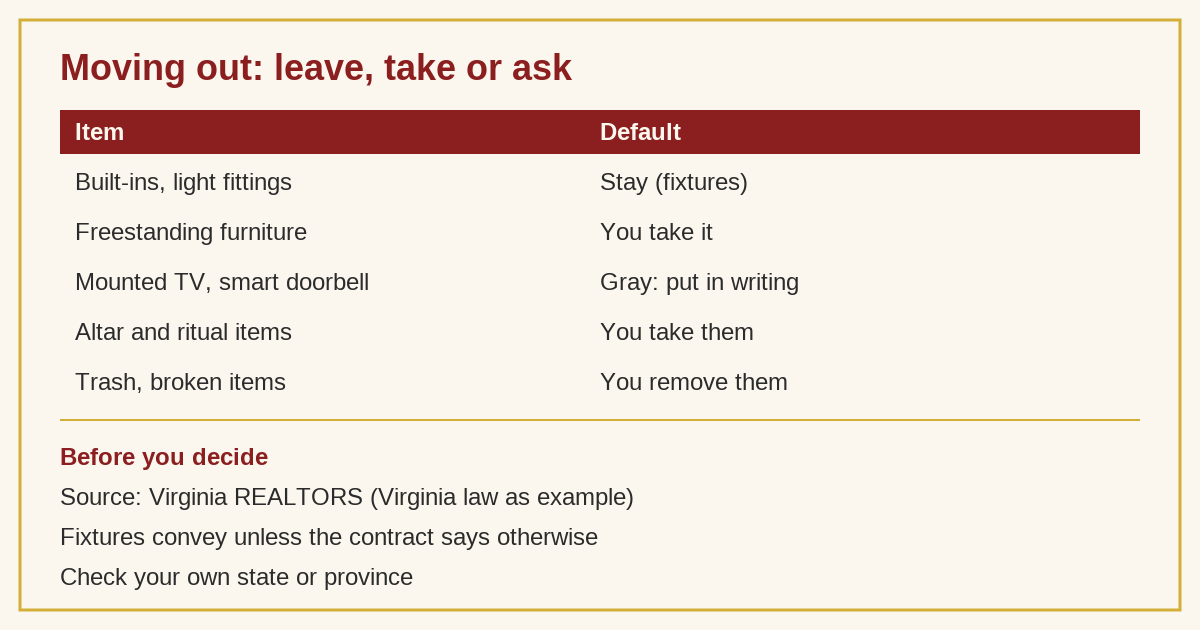
Leave, take or ask table
| Item | Default in a sale | Feng shui view (practitioners) | What to do |
|---|---|---|---|
| Built-in appliances, light fittings, fireplaces | Usually fixtures, so they stay | Leaving working fixtures is neutral | Leave them, unless the contract excludes them |
| Freestanding furniture | Not a fixture, so it is yours | Take what you value and leave nothing broken | Take it, or agree to sell it |
| Wall-mounted TV | Grey area | No particular view | Decide in writing whether the TV, bracket or both stay |
| Smart doorbell, locks, thermostat | Grey area, with accounts | No particular view | Reset and remove your account; agree whether the device stays |
| Plants | Grey area, so ask | Healthy plants are seen as fresh energy, so never leave dying ones | Take them or leave them healthy, by agreement |
| Mirrors fixed to walls | Grey area if fixed to the wall | Practitioners prefer mirrors placed with care | Ask, and settle it in writing |
| Altar, offerings, ritual items | Yours | Handle as your tradition directs | Take them, or remove them respectfully |
| Trash, broken items | Yours | Clutter is seen as stuck energy | Remove them |
| Keys, garage remotes, manuals, warranties, labelled spare paint | Commonly handed over; check the contract | A complete handover is a clean break | Leave them together in one marked drawer |
Worked example: a chandelier you want to keep
Say you are selling a detached house. The purchase agreement lists the dining chandelier, the wall-mounted TV and the smart doorbell as "included" by mistake, but you want the chandelier (a family piece) and the TV.
Here is how to put it right:
- Before closing, ask your agent to propose an amendment excluding the chandelier and TV. The buyer must agree, and may ask for a price change or a replacement fixture.
- Put up a simple fixture where the chandelier hung so the ceiling is not left bare, and patch the holes from the TV bracket.
- Remove your account from the doorbell and agree that the device stays.
- Do a final clean and take every one of your belongings out.
The contract now matches what actually leaves, the buyer gets no surprise at the walk-through, and no feng shui question had to settle anything.
Renters
A tenant leaves according to the lease: remove your belongings, clean, and return the unit in the condition the lease requires. Our renters guide lists changes you can make without touching the unit. Check your lease and your area's move-out inspection rules. Deposit rules and limits differ by state and province, so we state no figure.
Mistakes that lead to disputes
- Taking a built-in item without amending the contract, then arguing about it with the buyer.
- Leaving a mess and calling it "energy". In practice that ends in an argument at the final walk-through.
- Assuming a smart device is personal property without removing your account.
- Treating a ritual you know as universal, when moving customs vary by family and region.
FAQ
What should you leave behind when moving out of a house?
Leave what the contract says stays, which in a sale usually means the fixtures: built-in appliances, light fittings and similar attached items. Practitioners add that you should leave the home clean and empty of your own belongings. Anything you want to keep that could be a fixture should be excluded in writing.
Is there a feng shui ritual for leaving a home?
There is no single documented ritual, and customs vary by family and region. What practitioners commonly advise is practical: clear the home, clean it, and take your own items, including ritual objects. Treat any specific ritual as a personal choice rather than a rule.
Can I take the chandelier or light fixtures when I sell?
Only if the contract excludes them. In Virginia, as described by Virginia REALTORS, a chandelier is a clear example of a fixture and conveys with the sale by default, though even fixtures can be excluded by agreement. Say so in the listing and the contract, and check your own state or province.
Should I leave anything for good luck?
Some families leave a clean, tidy home as a courtesy and a good-luck gesture. We found no sourced custom that names a specific object to leave, so we don't recommend one. If you want to leave something, such as a plant or a note, keep it a courtesy and make sure the buyer is happy with it.
What about a smart doorbell or locks?
They are a grey area. Virginia REALTORS notes the devices are typically attached and essential, so they may be fixtures, but owner intent and the account matter. A common middle ground is that the device stays and the seller cancels the account. Agree it in writing.
Your list for the agent
Before you list, write down every item you plan to keep and give the list to your agent. Then read feng shui for selling a house for what to do with the rest, and plan your arrival with first 30 days in a new home. If you are choosing a moving date, see the auspicious date guide.
Sources
Checked November 2026.
We did not verify a state or provincial fixtures statute or a source for moving-out customs, so we state no figures from them.
Editorial note: Lucky Properties presents feng shui as a cultural and design tradition. This guide is educational; confirm contract, fixture and deposit questions with a licensed real estate professional or lawyer in your area.