Short answer
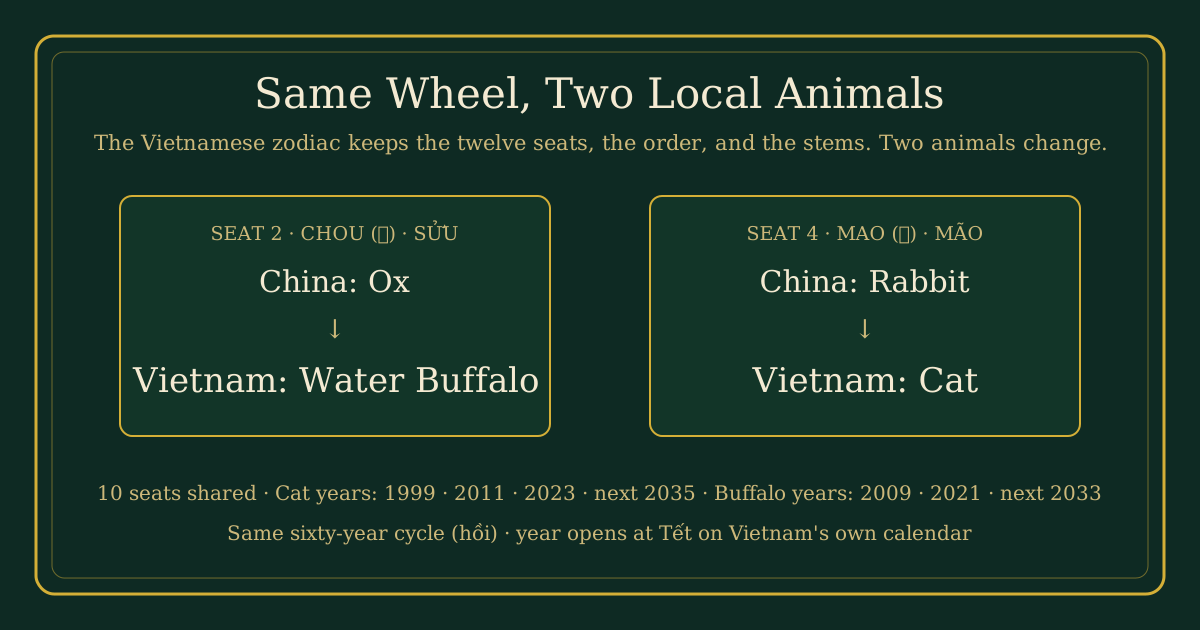
Vietnam runs the same zodiac as China: twelve animals, the same order, the same ten stems turning over the top, the same sixty-year cycle underneath. Then it changes two animals. The second seat, held by the Ox in the Chinese system, belongs in Vietnam to the water buffalo. The fourth seat, the Rabbit in China, belongs in Vietnam to the cat. Nothing else moves. A child born in a Chinese Rabbit year is born in a Vietnamese Cat year, on the same dates, with the same stem and element. The system even keeps the branch name for the seat, Mão, which is the Vietnamese reading of the same character, 卯, that China reads as Mao and fills with a rabbit. Why the animal changed is a genuine open question with three standing theories and no proof, and this guide keeps them labelled as theories. Underneath the animals sits a second, quieter difference: Vietnam computes its own lunisolar calendar, and in 1985 that calendar put Tet a full month ahead of Chinese New Year, so for a few weeks the two countries were living in different zodiac years at the same time.
This site's other zodiac guides work inside the Chinese system: the birth year chart lists every year by animal and element, the race legend guide tells the story that fixes the order, and the Chinese and Western zodiac comparison sets the two big systems side by side. This page is the one that steps outside China, because readers keep arriving with the same puzzle in hand: a birth year that one website calls Rabbit and another calls Cat. Both websites are reading real systems. This guide explains both, and shows where each one applies.
The twelve, side by side
The Vietnamese zodiac is called Mười hai con giáp, the twelve zodiac animals. Each seat carries a Vietnamese name, and the names repay a slow read. They are the Sino-Vietnamese readings of the twelve earthly branches, the same branch characters the Chinese system uses, pronounced in Vietnamese. The animal a seat holds is then named again in the everyday Vietnamese word. The fourth seat shows the pattern best: its branch name is Mão, and the everyday word for its animal, the cat, is mèo.
| Seat | Branch | Chinese animal | Vietnamese animal | Vietnamese name (branch, everyday word) | A recent year | What Vietnamese tradition says of it |
|---|---|---|---|---|---|---|
| 1 | Zi (子) | Rat | Rat | Tý (chuột) | 2020 | Welcomed as a bringer of good luck |
| 2 | Chou (丑) | Ox | Water buffalo | Sửu (trâu) | 2021 | Riches achieved through hard work |
| 3 | Yin (寅) | Tiger | Tiger | Dần (hổ) | 2022 | Warm-hearted yet fearsome, brave in danger |
| 4 | Mao (卯) | Rabbit | Cat | Mão (mèo) | 2023 | Tranquil, realistic, intelligent, artistic |
| 5 | Chen (辰) | Dragon | Dragon | Thìn (rồng) | 2024 | Imperial symbol, tied to the yang side |
| 6 | Si (巳) | Snake | Snake | Tỵ (rắn) | 2025 | Enigmatic and wise, likes to live well |
| 7 | Wu (午) | Horse | Horse | Ngọ (ngựa) | 2026 | Freedom and confidence |
| 8 | Wei (未) | Goat | Goat | Mùi (dê) | 2027 | Creativity and good taste |
| 9 | Shen (申) | Monkey | Monkey | Thân (khỉ) | 2028 | Versatile and mischievous, an inventor's sign |
| 10 | You (酉) | Rooster | Rooster | Dậu (gà) | 2029 | Brave and resilient, can be self-absorbed |
| 11 | Xu (戌) | Dog | Dog | Tuất (chó) | 2030 | Lucky, loyal, and likeable |
| 12 | Hai (亥) | Pig | Pig | Hợi (lợn) | 2031 | Patient, and associated with virility |
The character column is drawn from the Vietnamese zodiac summary on Wikipedia, which also records the structure beneath the table: the Vietnamese calendar divides its sixty-year cycle, called a hồi, into five rounds of the twelve animals, exactly as the Chinese sixty Jiazi divide into five rounds of twelve. Read the table by its differences and the whole system comes into focus. Ten rows are identical to the Chinese wheel. Two rows differ, and they differ in the animal only. The branch character, the seat number, the year, and the stem that pairs with the branch all stay where the Chinese system put them. Vietnam did not build a rival zodiac. It kept the inherited machine and re-cast two of its figures in local form, the way a folk tale keeps its plot and changes its cast when it crosses a border.
The years column deserves one caution, and it applies to every zodiac chart on this site. The animal changes at the lunar new year, Tet in Vietnam, not on January 1. The 2023 row means the Cat year that opened at Tet in January 2023 and ran into February 2024. A baby born in the first weeks of 2023, before Tet, belongs to the Tiger row above it. The age counting guide covers the matching Vietnamese habit of reckoning age by the new year, which is why the two questions so often arrive together.
The skeleton never changed: branches, stems, and the sixty-year hồi
To see why the swap is small, look at what a zodiac year actually is inside the system. A year is not primarily an animal. A year is a stem-branch pair: one of ten heavenly stems over one of twelve earthly branches, advancing in lockstep, producing sixty pairs before the sequence repeats. The animal is the popular face of the branch. Rat is the face of Zi, Tiger the face of Yin, and so on. Charts, almanacs, and BaZi readings all run on the pairs; the animals are how the pairs are remembered, pictured, and celebrated.
Vietnam kept all of that. The Vietnamese names in the table above are the branch names themselves, read in Sino-Vietnamese: Tý for Zi, Sửu for Chou, Dần for Yin, Mão for Mao. A Vietnamese almanac and a Chinese almanac name the same year with the same pair, written with the same characters; the 1831 Vietnamese book inscription Tân Mão niên, the Xin Mao year, uses the identical pair a Chinese printer would have used for the same year, and reference works on the Vietnamese calendar print that example. The sixty-year hồi turns on the same pairs. The five elements ride the same stems, so a Vietnamese year carries a stem element exactly as a Chinese year does: 2023 pairs the stem Gui with the fourth branch, so it is a Water year in both countries, and the only thing in dispute is whether the Water belongs to a rabbit or a cat. The elements guide and the Na Yin guide on this site read Vietnamese years without a single adjustment, because the layer they describe never forked.
That is the right frame for everything that follows. The cat is not a thirteenth animal added to the wheel, and the buffalo is not a rival to the ox in some competing system. Each is a local identification of one branch seat, made by a culture that received the branch system, kept it for a thousand years, and pictured two of its seats with the animals its own country put in front of it.
Advertisement
Why a cat? Three theories, no verdict
Every explainer of the Vietnamese zodiac reaches this question, and the plain state of the evidence is that no document survives to settle it. What circulates instead are three explanations, of different kinds. This guide gives each one with its source and its weakness, because the gap between a good theory and a proven fact is exactly where zodiac writing usually starts inventing.
The sound theory. The fourth branch is written 卯. Chinese reads it Mao. Sino-Vietnamese reads it Mão. The everyday Vietnamese word for a cat is mèo. The theory holds that somewhere in the long transmission of the system into Vietnam, the branch name, heard or read in its Vietnamese form, attached itself to the animal whose name it resembled, and the seat of the rabbit quietly became the seat of the cat. This is the explanation the Vietnamese zodiac entry on Wikipedia prints, and it has real plausibility: the branch names, not the animals, are the load-bearing part of the system, so a drift at the level of the name is a drift at the level that matters. Its weakness is that it is a reconstruction. It explains the swap neatly after the fact, and no early text has been produced that catches the change happening.
The rice-field theory. In January 2023, as Vietnam decorated for a Cat year while China decorated for a Rabbit year, AFP reported the swap worldwide and put the question to Nguyen Hieu Tin, an expert on traditional Vietnamese culture. His first answer pointed at the fields: rice is central to Vietnamese agriculture, rats threaten the crop in the fields, cats hunt the rats, and so the cat is a popular and valued animal in Vietnamese life. On this account the cat earned its seat the way the buffalo earned its own, by being the animal a rice culture actually depended on. The theory fits the buffalo swap elegantly, and that is also its weakness: an explanation that fits two facts with one idea may be a real pattern or may be a story built backwards from the pattern.
The no-two-similar-animals theory. The same AFP report carried a second suggestion from the same scholar: Vietnamese tradition may not have wanted two years held by similar animals, since the mouse, the rat of the first seat, and the rabbit are seen as closely linked creatures. Swapping the fourth seat to a cat separates the small-animal seats. This is the weakest of the three as evidence, since it argues from a taste the tradition is assumed to have had, but it is quoted here because it circulates widely and readers will meet it. A theory repeated often is still a theory.
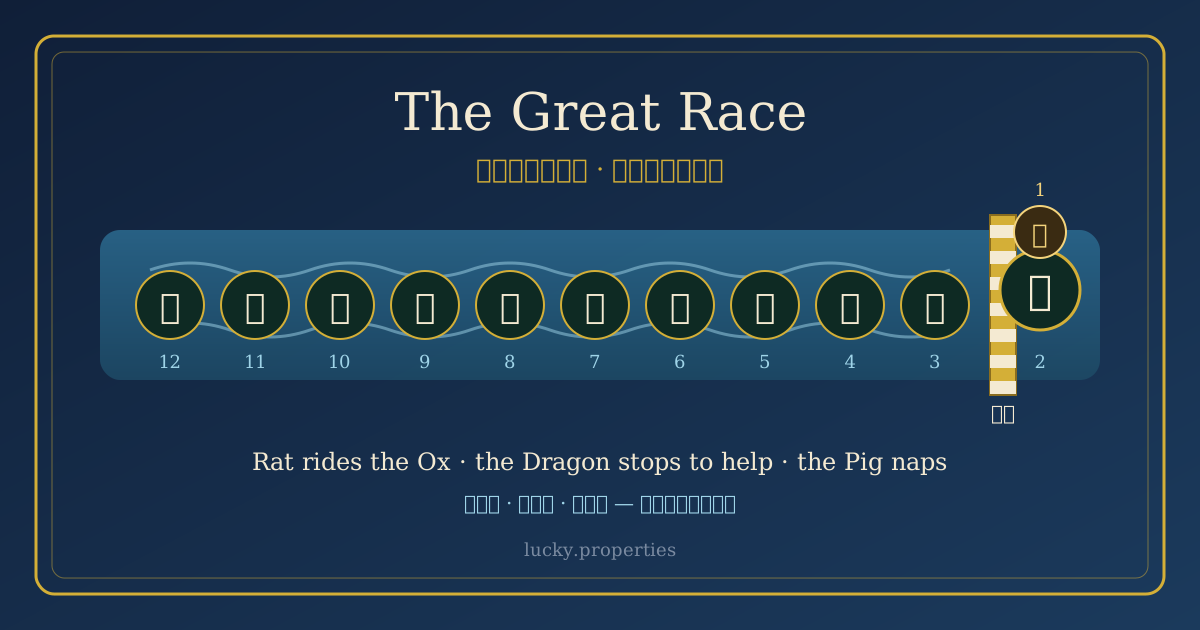
The legend literature adds a footnote rather than an answer. In the Chinese telling of the great race, the cat never reaches the finish at all: the rat fails to wake it, or betrays it, and the cat misses the twelve places entirely, which the story gives as the reason cats hunt rats. Vietnamese tellings of the race commonly let the cat swim and take the fourth place the rabbit holds in China. A story adjusted to fit a zodiac is evidence that the zodiac came first and the story followed, not the other way round. The site's race legend guide tells the Chinese version in full and notes the Vietnamese seat change; read the two pages together and the direction of travel, system first, story second, is hard to miss.
What can be said without theory is narrower and solid. The swap is old enough to be simply the tradition, not a modern novelty: Vietnamese sources treat the cat seat as the received form, and 2023 showed the custom in full public view, with cat statues and cat decorations across Vietnam for Tet while the rest of the region marked the Rabbit. Whatever its origin, the cat is not a mistake to be corrected against the Chinese chart. It is the Vietnamese form of the fourth seat.
Why a buffalo? The animal that was actually in the field
The second swap attracts less attention and needs less theory. The Chinese second seat is the Ox, the draft animal of North Chinese dry farming. The Vietnamese second seat is the water buffalo, trâu, the draft animal of the flooded rice paddy. Reference works phrase it with care: the Ox of the Chinese zodiac is usually considered to be a water buffalo in the Vietnamese zodiac. The branch is Chou, read Sửu in Vietnamese, and the seat's year, its order, and its pairings never changed. Only the pictured animal follows the local field.
The buffalo carries real weight in Vietnamese folk culture, heavier than a translation choice. It is the plough animal of the wet-rice lowlands, the large capital asset of a farming family, and a standing figure for patient strength. The character line in the table above, riches achieved through hard work, is the zodiac's own summary of that standing. Where the cat swap needs a linguistic or symbolic theory, the buffalo swap reads as direct substitution: a culture handed a seat labelled with a farm animal put its own farm animal in the seat. Readers of this site's Chinese material should picture the same adjustment they already make for the eighth seat, where Wei is a goat in some translations and a sheep in others, except that Vietnam's choice is fixed and universal rather than a translator's wobble.
The calendar underneath also splits: Tet, time zones, and the month of 1985
The animals are the visible difference. The calendar is the structural one, and it produces the strangest consequence in this whole subject.
Vietnam's lunisolar calendar, the âm lịch, descends from the Chinese calendar but has been computed by Vietnam's own court astronomers for most of its history; after independence from the third period of Chinese domination, Vietnamese dynasties appointed their own calendar offices and issued their own calendars on Chinese prototypes. The Gregorian calendar has been the official civil calendar since 1954, and the âm lịch survives for festivals and commemorations, Tet above all. Tet is generally celebrated on the same day as Chinese New Year, and generally is doing real work in that sentence.
A lunisolar calendar is read against a local standard time, and the two countries read against different ones. On August 8, 1967, North Vietnam moved its standard time from UTC+8 to UTC+7, with the South following in 1975. A new moon is a single instant worldwide; an instant near midnight lands on one calendar day in Hanoi and the next in Beijing. The first visible casualty was Tet itself: North and South Vietnam celebrated Tet 1968 on different days. Most years since, the calendars have agreed, and when they disagree it is by a day.
Then came the winter solstice of 1984. By Hanoi reckoning the solstice fell on December 21; by Beijing reckoning, December 22. The rule that the eleventh month of the lunisolar year must contain the winter solstice then sorted the months differently in the two calendars: the month running from November 23 to December 21 counted as the eleventh month in Vietnam, while in China the eleventh month was the one running from December 22 to January 20. Count forward from there and the new years land a month apart. Tet fell on January 21, 1985. Chinese New Year fell on February 20, 1985. A Vietnamese leap month inserted from March 21 to April 19, 1985 brought the two calendars back into step. The Vietnamese calendar entry on Wikipedia sets out the whole sequence, solstice dates included.
Now put a birth inside that gap, because this is where the zodiac stops being abstract. A child born in Hanoi on February 1, 1985 was born eleven days into the new Vietnamese year: a Buffalo, second seat, the year that follows the Rat year of 1984. A child born in Beijing on the same February 1 was born near the end of the Chinese Rat year, which had nineteen days left to run. Same birthday, same week, two zodiac animals, and both assignments correct under the calendar of the place. No other pair of zodiac systems produces this effect, because no other pair runs the same wheel on two separately computed calendars. The episode is also the cleanest proof that the animals ride on the calendar, not the other way round: change the calendar arithmetic and the animals move, even when nobody touches the wheel.
For ordinary years the practical residue is smaller. Tet and Chinese New Year share a date in most years, differ by a day in some, and a Vietnamese birth in late January or February is dated by Tet just as a Chinese birth is dated by Chinese New Year. Anyone with a January or February birthday who needs their animal for a chart should ask which new year their family's tradition counts from, the same advice this site gives for the Lunar New Year and Li Chun boundary inside the Chinese system.
The wider family: every region kept the wheel and changed something
Vietnam's two swaps look less unusual once the whole family is on the table. The twelve-branch wheel spread across East and Southeast Asia over centuries, and nearly every culture that received it adjusted the cast, the start date, or both. The variants below are summarised from the Chinese zodiac entry on Wikipedia, which collects them country by country.
| System | What changes against the Chinese wheel |
|---|---|
| Vietnamese | Water buffalo replaces the Ox at seat 2; Cat replaces the Rabbit at seat 4; year opens at Tet on Vietnam's own calendar |
| Japanese | Wild boar (inoshishi) replaces the Pig at seat 12; the eighth seat is read as a sheep; since 1873 the zodiac year has opened on January 1 |
| Korean | The twelve animals match China's; the eighth seat is read with the word for sheep (yang) rather than goat |
| Thai | A naga takes the Dragon seat; the year opens around Songkran in April, or at the first day of the fifth Thai lunar month, depending on the use |
| Cambodian | The Dragon can be read as the Neak, a sea serpent; sheep and goat are interchangeable at seat 8; the new year falls in April |
| Cham | The Monkey is replaced by a turtle; the order otherwise follows the Chinese wheel |
| Malay | The Rabbit is replaced by a mousedeer (pelanduk) and the Pig by a tortoise; the Dragon is equated with the naga and sometimes called the Big Snake |
Two patterns run through the table. First, the seats near the edges of local experience are the ones that move: pigs become boars where wild pigs outnumber farm pigs, rabbits become mousedeer or cats where a different small animal carries the local meaning, and the dragon, the one mythical seat, is the one most often re-imagined as a local water serpent. Second, the machinery never moves. Every system in the table keeps twelve seats, the same order, and a repeating cycle; Japan even kept the wheel while abandoning the lunar new year for it. Vietnam's version fits the family pattern exactly, and stands out only for changing two seats inside the East Asian core where its neighbours changed one or none. That is the accurate size of the claim: not a separate astrology, but the most locally edited edition of a shared one.
Working out your Vietnamese animal, in four steps
- Find the seat from the year. Use any Chinese zodiac chart, including this site's birth year chart, and find the seat your birth year occupies. Seats, stems, and elements transfer to the Vietnamese system unchanged.
- Swap the two labels. If the chart says Ox, the Vietnamese animal is the water buffalo. If it says Rabbit, the Vietnamese animal is the cat. Every other animal keeps its name.
- Check the new year boundary. Births in January or February belong to the previous seat if they fall before the new year. A Vietnamese reckoning uses the Tet date for the birth year; in most years it matches the Chinese New Year date on the chart, and in a split year like 1985 it does not, so a family record or an almanac for that year settles it.
- Keep the element. Read the element from the year stem exactly as the Chinese system does. A 2023 birth is a Water year in both systems: Water Rabbit in the Chinese naming, Water Cat in the Vietnamese. The ben ming nian guide applies unchanged too; a Vietnamese Cat meets a ben ming nian in every Cat year, 2023 most recently and 2035 next.
Limits, stated plainly
Everything in this guide is a description of a tradition, not a claim about what the tradition can do. The animal characters in the table, tranquil Cat, loyal Dog, inventive Monkey, are the tradition's own shorthand, repeated here so readers can recognise what a Vietnamese chart or Tet greeting means by them. No evidence shows a birth-year animal shaping a personality or a life, and this site does not present zodiac material as fact about the people born under it. Compatibility readings, lucky years, and ben ming nian cautions belong to the same frame: real as customs, practised by real families, and worth understanding on those terms.
The historical claims in this guide stand on a different footing, and they were checked against the sources linked in the text: the two animal swaps, the branch names, the sixty-year hồi, the 1967 time change, the split Tet of 1968, and the month-long split of 1985 with its solstice arithmetic. Where the record runs out, at the origin of the cat, the guide says so and labels the theories as theories. That line, verified where verification exists and openly uncertain where it does not, is the standard this site holds its zodiac pages to.