Two puzzles this guide settles
In January 2019, shops in Tokyo filled with wild boar figures, boar greeting cards, and boar shrine charms, while most English-language coverage of the season announced a Year of the Pig. Both reports were describing the same twelfth seat of the same zodiac wheel. The difference was the country doing the naming. Japan reads that seat as a boar.
The second puzzle is a birthday. A person born on January 20, 1999 who looks their sign up on a Japanese site is told Rabbit. A Chinese chart gives Tiger, with a note that the Rabbit year did not begin until February 16. Neither site has made an arithmetic error. Japan has started its zodiac year on January 1 since 1873, and China starts its year at Lunar New Year, so for the first weeks of most years the two countries are running different animals at the same time.
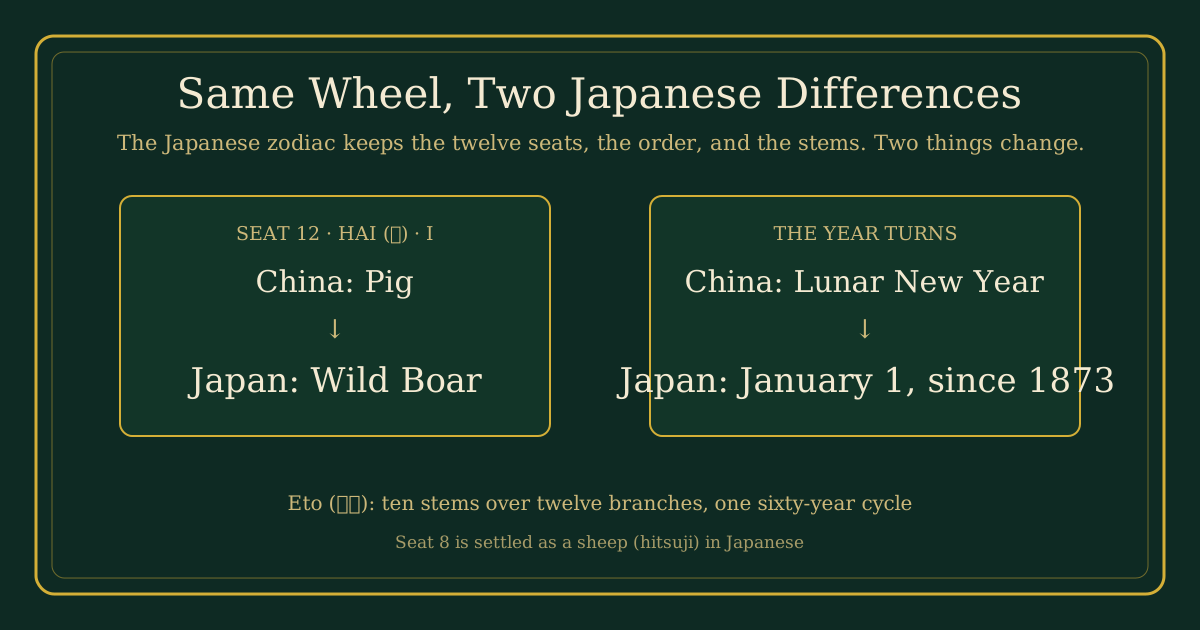
This site has a sibling guide for the Vietnamese zodiac, which changes two animals on the same wheel. Japan changes the picture at two seats as well, a boar at seat 12 and a settled sheep at seat 8, but its deepest edit is not an animal at all. It is the date the year turns. This guide works through the animals first, then the 1873 calendar decision that moved the turn, then the boundary births the decision creates, with the dates printed so any reader can check a January or February birthday against them.
The twelve seats, with their Japanese names
The system reached Japan from China, and Japanese references are frank that the exact arrival date is not recorded; it is generally placed before the Nara period (710-784). What arrived was not a set of mascots. It was a counting system: twelve divisions of the year, the month cycle, the day, and the compass, each division named with a branch character and later pictured by an animal so the order was easy to carry in memory.
In Japanese the twelve branches are the junishi. Each branch has a Chinese-derived reading and a plain animal name, and Japanese schoolchildren have traditionally memorised the order by chaining the first sounds: ne, ushi, tora, u, tatsu, mi, uma, hitsuji, saru, tori, inu, i.
| Seat | Branch | Chinese animal | Japanese animal | Japanese name (animal word) | A recent year |
|---|---|---|---|---|---|
| 1 | Zi (子) | Rat | Rat | Nezumi | 2020 |
| 2 | Chou (丑) | Ox | Ox | Ushi | 2021 |
| 3 | Yin (寅) | Tiger | Tiger | Tora | 2022 |
| 4 | Mao (卯) | Rabbit | Rabbit | Usagi | 2023 |
| 5 | Chen (辰) | Dragon | Dragon | Tatsu | 2024 |
| 6 | Si (巳) | Snake | Snake | Hebi | 2025 |
| 7 | Wu (午) | Horse | Horse | Uma | 2026 |
| 8 | Wei (未) | Goat | Sheep | Hitsuji | 2027 |
| 9 | Shen (申) | Monkey | Monkey | Saru | 2028 |
| 10 | You (酉) | Rooster | Rooster | Tori | 2029 |
| 11 | Xu (戌) | Dog | Dog | Inu | 2030 |
| 12 | Hai (亥) | Pig | Wild boar | Inoshishi | 2031 |
The branch characters and the order match the Chinese wheel exactly, which this site's birth year chart prints year by year. Read the Japanese table against it and only two rows move, seats 8 and 12, and in both rows only the pictured animal moves. The branch, the seat, the year, and the stem paired with the year all stay put. That pattern, inherited machinery with a locally cast figure in a seat or two, is the same one the Vietnamese wheel shows, and it is the normal way this system travelled.
One row needs a dating note before it causes an argument. The years column in this table is written in the Japanese count, where the animal of a year runs from January 1 to December 31. The 1999 example in the next sections shows why that note matters: a year label on a Japanese chart and the same label on a Chinese chart cover slightly different spans of days at the edges.
Seat 12: the boar, and seat 8: the sheep
Japanese guides state the twelfth-seat swap without ceremony. In the Chinese zodiac the twelfth animal is the pig; in the Japanese zodiac that place is taken by a wild boar, inoshishi. The Japanese American National Museum, writing up its 2019 New Year festival, put it in one line: in the Japanese cycle of zodiac signs, 2019 is the year of the boar, and it listed the boar years behind it, 1935, 1947, 1959, 1971, 1983, 1995, and 2007. The branch under the animal never changed. Hai is Hai in both countries. What differs is the animal a culture pictures when it fills the seat, a farm pig in the Chinese naming and the wild pig of the Japanese hills in the Japanese one.
The eighth seat is a quieter case, and it is a translation settled rather than an animal swapped. The Chinese branch name for the seat, Wei, carries the character for the yang animal, a word that covers goat, sheep, and ram without choosing. Chinese-English sources choose differently from book to book, which is why one chart prints Goat and the next prints Sheep for the same year. Japanese removes the wobble: the seat is read hitsuji, and hitsuji is specifically a sheep. A Japanese guide puts it this way: the eighth animal is more definitively known to be a sheep in Japan, rather than the ambiguous ram or goat of the Chinese naming. So the Fire year that opens in China on February 6, 2027 is a Goat year in one English rendering, a Sheep year in another, and simply the hitsuji year in Japan, where no choice had to be made.
Neither difference changes a chart. A reader born in 2019 is Hai in any system in the family; a reader born in the Wei year is Wei. The animals are the seats' public faces, and Japan's two faces differ from China's at exactly the seats where the local language or the local countryside gave a different picture.
Advertisement
1873: the year Japan moved its New Year
The animal differences are visible. The calendar difference is structural, and it starts with a government decision that had nothing to do with astrology.
For most of its history Japan kept a lunisolar calendar of the Chinese family, revised at home over the centuries; the National Diet Library's calendar history traces the line of Japanese revisions from the Senmyo calendar imported in 862 through the Jokyo, Horeki, Kansei, and Tenpo calendars of the Edo period. New Year in that system fell where Lunar New Year falls, in late January or February.
The Meiji government, set on modernising the country's institutions, replaced the old lunar calendar with the Gregorian calendar in November 1872, the change to take effect the following year. The library records the human consequence in one sentence: there was little time for preparation, and December 3 of the fifth year of Meiji became January 1 of the sixth year. A country that had expected several more weeks of the old year woke up in a new one.
The zodiac went where the calendar went. With New Year fixed at January 1, the animal of the year stopped waiting for the lunar festival and started turning with the civil year. Japanese sources on the zodiac state the result as a flat rule: unlike the Chinese zodiac, in the Japanese the animal of the year changes on January 1. Japan is, as the museum's festival write-up notes, the only country in the region that celebrates the new year on January 1 in the Western manner, and it has done so since 1873.
Two systems that share a wheel now disagree for a few weeks every year, and the disagreement lands on real birthdays. The next section prices it with dates.
Boundary births: one birthday, two animals, both correct
The rule is simple to state. A Japanese zodiac year runs January 1 to December 31. A Chinese zodiac year, in the festival counting used on public charts, runs from one Lunar New Year to the next, and Lunar New Year falls between January 21 and February 20. Any birth between January 1 and that year's Lunar New Year therefore takes the new animal in the Japanese count and the old animal in the Chinese count.
Three worked cases, with the dates this site has already verified in its own guides and in the standard sexagenary table:
| Birth | Japanese count | Chinese festival count | Why |
|---|---|---|---|
| January 20, 1999 | Rabbit | Tiger (Earth) | Japan opened the Rabbit year on January 1, 1999. The Chinese Rabbit year opened on February 16, 1999, so the birth falls inside the Tiger year that ran January 28, 1998 to February 15, 1999. |
| February 10, 2026 | Horse | Snake | Japan opened the Horse year on January 1, 2026. Chinese festival counting opened the Fire Horse year at Lunar New Year on February 17, 2026. |
| January 20, 2027 | Sheep | Horse | Japan opens the Sheep year on January 1, 2027. The Chinese Fire Goat year opens at Lunar New Year on February 6, 2027. |
The 1999 case answers a question this site's search data shows readers asking in almost these words: what element is the 1999 Chinese zodiac? Once the Rabbit year has begun in either count, the answer is Earth. The year pairs the stem Ji with the branch Mao, and Ji is an Earth stem, so 1999 is an Earth Rabbit year, and the Rabbit sign page and the elements guide read it that way. The boundary case is the only trap: a January 1999 birth counted the Chinese way is not an Earth Rabbit at all but an Earth Tiger, because the Tiger year it belongs to, 1998, also carries an Earth stem. Two Earth years sit side by side across that boundary, which is why sloppy charts that print only a year and an element can look right while naming the wrong animal.
A second boundary lives inside the Chinese system itself, between Lunar New Year and Li Chun, the solar term around February 4 that BaZi chart work uses to turn the year. This site's birth year chart and BaZi guide work that split in full. Japan's January 1 rule adds a third date to the same crowded fortnight. A birth in early February can now collect three different answers from three competent counters, each applying a stated rule: Japanese civil counting, Chinese festival counting, and Chinese chart counting. The practical fix is the one this site gives everywhere: name the system next to the sign, and keep the birth date, the new year date for that system, and the animal together as one record.
Eto is bigger than the animals: stems, branches, and the 60th birthday
English writing about Japan usually uses the word eto to mean the twelve animals, and in daily modern use that is mostly what it means. The word itself covers more. Eto is written with the characters for the ten heavenly stems and the twelve earthly branches, and in its full sense it names the whole paired count: ten stems (jikkan in Japanese) advancing over twelve branches, producing sixty distinct stem-branch pairs before the sequence repeats. The twelve animals are the branch layer of that machine, pictured. The sixty-year cycle this site describes for China as the Jiazi cycle is the same machine in Japan, pair for pair. The Horse year that Japan is marking in 2026, for example, is the pair Hinoe-uma, stem Bing over branch Wu, a Fire Horse pairing in both countries, whatever date each one started it on.
The cycle has a personal milestone attached to its full turn. Kanreki, the 60th birthday, joins the character for return with the character for calendar: at sixty, the stem-branch pair of your birth year comes round again and the count returns to its start. Japanese tradition treats the day as a longevity celebration and a kind of rebirth, the cycle completed and beginning over. The arithmetic is plain enough to check against the table above. A person born in 1966 was born in a Fire Horse year, Hinoe-uma. Sixty years later, 2026 is Hinoe-uma again, the same stem over the same branch, and a Japanese family marking a 60th birthday in 2026 is marking exactly that return. The ben ming nian guide on this site covers the Chinese custom for the smaller twelve-year returns of your own sign; kanreki is the sixty-year return of the full pairing, sign and stem together.
People whose own animal is the animal of the current year get a name of their own in Japan as well: toshi-otoko for a man, toshi-onna for a woman, the man or woman of the year. Tradition treats their year as a special one, a time for a fresh start and for care against misfortune, and shrines and families mark it accordingly. It is the Japanese cousin of the ben ming nian idea, stated more lightly: the Chinese custom wraps the year in cautions and red clothing, the Japanese one in a title and a shrine visit. Both are customs, reported here as customs.
The greeting story, and the cat that missed it twice
Every zodiac culture keeps a story that fixes the animal order, and Japan's version differs from China's in a way that fits its calendar. In the Chinese telling, retold in full in this site's race legend guide, the animals race across a river to the Jade Emperor. In the Japanese telling, the frame is a New Year audience: the gods announced that the first twelve animals to arrive and offer New Year greetings would be given the places in the calendar.
The cat fails in both countries, by the rat's hand in both. In the Japanese versions, the rat either gave the cat the wrong date, so the cat arrived a day late and found the twelve places filled, or promised to wake the cat and did not. The rat itself reached the audience by riding on the ox, who had set out earliest because he was slowest, and jumping down at the last moment to arrive first. The boar, last of all, dashed in at the end to take the twelfth place, which the story gives as the reason the boar sits at the end of the wheel. Japanese tellings even keep the moral the Chinese story draws: cats chase rats to this day because of the trick.
Read the two stories side by side and the direction of travel is the same one the Vietnamese guide found. The wheel came first, as a counting system with branch names and no animals required. The stories were fitted to the finished wheel afterwards, each culture restaging the same plot, a contest, a trick, a fixed order, in its own setting: a river race in China, a New Year greeting in the country that had made New Year its zodiac hinge.
Where eto sits in Japanese life now
Ask where the system actually appears in modern Japan and the answer is: at New Year, on paper, and inside the language itself.
New Year cards. The nengajo, the New Year postcard, is the zodiac's largest public stage. Families and firms send cards timed to arrive on January 1, the post office runs a special delivery operation for them, and the standard design on a preprinted card is the zodiac animal of the coming year. A household in mourning for a death during the year sends a plain mourning card instead and asks friends not to send greetings, which is its own part of the custom. Through the card trade, the animal of the year reaches people who never consult a chart.
Shrine visits and printed fortunes. Hatsumode, the first shrine visit of the year, surrounds the same animal with objects: shrine decorations and wooden ema plaques carry it, limited-edition omikuji fortune slips are printed with it, and the red shrine stamps called goshuin get special versions for the season. Some shrines keep a permanent tie to one animal; Japanese zodiac guides point visitors to Hakuto Shrine in Tottori for the rabbit and to Go Shrine in Kyoto for the boar. Figurines of the year's animal, clay bells and carvings among them, are sold and displayed as seasonal ornaments in the same weeks.
Fossils in the clock and the compass. The branches once divided the day into twelve double hours and the compass into twelve directions, and the language kept the receipts. Rat, branch Zi, stood due north and Horse, branch Wu, due south; the line joining them, the Zi-Wu line, is the origin of the Japanese word for a meridian, shigosen. The Horse double hour ran across the middle of the day, so its centre is shogo, noon; the hours before it are gozen, the a.m., and the hours after it gogo, the p.m. A Japanese speaker uses the Horse branch every day without picturing a horse. The full direction and hour table behind those survivals matches the one this site prints for the birth hour animals, since the two systems share the branch clock.
None of this requires a belief claim. The cards, the shrine goods, and the vocabulary are observable facts of Japanese life, and they are the reason the zodiac in Japan reads as a calendar custom first and a fortune-telling system second, where in China the balance between the two is closer.
Working out a Japanese animal, in four steps
- Start from any twelve-year chart. Use a known anchor year and count in twelves. 2020 was a Rat year in both countries; stepping forward gives Ox 2021, Tiger 2022, Rabbit 2023, and so on to Boar 2031. This site's birth year chart lists the years in full.
- Translate the two seats. If the chart's animal is the Pig, the Japanese animal is the wild boar. If it is the Goat, the Japanese animal is the sheep. Every other animal keeps its name in both systems.
- Apply the January 1 boundary. For a Japanese reading, the animal changes on January 1 of the year. A birth on January 15 takes the new year's animal in Japan. Before reporting a Chinese reading for the same birth, check the Lunar New Year date for that year; if the birthday falls before it, the Chinese festival animal is the previous year's.
- Add the element from the stem, with its boundary attached. The element follows the year's stem in both countries, by the last-digit rule set out in the elements guide: 1999 is Ji Mao, Earth Rabbit, once the year has turned. State which new year date you turned it on, January 1 or Lunar New Year, whenever a January or February birthday is involved.
Limits, stated plainly
This guide describes a tradition and a calendar history. The calendar history is checkable and was checked for this page: the branch order and characters, the boar and sheep readings, the Gregorian reform of 1872 that took effect in 1873 and the December 3 to January 1 jump the National Diet Library records, the 1999 and 2026 boundary dates, and the stem-branch pairings behind kanreki all come from the sources named in the text.
The tradition layer is reported as tradition. When Japanese custom calls the boar sincere or treats a toshi-onna's year as one for a fresh start, those are the system's own readings of itself, repeated so a reader can recognise what a card, a charm, or a chart means by them. No controlled evidence shows a birth-year animal shaping a personality or a life, in Japan or anywhere else, and this site does not present zodiac material as fact about the people born under it. What can be gotten right, and what this guide has tried to get right, is the reckoning itself: the right animal, under the right system, from the right new year date.