Every cubic metre of air your furnace heats or your air conditioner cools passes through one cheap panel of pleated paper. When that panel clogs, the blower works harder, rooms drift off temperature, and the equipment that costs thousands is protected by the part that costs less than lunch. Changing it is a ten-minute job. Getting the details right, size, direction, rating, and schedule, is what separates maintenance from superstition.
Step 1: power down and pull the old filter
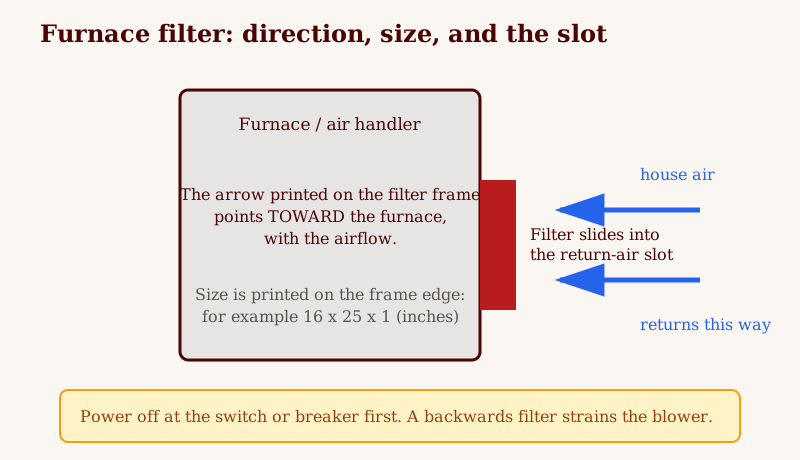
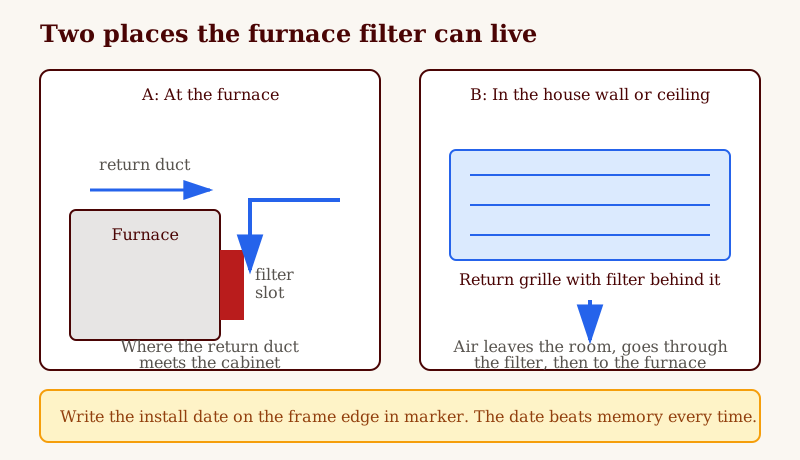
Switch the furnace off at its service switch (usually on or near the unit) or the breaker. The filter lives in a slot where the return duct meets the furnace, behind a panel or a simple cover, or occasionally in a return grille inside the house. Slide the old filter out slowly. It comes out loaded, so bag it where it stands rather than carrying it through the house.
Before it goes in the bag, read it. Everything you need is printed on the frame edge.
The fiddly part here is feel, not tools. The old filter should slide out with a light pull. If you have to force it, stop and look. A filter wedged in tight usually means the wrong thickness was jammed in last time, or the frame is bowed. Forcing it tears the media and dumps a season of dust into the duct you just tried to protect. Wiggle it side to side, keep it level, and let it come at its own pace. What done looks like: the slot is empty, the rails are clean enough to run a finger along, and the old filter comes out in one piece.
Step 2: read the size, write the date
The frame carries three numbers, length x width x thickness in inches, such as 16x25x1. That is the nominal size to buy. Also note the airflow arrow on the frame; take a phone photo of the old filter installed, arrow visible, and you will never guess at direction again.
Write the install date on the new filter's frame in marker. Memory is a terrible maintenance log; the date on the frame is a perfect one.
Advertisement
Step 3: pick a rating without the upsell
MERV (Minimum Efficiency Reporting Value) rates how fine a particle the filter catches.
- MERV 6 to 8: the basic fibreglass or pleated panel. Fine for protecting equipment, modest for air cleaning.
- MERV 9 to 11: the sweet spot for most homes. Real pollen and mould capture with airflow most blowers handle easily.
- MERV 13+: hospital-adjacent filtration that many residential blowers, especially older ones, cannot push air through comfortably. Higher is not automatically better; it is a trade against airflow, and the furnace manual is the authority.
Allergy households get more from a MERV 11 changed on time than from a MERV 13 suffocating the blower.
Step 4: install with the airflow
Slide the new filter in with the frame arrow pointing toward the furnace, following the airflow from house to blower. Seat it fully so no edge gap lets air bypass. The new filter should glide in. If you feel strong resistance halfway, pull it back out and check for a bent frame or a rail full of grit. Pushing harder is how frames fold and edges gap open.
Replace the cover, restore power, and let the system run a cycle. Stand at a supply vent: airflow should feel at least as strong as before. Give it a full five minutes. A system with a variable-speed blower ramps up slowly, and judging it in the first thirty seconds gives you the wrong answer. What done feels like: steady air at the vents, no whistle at the filter slot, no rattle from a loose cover. A whistle almost always means an edge gap. Reseat the filter and press the cover home before you blame the rating.
If airflow drops after the new filter
This is the most common callback on this job, and it usually has a boring cause.
- Arrow backward. Pull the filter and look. On a pleated filter installed backward, the mesh support sits downstream and the media can bow toward the blower. It happens constantly because the arrow is small and the slot is dark. Use the phone photo you took of the old filter.
- Rating jumped too far. A move from MERV 8 to MERV 13 doubles or triples the resistance on some systems. Older blowers with a fixed-speed motor cannot make up the difference. Drop back to MERV 11, or keep the higher rating and go thicker if your slot allows it. A 4-inch MERV 13 often flows better than a 1-inch MERV 13 because it has far more pleat area.
- Filter still wrapped. It sounds too simple to list, and it accounts for a real share of weak-air calls. The plastic film has to come off before the filter goes in.
- The old problem was never the filter. If airflow is weak with the slot empty, look past the filter: supply vents closed or blocked by rugs, a return grille painted shut, a duct disconnected in the attic. The filter change just made you pay attention at the right moment.
Wait a full heating or cooling cycle before you decide. Rooms take time to come back, and a system that short-cycles needs ten minutes to reveal it.
Common mistakes
- Buying by the box photo instead of the frame numbers. Nominal and actual sizes differ by up to half an inch between brands. Carry the old frame to the store the first time, or measure the slot itself: length, width, and the depth the rails will accept.
- Skipping the date. An undated filter becomes a guessing game by month three. Write the month and year on the frame edge that faces you when the cover comes off.
- Double-filtering. A filter at the furnace and another at the return grille sounds thorough. In practice it stacks resistance and starves the blower. Pick one location, the one the system was built with.
- Letting the schedule ride on the season. Dust load follows life, not the calendar. A new dog, a kitchen renovation two rooms away, or a smoky August can load a filter in weeks. The monthly glance costs nothing. Hold the filter up to a light: if you cannot see light through the pleats, its time is up regardless of the date.
A schedule that matches your house
The box says 90 days because the box cannot see your house. Use this instead:
- 1-inch filter, no pets: check at 60 days, change by 90.
- 1-inch filter, pets or dusty street: check monthly, change at 30 to 60 days.
- 4 or 5-inch media filter: 6 to 12 months, checked at the season change.
- After any renovation, wildfire smoke week, or the gutter-and-roof debris season, check immediately. A filter can load in a week of drywall dust.
Set the schedule beside the other standing jobs: weatherstripping before winter, a thermostat you trust, and the water checks. Done together twice a year, spring and fall, this is how a house gets maintained instead of repaired. Call an HVAC tech when the blower is noisy, the furnace short-cycles with a clean filter, or you see ice on the refrigerant line; those are diagnoses, not maintenance.