The short version
Short answer: Lucky colors are where a culture writes its hopes in visible form. China writes prosperity in red and gold; the West writes purity in white and money in green; feng shui writes balance in five element colours matched to rooms. Every system in this guide is real as tradition and as colour psychology (colour genuinely shifts mood and perception), and none of them is a mechanism that bends luck, which is the distinction this guide keeps throughout. This hub maps the world table, then routes you to the three working systems our cluster guides cover in detail: lucky colors by zodiac sign, Chinese zodiac lucky colors, and feng shui colors by room, with features on red in Chinese culture and front door colors by direction.
The world table
| Color | Where it is lucky | What it carries there | Everyday sign |
|---|---|---|---|
| Red | China and much of East and Southeast Asia; broadly festive in the West | Joy, fortune, protection, celebration | Red envelopes, wedding red, New Year everything, sale signs |
| Gold | Nearly worldwide, strongest in Chinese and Indian tradition | Wealth, honour, the divine | Gold jewellery at weddings, gold accents in temples and homes |
| Green | US (money), Islamic tradition, feng shui wood element | Growth, renewal, prosperity | Dollar-green, spring greens in interiors, green in flags and dress |
| Yellow | China (imperial and earth), India (knowledge and harvest festivals) | Royalty and centrality historically; learning, spring | Imperial yellow in the Forbidden City, turmeric and marigold yellow in India |
| White | The West (purity, weddings); mourning in parts of East and South Asia | Purity and beginnings here; grief and funerals there | White wedding dresses, white mourning dress, white flags of truce |
| Purple | Historically royal in the West and auspicious in parts of Asia | Rank, rarity (the dye was once worth more than gold), spirituality | Royal purple, purple in Japanese rank symbolism |
| Blue | Protective in Mediterranean and Middle Eastern tradition (the evil-eye bead) | Protection, calm, trust | Blue doors and beads from Greece to Turkey, blue corporate trust marks everywhere |
Two lessons hide in the table. First, the same wavelength flips meaning across borders: white marries brides in Chicago and mourns grandmothers in Chengdu, and both are coherent. Second, the strongest lucky colours are almost always the expensive ones in their era: imperial yellow and royal purple were sumptuary colours, gold is literally wealth made visible, and red dyes saturated enough to read as festive were costly before synthetics. Luck follows value and scarcity more often than romantics admit.
Advertisement
System one: the zodiac (Western astrology)
Western astrology colours you by sign and ruling planet: fire signs in reds and oranges, earth signs in greens and browns, air signs in yellows and sky tones, water signs in blues and sea greens, with per-sign refinements (Mars-red for Aries, Venus-copper for Taurus, and so on). The tradition is ancient in root and magazine-polished in its modern form. If you want your sign's palette and how people actually use it (wardrobe, interview day, the exam pen), the cluster guide gives the full twelve-sign table with the reasoning shown, so you can bend it intelligently rather than obey it blindly: lucky colors by zodiac sign.
System two: the Chinese zodiac animals
Chinese tradition assigns each of the twelve animal years its own lucky colours, numbers, and flowers, and the lists are consulted for everything from wedding palettes to business launches in animal years. Dragon years are given gold, silver, and grey-white; Rat years blue, gold, and green; and each animal carries a small kit of this kind. These associations layer over the deeper five-element system (each animal also cycles through wood, fire, earth, metal, and water years), which our Chinese zodiac colors guide lays out with a twelve-animal table and the calendar years to find yours. If you do not know your animal, the site's find my sign tool will tell you in seconds.
System three: feng shui and the five elements
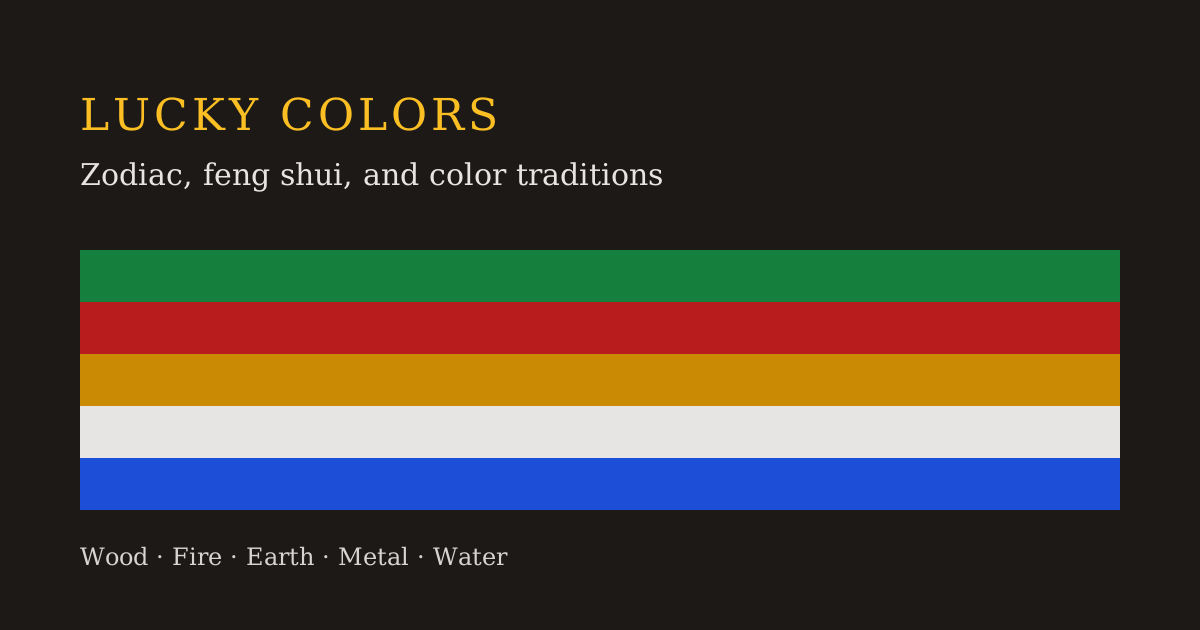
Feng shui colours a room the way a doctor doses: by what the space needs. The five elements each own a colour family and a set of rooms and intentions: wood's greens for growth and family areas, fire's reds for energy and recognition, earth's yellows and terracottas for stability, metal's whites and greys for clarity, water's blues and black for calm and career. The five elements guide teaches the generating cycle underneath, and the cluster guide applies it room by room with paint-level specificity, cross-linked to our bagua room-by-room guide: feng shui colors by room.
The special case of the front door
One surface in a home carries more colour symbolism than all others combined: the front door, the mouth of the house in feng shui and the handshake of the house everywhere else. Traditions assign door colours by compass direction (fire-red for south-facing doors, water-blue or black for north, and so on) and by intention, while the West adds its own folklore (red doors of welcome and, in one persistent Scottish and American tale, a mortgage paid off). The cluster guide separates sourced tradition from the mortgage myth: front door colors by direction. It pairs naturally with our compass reading guide, since you need to know which way your door faces before any direction-based tradition can speak.
Using lucky colors like an adult
- Pick a system and let it be local. Zodiac for personal flair, Chinese animal colours for the year you are in, feng shui for rooms. Mixing all three on one wall creates noise, not luck.
- Spend psychology, not superstition. A colour that lifts your mood every morning is doing documented work. That is the benefit to buy; the fortune is a story you are allowed to enjoy alongside it.
- Mind the border crossings. White at a Chinese wedding, red at a Western memorial, green hats in China (an idiom landmine our red guide touches on): colour etiquette is real even where colour luck is folklore. Courtesy is the grown-up form of the whole topic.
- Let the palette pass the daylight test. Tradition should nominate candidates, but your light, your rooms, and your eyes hold veto. A lucky colour you dislike is a daily tax; a colour you love in a tradition you respect is the entire point.
The neighbours in this wing of the site: the lucky numbers hub covers the digits that pair with these colours on every plate and envelope in the lucky economy, and the angel numbers guide handles the other great modern system of meaningful patterns.
Which system should you use? A short decision guide
Readers arrive with three different questions, and each has a correct tool in this pillar. If the question is personal flair (what should I wear, gift, or carry into a big day), use your Western zodiac palette from the sign chart, tie-broken by your Chinese animal colours when the occasion is a Chinese festival or family table. If the question is calendrical (this year's outfit, this year's opening), the animal of the year and your own animal take the lead, with red as the presiding celebrant. If the question is a room, forget birthdays entirely: the feng shui element system reads the space, its direction, and its job, and your personal colours re-enter as art and textiles. Most colour regret comes from asking one system to do another's work: zodiac-painted nurseries that fight the light, feng shui whites at a Lunar New Year dinner. Match tool to question and the traditions stop contradicting each other, because they were never answering the same thing.
Colour at work: the respectable modern use
The one arena where lucky colour operates with a straight face in contemporary life is presentation. Interview and negotiation dressing borrows sign and element palettes as confidence technology: the Taurus green tie, the Leo gold detail, the water-blue that calms a tense room on purpose. Brand designers make the same calls at scale (green for growth and money in the West, red and gold where Chinese consumers are courted, blue wherever trust is the product), and the research language for it is colour psychology rather than luck. Our position, stated once for the whole pillar: use the traditions as a styling library with meanings you can say out loud, and let the psychology do the lifting. A colour you chose on purpose, for reasons you can explain, walks into the room differently than a colour that happened to you, and rooms notice.
Maintaining a palette: the seasonal reset
Palettes, like gardens, drift. The tradition's calendar hands you four natural reset points (New Year for the animal palette, the equinoxes and solstices for the room), and a five-minute audit at each keeps a lucky-colour practice from fossilising into decor superstition. Ask three questions. What has faded, literally: cushions and throws bleach toward their element's tired cousin, and a washed-out fire red reads as exhausted earth. What has been outgrown: the interview palette of three jobs ago, the child's room painted for a toddler now sitting exams. What wants promoting: the accent that kept earning compliments all season is telling you your season's element. Adjust in textiles first, paint last, and write the changes into the same notebook as the sightings and the compass readings. A household that treats colour as a maintained practice, revised on schedule, gets the tradition's actual promise: not luck delivered, but an environment that keeps being chosen on purpose.