Short Answer: In Period 9 (2024–2043), governed by the Li Trigram (Fire element), spatial harmony extends beyond visual aesthetics into acoustic dynamics. Fire energy represents visibility, light, and rapid vibration; excessive acoustic noise or reverberation amplifies erratic Fire energy, leading to stress and anxiety. Balancing room acoustics with sound-dampening natural materials (Wood & Earth elements) stabilizes Chi circulation in modern residential architecture.
By the Lucky Properties Editorial Team | September 25, 2026
1. The Acoustic Dimension of Chi in Period 9
Traditional Feng Shui focuses on visual orientation, door alignment, and furniture layout. However, in classical Chinese metaphysics, Sheng Chi (generative energy) moves like a wave - identical to sound waves moving through physical air.
The Li Fire Trigram and Sonic Vibration
The Period 9 Li Trigram corresponds to high frequency, illumination, and mental clarity. When a home suffers from poor acoustics - hard tile floors, bare glass walls, and echoey open-concept layouts - sound waves bounce continuously. In Feng Shui terms, this converts calm Sheng Chi into turbulent Sha Chi (cutting energy), causing physiological nervous system arousal.
2. Five-Element Acoustic Balancing Matrix
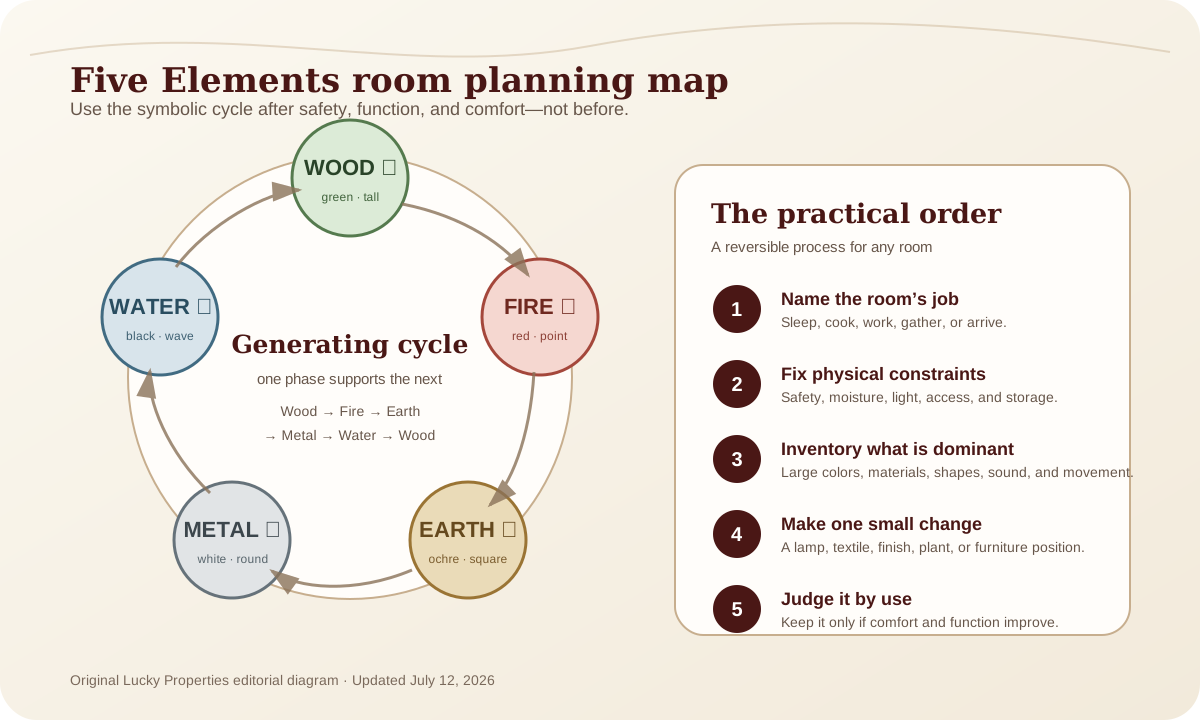
To harmonize acoustic energy, apply the Five-Element Generating and Controlling Cycles:
| Element | Material Expression | Acoustic Function | Feng Shui Effect |
|---|---|---|---|
| Wood | Wool acoustic panels, slatted oak timber | Absorbs high-frequency flutter echoes | Feeds Fire smoothly; promotes steady growth |
| Earth | Clay plaster walls, heavy wool rugs, linen drapes | Dampens mid-frequency reverberation | Absorbs excess Fire energy; Grounds occupants |
| Metal | Brass singing bowls, chiming clocks | Introduces crisp, focused sonic cues | Clears stagnant energy in South sectors |
| Water | Indoor water walls, low-frequency hums | Suppresses harsh ambient noise | Controls excess Fire; restores emotional calm |
| Fire | Ambient lighting, warm acoustics | Creates invigorating atmosphere | Activates intelligence and reputation sectors |
Advertisement
3. Sector-Specific Acoustic Remedies for 2026
The South Sector (Li Trigram Hub)
- Goal: Maintain soft, clear acoustic clarity without harsh echoes.
- Remedy: Install natural wood slat wall panels backed with recycled acoustic felt behind home office seating or media displays.
The Northwest Sector (Qian Metal / Patriarch Sector)
- Goal: Ground authority and financial stability.
- Remedy: Place heavy hand-tufted wool carpets to eliminate low-frequency footstep thudding.
4. Architectural Checklist for 2026 Residential Design
- Calculate Reverberation Time (RT60): Target an RT60 of 0.4 to 0.6 seconds in main living and working zones.
- Layer Soft Textures in Open Layouts: Combine floor-to-ceiling linen curtains with acoustic plaster on ceilings to dampen reverberation.
- Incorporate Natural Water Acoustics: A continuous, non-splashing water fountain in the East or Southeast activates wealth Chi while masking urban traffic noise.
5. A Room-by-Room Acoustic Pass You Can Do This Weekend
You do not need instruments to find the worst echo in a home. Stand in the middle of the room, clap once, and listen for a fluttering tail. A short, dry clap means the room already absorbs sound well. A ringing, metallic tail means hard surfaces are bouncing your voice back at you, and everyday sounds like a television, a kettle, or a video call will feel harsher in that room than the volume alone explains.
Start with the largest soft surface you can add. A rug under a seating group, curtains that close over a glass wall, or a bookshelf filled along a bare wall all break up flat reflections. Books, upholstered chairs, and fabric lampshades count too; the goal is to give sound somewhere to be absorbed instead of bouncing between tile, drywall, and glass. In an open-concept space, treat each activity zone as its own acoustic room: a rug defines the conversation area, a curtain or screen can soften the dining corner, and shelving on the wall behind a desk calms a work call.
Work one zone at a time and re-clap after each change. Small, layered additions usually beat one dramatic treatment, and they keep the room looking like a home rather than a studio. If two hard surfaces face each other, such as a glass wall opposite a tiled kitchen front, softening just one of them often removes most of the flutter. The Five Elements balancing guide explains how wood, earth, metal, water, and fire materials are traditionally grouped, if you want the symbolism behind the material choices above.
6. What Acoustic Work Can and Cannot Do
Softer acoustics can make a room feel calmer, make speech easier to follow, and reduce the low-grade fatigue of living with constant echo. That is a comfort and usability improvement, and it is reason enough to do it. It does not, by itself, change income, health, or relationship outcomes, and no panel or fountain should be sold to you as a guarantee of any of those things.
On this site, Feng Shui language is an interpretive tradition used to organise design choices, not a measurement system. Use it to decide where a rug or a curtain might help, then judge the result with your own ears. If a quiet room is the actual goal, the Bagua map floor plan guide can help you read the room as a whole before you move furniture, and a local acoustic professional can measure reverberation properly where a home theatre or studio needs precision.
Frequently Asked Questions
Do I need acoustic panels, or are normal furnishings enough? For most living rooms and bedrooms, normal furnishings are enough. Rugs, curtains, bookshelves, and upholstered furniture absorb the reflections that make a room feel harsh. Save purpose-built panels for media rooms, studios, or a home office where call quality matters every day.
Which room should I treat first? Start with the room where people talk the most and stay the longest, usually the main living area or the room used for work calls. Echo is most tiring where voices carry all day, and that is also where one rug or one set of curtains makes the biggest audible difference.
Does the South sector rule apply to every home? The sector notes above follow one traditional mapping used on this site. Homes differ in orientation and layout, and schools of Feng Shui differ too. Treat the sector as a prompt to check the acoustics of that area, not as a rule that overrides how the room is actually used.
Can a water feature replace soft furnishings? No. A gentle water sound can mask steady background noise, such as traffic, but it does not absorb echo. Use it alongside soft surfaces, keep the sound low, and place it where splashing and humidity will not damage floors, wiring, or nearby furniture.
How do I know the changes worked? Repeat the clap test in the same spot, then hold a normal conversation and make a call in the room. If voices sound clearer at the same volume and the ringing tail is gone, the room is doing its job. A phone recording made before and after, from the same chair, is a fair home comparison.