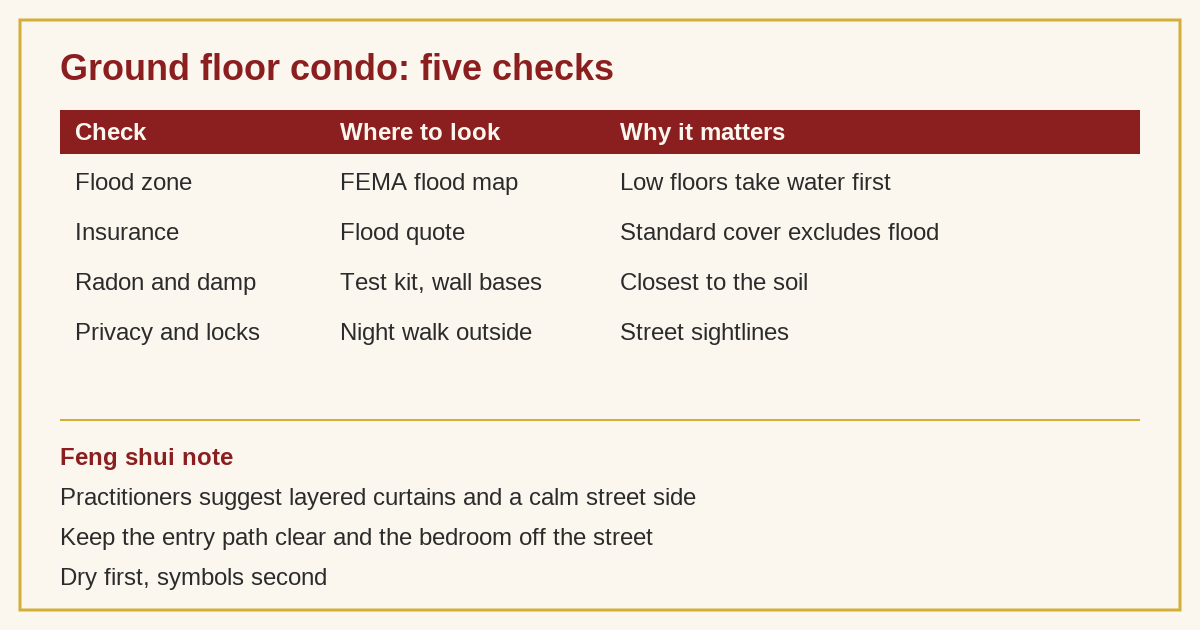
Practitioners say a ground floor home sits close to earth energy and is easy to reach, but it is exposed to the street and to damp. Before you buy one, check the flood zone and the insurance, then moisture and radon. Privacy at the windows, security and street noise come next. The access is a real advantage for older owners and wheelchair users.
Rules and sources reviewed: 23 November 2026
Picking a floor by its number is a separate question, covered in the condo floor and unit number buying guide. Here we stay on the lowest floor. More buyer topics are in our real estate and home buying guides.
| Ground floor check | What the rule or teaching says | Source |
|---|---|---|
| Flood damage and standard policies | A standard homeowners policy generally excludes flood; flood cover is bought separately (not verified since November 2026) | FEMA, National Flood Insurance Program |
| Flood zone lookup | Look up the address on the FEMA Flood Map Service Center before you offer | FEMA Flood Map Service Center |
| Radon action level | The US EPA recommends fixing a home at 4 pCi/L or more; lowest occupied floors test highest more often (not verified since November 2026) | US EPA, A Citizen's Guide to Radon |
| Accessible ground-floor units | US multifamily buildings of four or more units first occupied after 13 March 1991 must meet Fair Housing Act design and construction rules for ground-floor units (not verified since November 2026) | US Fair Housing Act, design and construction requirements (HUD) |
| Condo contents cover | A condo unit owner usually buys a unit policy for contents and improvements | Insurance Information Institute and provincial insurance regulators |
| Feng shui reading | Form School links low floors to earth, stability and exposure at the street | Traditional teaching, no scientific test |
On this page
- What the tradition says about low floors
- Flood risk and insurance
- Moisture, radon and air
- Privacy, security and noise
- Who a ground floor suits
- Five ground floor buying mistakes
- FAQ
What the tradition says about low floors
Practitioners describe the ground floor as the most grounded floor and the one most tied to the street. On the plus side they count stability, a short trip home with groceries or children, and a patio or garden right outside. The minus is exposure. Passers-by can see in, street noise and traffic energy hit the windows directly, and damp rises from the ground, which they link to heavy, stagnant air.
Their suggestions are practical ones: layered curtains or frosted film on street-facing windows, a clear path from the entry to the living area, and a bedroom on the side away from the street if the layout allows. For the entry itself, see our entryway feng shui for small condos.
Advertisement
Flood risk and insurance
Low floors take water first. It can come from a river, a storm drain, a burst pipe upstairs or a failed sump pump in the parking level. In the United States, look up the address on the FEMA Flood Map Service Center and ask the seller whether the unit has ever flooded. A standard homeowners policy generally does not cover flood, and flood cover is a separate policy (not verified since November 2026). In Canada, overland water cover is an optional add-on with many insurers, so ask for a quote before you commit.
The board or manager can tell you the building's history: water in the garage, backed-up sewers and past claims. Ask them too what the master policy covers and what the unit owner must insure. Then ask for the reserve fund study, since drainage and waterproofing are among the usual big-ticket items.
Moisture, radon and air
A ground-level unit sits right next to soil. Look for stains at the base of the walls, peeling paint, swollen baseboards and condensation on the windows, and notice any musty smell. Ask how the building handles drainage and how the parking level is waterproofed.
Radon is a gas from soil that collects in low spaces. The US EPA's guidance is to fix a home with a level of 4 pCi/L or more and to test the lowest lived-in level (not verified since November 2026). Ask whether the building has been tested, and test the unit yourself with a kit or a licensed tester. Results can vary by season. Our guide on basement and attic living space explains moisture and radon checks for low spaces in more detail.
Practitioners also suggest plants and a clean, dry entry. Both are cheap, but they come after a moisture fix and never stand in for one.
Privacy, security and noise
Stand outside at night and look in through the windows. Note where people can walk, whether a fence or hedge screens the patio, and whether the windows and patio door lock well. The building manager and your insurer can tell you about the entry system and any past break-ins. While you're there, listen for a bar, garbage pickup, a bus stop, a delivery bay or a parking ramp.
None of the fixes cost much: frosted film on the lower window panes, a solid fence, lighting on the patio, a bar in the patio door track and a door viewer or camera at the entry.
Who a ground floor suits
A ground-floor unit can be the right choice if stairs or lifts are hard for you, if you use a wheelchair or walker, or if you want to step straight outside, with or without a dog. In the US, multifamily buildings of four or more units first occupied after 13 March 1991 have to meet Fair Housing Act design and construction rules for accessible ground-floor units (not verified since November 2026); ask the agent whether the building is covered. That is housing law, not a feng shui claim.
| Buyer situation | Ground floor often helps | Check |
|---|---|---|
| Older owner or mobility limits | No stairs, no waiting for a lift | Step-free entry and door widths |
| Pet owner | Quick trips outside | Pet rules and patio fencing |
| Young children | A short trip with a stroller | Street noise at the bedroom windows |
| Remote worker | Calm, if the unit faces away from the street | What passers-by can see |
| Worried about flooding | It doesn't help here | Flood zone and an insurance quote |
Five ground floor buying mistakes
- Skipping the flood map lookup because the building is "new".
- Assuming the master policy covers your belongings and finishes.
- Viewing only by day, so you never hear the street noise or see the sightlines at night.
- Painting over damp or adding plants instead of finding where the water comes from.
- Buying a patio unit without asking who owns and maintains the patio and fence.
FAQ
Is a ground floor condo bad feng shui?
Not by rule. Practitioners see stability and easy access as strengths and exposure to the street and damp as weaknesses. Screens, a clear entry and a bedroom away from the street are the usual suggestions.
Do ground floor condos flood more?
They take water first when there is a flood or a drain fails. Look up the address on the FEMA Flood Map Service Center in the US, ask for the building's water history and get an insurance quote before you offer.
Do I need flood insurance for a ground floor condo?
A standard homeowners policy generally excludes flood. Ask your insurer and the building manager what the master policy covers and what you must buy yourself; a lender may require flood cover in a mapped flood zone.
Is radon a concern on the ground floor?
It can be, because the lowest lived-in level is closest to the soil. The US EPA recommends fixing a home at 4 pCi/L or more; test the unit and ask whether the building has results.
Are ground floor condos less safe?
Street-level windows and patio doors give easier access, so locks, lighting and a solid entry system matter. Ask the manager about the building's history and your insurer about requirements.
Is a ground floor condo easier to resell?
There is no general rule. Ask your agent for recent sales of ground-floor and upper-floor units in the same building and compare days on market and price per square foot.
Two checks before you offer
Look up the address on the FEMA Flood Map Service Center (or ask your insurer for an overland water quote in Canada), then order a radon test before the inspection deadline in your offer.
Sources
Checked November 2026. Anything marked "not verified since November 2026" should be read in its current form at the source before you rely on it.
- FEMA, Flood Map Service Center and National Flood Insurance Program guidance
- US EPA, A Citizen's Guide to Radon
- US Department of Housing and Urban Development, Fair Housing Act design and construction requirements
- Provincial insurance regulators and insurers on overland water cover in Canada (ask your insurer)
- Traditional Form School teaching on low floors and street exposure, as described by practitioners
Editorial note: Feng shui is presented here as a cultural and design tradition. Confirm legal, financial and inspection questions with a licensed professional.