Gutters have one job: catch the water off the roof and deliver it to the downspouts, away from the house. When they clog, the water goes over the edge and behind the fascia, rots the soffit, stains the siding, and pools against the foundation. Every one of those repairs costs more than a lifetime of gutter cleaning. The task itself takes an hour or two on a one-storey house. The hazard is not the gutter. It is the six inches of overreach from a badly placed ladder, so the ladder gets set up like it matters, because it does.
Gear
- Extension ladder in sound condition, rated above your weight plus tools
- Ladder stabilizer or standoff arms if you have them (they hold the ladder off the gutter itself)
- Work gloves. Gutter edges and hidden screws cut like tin snips.
- A gutter scoop or a stiff plastic trowel
- A bucket with a handle, hooked to the ladder, or a tarp on the ground below
- Garden hose with a spray nozzle
- A helper on the ground. Not optional at two storeys.
Set up like the job depends on it
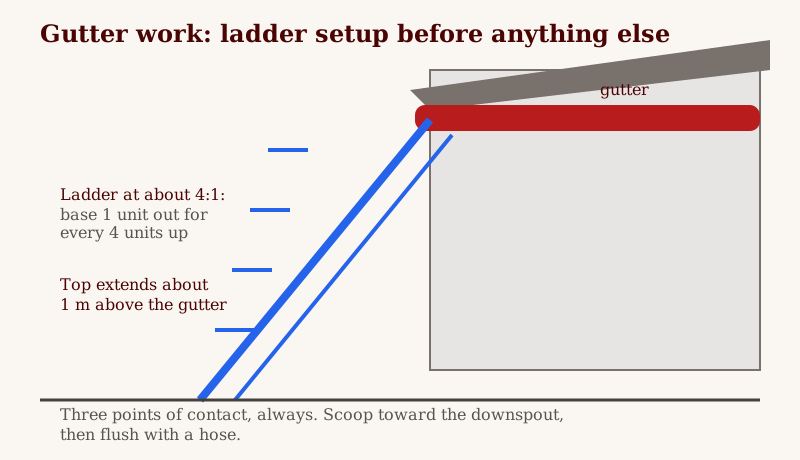
- Plant the ladder on flat, firm ground at roughly 4 to 1: for a gutter 4 metres up, the base sits about 1 metre out from the wall.
- Check the angle with your body: toes at the feet, arms straight ahead, palms flat on a rung means the angle is right.
- Extend the top about a metre above the gutter line so you step and hold at ladder height, and never lean your weight on the gutter, which is thin aluminum held by spikes or straps.
- Keep three points of contact, two hands and a foot or two feet and a hand, at all times. Move the ladder often. The rule that prevents falls is boring: if you cannot reach it without leaning your hips past the rails, climb down and move the ladder.
Scoop, then flush
Work toward the downspout so debris has somewhere to go. Scoop the big material out by hand and scoop, dropping it in the bucket or onto the tarp. Work in ladder-width sections and move; a one-storey house is maybe eight setups.
Then flush. Run the hose along the gutter toward the downspout and watch: water should move steadily and exit in a strong stream. A lazy downspout means a clog in an elbow; see the FAQ for the order of attack. While the water runs, check the gutter slope with your eye: standing water in long ponds means a sagging run or a pulled spike, worth re-fastening before winter ice makes it worse.
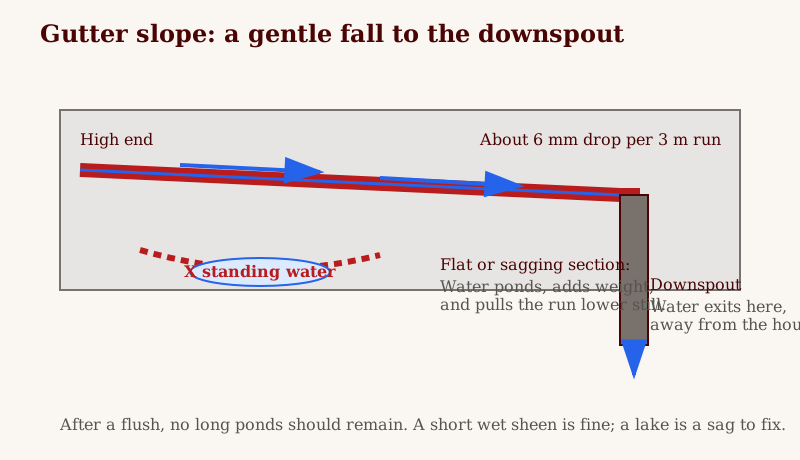
Read the flush like a test, not a rinse. What moving right looks like: the hose stream reaches the downspout in seconds, the downspout roars steady rather than gulping, and the gutter behind you dries to a wet sheen within a minute of moving on. What wrong looks like: water backing up toward you at the hose, a pond that sits dead still in front of the ladder, or a downspout that drips at a joint halfway down. Each one names its fix.
Feel matters here too. Scooping is a hands-in job: dry leaves pull out light, wet sludge pulls out heavy and sour, and grit from shingle wear feels like coarse sand under your glove. When every handful turns to grit, sweep a hand along the gutter bottom as you go, because grit holds water against the aluminum and shortens its life. Gloves stay on for all of it. The seam screws and cut edges inside a gutter do not announce themselves before they cut.
Finish by walking the house. Streaked siding, peeling paint on the fascia, and mulch washed out of the beds below are the signatures of overflow, and now you know which runs caused them.
Advertisement
Standing water, sags, and overflow that will not quit
A clean gutter can still fail. These are the three patterns left after the scooping is done.
Water ponds in one stretch. The run has bellied. Sight along the top edge from one end: a healthy run reads as one straight, gently falling line, and a sag reads as a dip you can see. Find the fasteners above the pond. Gutter spikes pull out of rotted fascia a little more each winter until the run hangs off them. Back the loose spike out, check that the wood behind it is sound (a screwdriver should meet resistance, not push through soft fibres), and refasten. If the fascia there is soft, that stretch is a repair, not an adjustment, and it wants doing before the ice season loads it.
The gutter still overflows in rain. If a moderate rain sends water over the edge of a clean, well-sloped gutter, the bottleneck is downstream: a partly blocked downspout or an elbow packed with grit that the flush at cleaning pressure never moved. Work it in this order. First, hose pressure from the top with the nozzle pushed into the downspout mouth. Second, a plumber's auger up from the bottom outlet. Third, take the elbow apart at its screws and clear it on the ground. Elbows hold the densest plugs in the whole system and they empty in seconds once they are off.
Overflow at one corner only. Check the mitre joint and the end cap there for a failed seal, and check whether that corner's downspout takes water from two runs at once. A corner doing double duty overflows in heavy rain even when everything is clean, and the cure is a larger outlet or a splash guard at the valley above, not more cleaning.
Give each fix a rain before you judge it. One steady rain with no spill lines on the siding, no trench dug in the mulch below, and downspouts running clear is what done looks like from the ground.
Common mistakes
- Cleaning toward yourself. Scooping against the downspout pushes debris away from its exit and packs it at the far end, where the next rain floats it back. Work toward the downspout so every pass shortens the trip out.
- Skipping the flush because it looks clean. Scooped gutters can still hide a blocked elbow and a reversed slope. The flush is the inspection. Without it you have moved leaves, not verified drainage.
- Leaning the ladder on the gutter. The gutter bends, the spike loosens, and you have created next year's sag while fixing this year's leaves. Ladder against the wall or on standoffs, top above the gutter line, weight on the rails.
- One cleaning a year under trees. Seed drop in spring plugs downspout strainers even on houses that shed few leaves. If branches touch or overhang the roof, budget the second pass. It is the cheaper of the two by far against a fascia repair.
Timing
Late spring clears the seed drop; late fall clears the leaves before freeze-up, which is the cleaning that prevents ice dams from backing meltwater under the shingles. Set both beside the fall weatherstripping pass and the furnace filter check, and the house goes into winter with its water and air both going where they should.
One hard limit, repeated because it matters: any eave you cannot reach safely from firm ground is a professional's job. The going rate buys their ladders, their standoffs, and their balance. It is the best-value hire in this entire pillar.