A Chinese zodiac year sign is found from a date. A birth-hour animal is found from a clock. The traditional day is split into 12 double-hours, called shichen, and each double-hour carries one Earthly Branch and one animal. A child born at ten in the morning and a child born at ten at night in the same year share a year sign and sit in different hour bands.
That split is why family members with the same year animal can be given quite different readings once the full chart is cast. The year is the coarse layer. The hour adds a finer one. If you want the quick result first, you can use the find-my-sign page and then read the table below to see where the hour band falls.
The 12 double-hours
Each shichen lasts two modern clock hours. The branch name comes first in traditional tables, then the time band, then the animal. The day-part labels in the last column are plain guides to the light at that hour in a traditional farming day. They are kept simple on purpose.
| Branch | Clock hours | Animal | Day part |
|---|---|---|---|
| Zi | 23:00-01:00 | Rat | night |
| Chou | 01:00-03:00 | Ox | night |
| Yin | 03:00-05:00 | Tiger | night |
| Mao | 05:00-07:00 | Rabbit | dawn |
| Chen | 07:00-09:00 | Dragon | morning |
| Si | 09:00-11:00 | Snake | morning |
| Wu | 11:00-13:00 | Horse | midday |
| Wei | 13:00-15:00 | Goat | afternoon |
| Shen | 15:00-17:00 | Monkey | afternoon |
| You | 17:00-19:00 | Rooster | evening |
| Xu | 19:00-21:00 | Dog | evening |
| Hai | 21:00-23:00 | Pig | night |
To read your hour, find the clock time of birth and read across. A birth at 06:15 sits in Mao, Rabbit, dawn. A birth at 14:40 sits in Wei, Goat, afternoon. A birth at 20:05 sits in Xu, Dog, evening. No stem work and no date conversion is needed for this step. The table is the tool.
Two features of the table repay a second look. The day does not start at midnight in this scheme. The first double-hour, Zi, straddles midnight, running from 23:00 to 01:00. And the sequence does not reset at dawn. It runs through the full turn of the day in branch order, night into morning into evening into night again.
The animal order in the hours matches the animal order in the years: Rat, Ox, Tiger, Rabbit, Dragon, Snake, Horse, Goat, Monkey, Rooster, Dog, Pig. A reader who knows the year order already knows the hour order. Only the unit changes, from a year to a double-hour.
Why the hours carry animals
The animals ride on the Earthly Branches. There are 12 branches, and each branch has carried an animal association for a long span of the tradition. The branch order sets both the year sequence and the hour sequence.
Zi is the first branch. In the day, Zi sits across the middle of the night, so the day count in the traditional scheme turns inside the Rat hours. Chou follows as the Ox in the deep night after midnight. Yin takes the Tiger in the last part of the night. Mao takes the Rabbit at dawn.
Counting forward, Wu is the seventh branch. Wu lands on 11:00 to 13:00, the middle of the day. Wu is the branch of noon in the traditional system, so the midday double-hour takes the Horse. The Horse at noon is a result of the count. Start at Zi at midnight, step two hours at a time through seven branches, and the seventh step falls at midday with Wu and the Horse.
The same branch can appear in a year, a month, and an hour in one chart, with the animal repeating at different scales. A Horse year, a Horse month in the solar chart sense, and a Horse hour do not mean the same thing inside a reading, because the pillar position changes the weight a teacher gives it. The shared animal comes from the shared branch. The reading comes from the position.
This is also why printed hour tables agree even when teachers differ on other points. The branch to animal pairing and the branch order are fixed parts of the system. Disagreement enters at the edges: the day change inside Zi, the handling of a birth on a boundary, and the time basis for the chart. The table itself is settled.
The hour pillar inside a BaZi chart
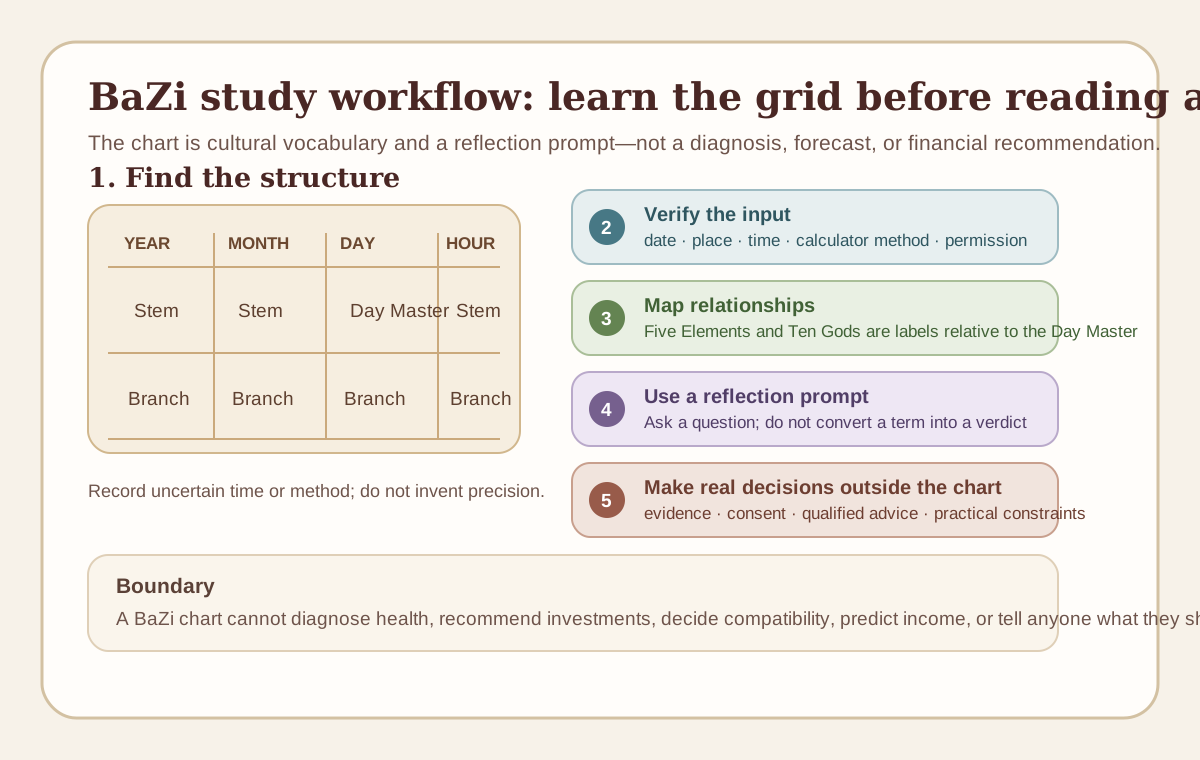
BaZi builds a chart from four pillars: Year, Month, Day, and Hour. Each pillar carries a Heavenly Stem and an Earthly Branch. The year pillar gives the year animal that most people know. The hour pillar gives the birth-hour branch and animal from the table above, paired with a stem that the teacher derives from the day stem under the rules of the school.
A chart uses all four pillars together. The year sign alone is the coarsest layer, which is why two people born in the same year can have very different charts. They share one pillar of four. The month pillar ties the chart to the season, the day pillar is often given central weight by teachers, and the hour pillar completes the set.
In traditional reading the hour pillar is associated with later life, children, and ambitions. That association belongs to the reading tradition and is framed here in those terms. Teachers weigh the hour pillar against the other three and against the luck cycles in a full reading. A single pillar is not read as a fixed result for a person. It is one part of a four-part structure, and the structure is the chart.
Readers who want the full build can work through the BaZi mastery guide for the four-pillar layout, then run the BaZi calculator to see the pillars set out for a birth date and time. The hour table on this page supplies the branch layer of the fourth pillar. The calculator and the guide handle the stem layer and the reading frame.
A plain limit follows from the structure. The hour animal can tell you which double-hour contains the birth time. It cannot on its own rank the chart, compare two charts, or settle a question about a person. Inside the tradition those tasks use all four pillars, the interactions among the stems and branches, and the judgment of the teacher casting the chart.
Advertisement
The folk inner sign
Outside formal BaZi, folk use gives the birth-hour animal a smaller, social role. In that folk description the year sign is the public sign, the animal named at new year, printed on calendars, and asked about at family gatherings. The birth-hour animal is sometimes described as a private or inner sign, the one shown to close family rather than to the wider circle.
That description turns up in family talk and in popular zodiac books. A person may say the year animal is how the world meets them and the hour animal is closer to how they act at home. Framed as folk description, that language gives families a way to talk about the difference between a public manner and a private one using the signs they already know.
It helps to keep the folk layer and the chart layer apart. The folk inner sign is a conversational use of the hour animal on its own. The BaZi hour pillar is a formal part of a four-pillar chart with a stem attached and a set of interactions to read. Both use the same table to find the animal. They do different work after that point. Mixing the two leads to thin readings: a folk phrase treated as a chart result, or a chart term used as a party label with the chart left out.
A similar folk layer sits around compatibility and color. The guides on Chinese zodiac love compatibility and Chinese zodiac lucky colors by animal show how popular reading applies the animal in daily life. Those uses sit inside the same traditional and folk frame. They are cultural readings, not measured results.
The midnight split and boundary cases
The Rat hour creates the best known edge case in hour work. Zi runs 23:00 to 01:00 and crosses midnight. A birth at 23:30 is Rat hour under any reading. The open question is the day. If the day rolls at 23:00, that birth takes the next day for the Day pillar. If the day rolls at midnight, the same birth keeps the day that is ending.
Schools split on this point. Some teachers roll the day at 23:00, treating the start of Zi as the start of the new day for chart purposes. Others roll the day at midnight and keep Zi as one double-hour across the date change, with an early Zi and a late Zi noted in the chart. This is a genuine and well known split inside the tradition. It is not a mistake to be cleared up by picking a side in a general guide.
The practical handling is record keeping. Write the birth time with minutes, and the date as it appears on the birth record. If the birth falls between 23:00 and midnight, ask the teacher which day rule the school uses and note the answer on the chart. A chart cast under one rule can be recast under the other for comparison. A chart with no birth time noted cannot.
Boundary births raise a smaller version of the same problem. A birth recorded at exactly 01:00, 11:00, 23:00, or any other even hour sits on the line between two double-hours. Recorded times are often rounded to the nearest five minutes, and older records may give the hour only. For a birth that sits on a boundary, teachers often read the chart both ways, once with each branch, and look at which reading fits the rest of the pillars under their method. If the delivery record gives an exact minute, use it. If it gives a round hour, say so when the chart is cast.
A birth a few minutes from a boundary deserves the same care. A time of 10:58 and a time of 11:02 fall in different double-hours, Snake and Horse, on a difference smaller than the rounding in many records. Where the stakes are a formal reading, the exact recorded time and a note on its source are worth more than a fast answer from the table.
Twins bring the boundary into one family. Twins born across a double-hour line take different hour animals from the same delivery. Twins born across 23:00 or midnight can also take different day pillars under some school rules. The tradition treats that as a normal result of the time system, not as an error. Each chart is cast from its own birth time.
Time zones and solar time
One more layer sits under the clock. Charts were cast in a period when local apparent time set the hour, read from the sun and from timekeeping tied to the place. A modern birth time is a clock time inside a time zone, and a time zone can span a wide band of longitude. The sun crosses the eastern edge of a wide zone well before it crosses the western edge, while the clock shows the same hour in both places.
Modern teachers differ on the handling. Some cast the chart on the recorded clock time as given. Some adjust for longitude inside the zone. Some apply a fuller solar time correction. Practice varies by school and by teacher, and this guide does not set a rule for it.
For the hour animal table, start with the recorded clock time. That gives the branch under the clock method and matches how most popular tables are used. For a formal BaZi reading, raise the time question at the start: which time basis will the chart use, clock time or adjusted time, and has an adjustment moved the birth across a double-hour line. Most births sit well inside a double-hour and the answer changes nothing. A birth near a boundary or near the edge of a wide time zone is where the choice can move the branch.
Daylight saving time adds a plain record question in places that use it. The birth record shows the clock time in force at the hospital on that date. A teacher who adjusts time will want to know whether the recorded time was standard time or daylight time. Note it on the record when you know it. Guessing later is harder than writing one line now.
Worked readings from the table
A few births carried through the table show how little work the hour lookup takes, and where the record questions start.
A birth at 08:05 sits in Chen, 07:00 to 09:00, Dragon, morning. The time sits well inside the band. No boundary issue arises and the time basis question rarely moves a birth this far from an edge. In a full chart this branch becomes the branch of the hour pillar, with the stem set by the teacher from the day stem.
A birth at 12:30 sits in Wu, 11:00 to 13:00, Horse, midday. This is the seventh branch at the middle of the day. A reader who checks the count from Zi at midnight reaches Wu in seven steps and lands at noon. The placement matches the branch-of-noon rule given earlier. It is the easiest hour in the table to verify by count alone.
A birth at 17:45 sits in You, 17:00 to 19:00, Rooster, evening. The band sits after Shen and before Xu. A birth ninety minutes later at 19:15 would sit in Xu, Dog. Two siblings born in the early and late evening of the same day can carry different hour animals with no dispute about the table. Only the clock separates them.
A birth at 00:20 sits in Zi, Rat, night. The hour animal is clear. The day pillar is the open point, because the birth falls after midnight inside the straddling double-hour. Under a midnight day roll the date on the birth record and the chart day match in a simple way. Under a 23:00 roll the chart day still matches the calendar date after midnight, but the prior evening portion of Zi belongs to the new chart day before the calendar turns. A teacher states the rule in use. The table cannot pick it.
A birth at 05:00 exactly sits on the line between Yin and Mao, Tiger and Rabbit. The recorded minute decides the band if the record is exact. If the record was rounded, the birth could sit in the last minutes of Yin or the first minutes of Mao. This is the case where a teacher reads both branches against the rest of the chart. Writing exact on the record, or rounded to the hour, saves a later argument.
The shape of the traditional day
The double-hours also describe how a traditional day was divided before clock time was uniform. Night watch language, market opening, meals, and rest were tied to the shichen in daily life. The names still appear in classical texts, in historical drama, and in older family records that give a birth by the double-hour rather than by a clock number.
That older record form matters for family history work. A grandparent record may give a birth as the Mao hour or the Wei hour with no clock time at all. The table converts that record into a two-hour clock band for a modern chart. The band is as exact as the source allows. Turning a two-hour band into a single minute would add detail the record does not carry.
The day-part labels in the table follow the light. Mao at dawn, Wu at midday, You in the evening, and Zi across the middle of the night give four anchor points that are easy to hold in memory. Learn those four and the rest fall into place by counting two hours forward or back. Rat at midnight, Horse at noon, Rabbit at dawn, Rooster at the evening band. The four anchors carry the full sequence for a quick check without the table open.
Season shifts the light but not the band. Dawn falls earlier in summer and later in winter, while Mao stays at 05:00 to 07:00 as a clock band in the modern table. The system ties the branch to the hour count rather than to sunrise on a given date. Teachers who work with solar time adjustments handle season and longitude inside the chart casting. The public table keeps the clock bands fixed so any reader can use it.
Limits of the hour layer
The double-hour system is exact about bands and quiet about meaning. The table can place a birth time in Zi or Wu with no doubt at all once the time basis is set. What a teacher makes of that placement inside a four-pillar chart is a reading inside a tradition, built on texts, school rules, and experience. Two teachers can agree on every branch in a chart and differ in emphasis in the reading. That difference belongs to the interpretive layer.
The folk inner sign sits one step further from formality. It gives families and friends a shared language for public and private sides of a person. Used in that spirit it does the work folk language does in many cultures. It is not a measurement and it does not sort people into fixed types.
Keep the pieces in their places and the hour layer is useful on its own terms. Find the double-hour from the table. Note the exact birth time and its source. If the birth falls in Zi late at night, on a boundary, or near a time zone edge, record the open point rather than forcing a single answer. Bring those notes to any formal reading. A chart cast from a clean record can be checked, recast, and compared. A chart cast from a rounded memory cannot, and no table can repair the record after the fact.