Short answer
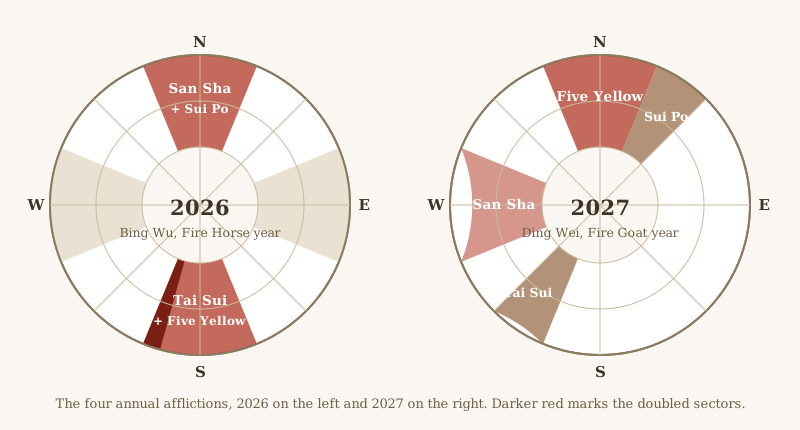
An auspicious date, in the tradition that prints the lists, is a day that passes four checks for one specific activity and one specific person. First, the day officer, one of a repeating twelve in the Tong Shu almanac, should fit the activity: Success and Stable days for weddings and signings, Open days for openings, Remove days for clearing out. Second, the almanac's printed suitable list for that day should actually name your activity. Third, the day must not clash with your zodiac sign, because every day's branch opposes one sign. Fourth, the year-level afflictions, Tai Sui and its neighbours, should not rule the activity or the building out. A day that clears all four layers is a traditionally good day for that event. A day that clears them for somebody else's wedding may fail your moving day on layer one, two, or three, which is why a bare list of "auspicious dates 2026" with no activity and no person attached is only the first quarter of the method.
This guide works through the layers in the order a reader of the printed book meets them. It gives the full twelve-officer table with the traditional activity readings, shows how the officer is computed from the month and day branches so you can check any printed page yourself, reads one real almanac day (Monday, January 19, 2026) field by field, and finishes with a worksheet and the limits of the whole exercise.
The book: Tong Shu, Tung Shing, Yellow Calendar
The source text is the Chinese almanac. In Mandarin it is the Tong Shu (通書, "the book of everything"); the Cantonese name, Tung Shing (通勝), is the one on the covers sold in Hong Kong, Macau, and Taiwan. The name changed for a practical reason. Shu, book, is a homophone of the word for defeated, so "the book of everything" sounded like "defeated in all things". Publishers swapped in Shing, victorious, and the book became "victorious in all things" instead. It is also called the Huang Li (黃曆), the Yellow Calendar, a name legend ties to the Yellow Emperor, and for most of its history it functioned as a farmers' almanac, geared to weather, sowing, and harvest.
Three facts about the book shape everything downstream.
It is rebuilt every year. The almanac is an annual. Each edition converts the coming year's dates, sets out the solar terms, and prints a page or a line for every day, because the day data never repeats from one year to the next in a way a reader could carry over.
It runs mainly on the solar terms. The calendar inside is built primarily on the 24 solar terms rather than the lunar month count, which is why the almanac's months for date-selection purposes turn at terms like Lichun in early February instead of at Lunar New Year. Lunar dates are printed too, and the age-counting guide on this site shows where the lunar count still runs family life.
Most of it is day suitability. The bulk of the contents deals with what is suitable to do on each day. Families still use it for weddings and funerals, its single most common use is choosing a wedding date, and feng shui practitioners use it alongside other methods for marriages, opening ceremonies, move-in days, big contract signings, renovation starts, and travel. Editions sold in Hong Kong, Macau, and Taiwan are based on two late-Qing versions, so two genuine printed almanacs can mark the same day differently. That is a feature of the lineage, not a misprint, and the FAQ at the end returns to it.
Anatomy of one day: the fields on an almanac page
Open any printed or online almanac at a single day and the same fields appear. Reading them in a fixed order turns a dense page into a checklist.
| Field | What it tells you |
|---|---|
| Gregorian and lunar date | The day itself, in both calendars, plus the year's stem and branch |
| Day stem and branch | The day's own pair from the sixty-pair cycle, which never breaks and never repeats within sixty days |
| Day officer | One of the twelve officers, computed from the month and day branches (next section) |
| Suitable (宜, yi) | The printed list of activities this day supports: marriage, moving, groundbreaking, signing, travel, and so on |
| Avoid (忌, ji) | The printed list of activities this day argues against |
| Clash (沖, chong) | The zodiac sign the day opposes, and usually the direction of the day's sha |
| Peng Zu taboos (彭祖百忌) | Two short traditional taboo lines, one keyed to the day's stem and one to its branch |
| Lunar mansion | The day's station among the twenty-eight mansions, an older layer some editions weight more than others |
| Auspicious hours | Which of the day's twelve double-hours the almanac marks as favourable |
Two habits make the page easier to use. Read the suitable and avoid lists as the editor's summary of everything else on the page: they are where the officer, the stars, and the taboos get folded into plain instructions. And read the clash line before the suitable list, not after. A day whose suitable list includes weddings is no use to a couple whose signs it clashes, and the clash is printed in one word.
The twelve officers: the layer that does most of the work
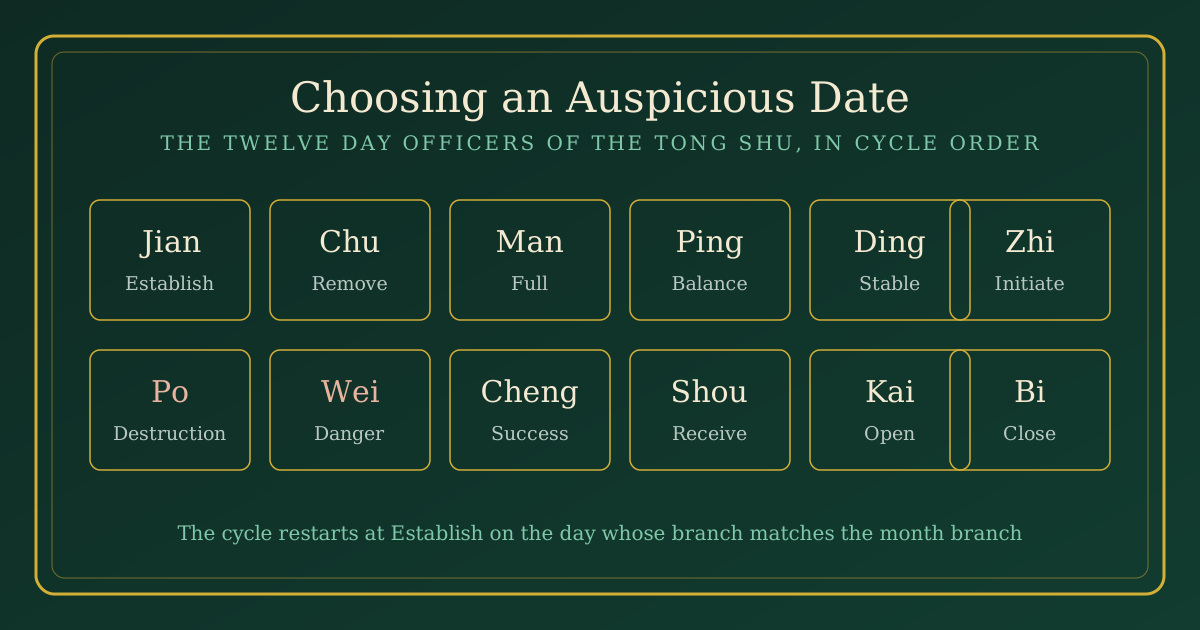
The twelve day officers (建除十二神) are a repeating cycle of twelve day types. Each day is governed by one officer, and date selection at its simplest is matching the officer to the activity. The names, in order, are Jian (Establish), Chu (Remove), Man (Full), Ping (Balance), Ding (Stable), Zhi (Initiate), Po (Destruction), Wei (Danger), Cheng (Success), Shou (Receive), Kai (Open), and Bi (Close).
The officer is not looked up from the day's stem. It is computed from branches. When the day's earthly branch is the same as the month's earthly branch, the day is an Establish day. The following days then take the officers in order: the next branch day is Remove, then Full, and so on through the cycle, until the count comes back to Establish when the branch matches again. In date-selection work the month branch follows the solar terms. The Ox month, for example, runs from the Xiaohan term in early January to the start of Lichun in early February, so every day in that stretch is officer-counted from Ox.
| # | Officer | Traditional character of the day | Traditionally used for | Traditionally avoided |
|---|---|---|---|---|
| 1 | Jian, Establish (建) | Beginnings and foundations | Starting a job or project, business dealings, proposing marriage | The wedding itself, endings, demolition |
| 2 | Chu, Remove (除) | Clearing and release | Cleaning, decluttering, closing out what is finished, clearance sales | Weddings, new partnerships, anything meant to grow |
| 3 | Man, Full (滿) | Fullness and return | Signing agreements, official openings, gatherings, house warming | Demolition, funerals, medical treatment in some editions |
| 4 | Ping, Balance (平) | Even, negotiated outcomes | Marriage, starting construction, business negotiation, travel | Litigation, unless a split outcome is acceptable |
| 5 | Ding, Stable (定) | Fixing things for the long term | Marriage, contracts, opening a business, house warming, starting construction | Long journeys, lawsuits |
| 6 | Zhi, Initiate (執) | Holding and carrying through | Starting a project, accepting an assignment, beginning renovation work | Moving house, long travel |
| 7 | Po, Destruction (破) | Breaking apart | Demolition and deliberate endings, little else | Weddings, openings, launches, investments, travel |
| 8 | Wei, Danger (危) | Risk present in the day | Quiet, low-stakes activity; ground breaking in some readings | Risky undertakings, major decisions |
| 9 | Cheng, Success (成) | The strongest all-purpose officer | Marriage, proposals, moving house, business proposals, most major undertakings | Breakups and divorces, by the obvious logic |
| 10 | Shou, Receive (收) | Collecting and taking in | Closing a deal, starting school or a job, asking for payment or a raise | Funerals, hospital visits |
| 11 | Kai, Open (開) | Opening and welcome | Business openings, house warming, starting a job, travel | Funerals, closures |
| 12 | Bi, Close (閉) | Sealed and still | Sealing, storing, finishing and filing | New starts of any size |
Read the table the way practitioners insist it be read: most days are mixed. Standard references on the system point out that every officer except Success and Destruction carries both a usable and an unusable side. A Remove day is a bad wedding day and the correct day to clear a house before listing it. A Close day is poor for an opening and perfectly reasonable for sealing a storage unit or filing a finished project away. The officer answers "what kind of day is this", and the activity decides whether that kind is the one you want. Two officers do sit at the poles. Success is listed as suitable for nearly everything long-term in every reference this guide drew on, and Destruction is the day the tradition reserves for tearing down.
Advertisement
The clash filter: the personal layer anyone can run
The officer and the printed lists are the same for every reader. The clash is where the method becomes personal, and it needs nothing but your birth-year sign, which the birth-year chart gives with exact New Year boundaries.
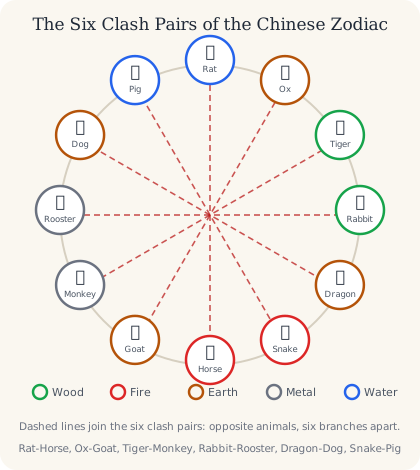
Every day's branch opposes the branch six places away from it. The six clash pairs are fixed: Rat with Horse, Ox with Goat, Tiger with Monkey, Rabbit with Rooster, Dragon with Dog, Snake with Pig. The full pair table, including the harmony and trine groupings that sit alongside the clashes, is worked in this site's clash pairs guide. On the almanac page the clash is printed as one line: clash Pig means the day's branch is Snake, and Pig-born readers are the ones flagged.
Applied to date selection, the rule is simple. For an event centred on one person, a wedding centred on two, a business opening centred on its owner, remove every candidate day that clashes with a central person's sign. Tradition treats the clashed person as the wrong person to front that day's major commitments: they sit the decision out, or somebody unclashed signs, cuts the ribbon, or carries the box over the threshold first. Supporters, guests, and staff are not filtered; the net is deliberately narrow, one or two people wide.
The clash filter is also where date selection plugs into the year. A year clashes the sign it opposes all year long, which is the fan Tai Sui pattern the ben ming nian guide covers, and the year-level earth rules, the directions a household should not dig in, sit in the Tai Sui and annual afflictions guide. A moving date can pass the officer and clash tests and still be the wrong date for that house in that year if the move involves breaking ground in an afflicted sector. The layers stack; none of them replaces the others.
One almanac day, read in full: Monday, January 19, 2026
A worked example, using only the method above and one published almanac page.
The setting. January 19, 2026 falls inside the Ox solar month, the stretch between the Xiaohan term (January 5, 2026) and Lichun (February 4, 2026). The month branch is therefore Ox. The day's branch, as the printed page confirms through its clash line, is Snake: the page lists the day's clash as Pig, and Snake is the only branch that clashes Pig.
The officer, computed. Count the officers from the month branch. Ox day would be Establish (1). Tiger day is Remove (2), Rabbit is Full (3), Dragon is Balance (4), Snake is Stable (5). So January 19, 2026 is a Ding, Stable, day, which is exactly what the almanac prints. Any reader can run this count on any date whose day branch they know, and it either matches the printed officer or one of the two inputs has been taken wrong.
The suitable list, read. Stable days are the tradition's long-term days, and the printed suitable list for this date follows the pattern the officer predicts: marriage and engagements, moving house, signing contracts, business transactions, receiving payments, and groundbreaking all appear, with long journeys and lawsuits the standard things a Stable day argues against. Three different events can now be run against the same page.
- A couple, one Ox-born and one Rabbit-born, checking the date for a wedding: officer fits (Stable is a classic wedding officer), the suitable list names marriage, and neither partner's sign is clashed. The date passes all three printed layers for them.
- A Pig-born shop owner checking the same date for signing a lease: officer fits and the list names contracts, but the day clashes Pig. The traditional move is to shift the signing a day or two, or to have an unclashed partner sign. Same page, opposite answer, and the only thing that changed is the person.
- A family checking the date for moving house: the list names moving, nobody in the family is Pig-born, so the day passes, subject to the year layer. 2026 is the Fire Horse year, and the afflictions guide's rule about not breaking ground or renovating in the year's afflicted sectors still applies to any digging the move involves. A furniture-only move never touches that layer.
The hours, briefly. Inside the day, the almanac divides the twenty-four hours into twelve double-hours, each carrying its own branch, and marks which of them it counts as auspicious. Couples who have fixed a Stable day for a ceremony traditionally take the ceremony's start from those marked hours rather than from the middle of the day by default. The day gets you the date; the hours table is the fine adjustment, and it is the last layer to consult, not the first.
Shortlists by activity
Running the four layers for the events readers ask about most produces these working shortlists. Treat them as starting filters, then apply the clash and the printed list to your actual candidate dates.
| Event | Officers tradition favours | First removals |
|---|---|---|
| Wedding | Success, Stable, Balance, Full | Days clashing either partner's sign; Destruction days |
| Moving house | Success, Stable, Open, Full | Days clashing the household head's sign; Close days |
| Renovation start, groundbreaking | Initiate, Balance, Stable | Days in the year's afflicted sectors for digging, whatever the officer; Destruction days unless the work is demolition |
| Business opening | Open, Success, Full, Receive | Days clashing the owner's sign; Close days |
| Signing a contract | Stable, Full, Success, Initiate | Days clashing the signatory's sign |
| Clearing a house out | Remove, Close | Almost nothing; these are the days other events reject |
The renovation row deserves its second column. Groundbreaking is the one domestic activity where the year layer outranks the day layer, because the affliction rules are about where the earth is disturbed, not about the calendar page. The renovation guide on this site works the room-by-room side of the same job, and the afflictions guide works the sector side. Date selection chooses when; those two choose where and how.
For weddings, the colour and custom layer sits in the wedding lucky colours guide, and it is deliberately last: a date that fails the clash test is not rescued by the right shade of red.
Where the printed method stops: the BaZi layer
Everything above is the general method, the one a printed book can carry. Practitioners who select dates professionally add a personal layer the book cannot print: they test the shortlisted days against the client's four pillars, the year, month, day, and hour pillars of the birth chart covered in this site's BaZi chart guide. A day whose officer is middling can suit a particular chart well, and the tradition's own references are blunt that a generally auspicious day is not automatically auspicious for every person. This is also why a practitioner's chosen date sometimes contradicts a website's list. The list ran three layers; the practitioner ran four, and the fourth one is personal. Date selection sits inside the wider family of methods surveyed in the fortune-telling methods comparison, and it is the most mechanical of them: arithmetic and printed tables all the way down, which is exactly why a careful reader can reproduce the general layer at the kitchen table.
The five-step worksheet
- Fix the window from real life first. Venue availability, registrar hours, family travel, the lease end date. Date selection chooses inside a window; it does not create one.
- List the candidate days and get each day's branch. Any printed almanac or almanac app shows it. From the day branch, compute the officer: find the month branch from the solar term the date falls after, count Establish on the matching-branch day, then forward in officer order to your day.
- Apply the officer shortlist for your event. Keep the days whose officers fit the activity, using the shortlist table above. Expect to keep roughly a third of the window.
- Run the clash filter. Strike every remaining day that clashes with the sign of the person, or either partner, or the owner, at the centre of the event.
- Check the printed suitable list and the year layer. On the two or three survivors, confirm your activity is named in the day's suitable list, then check the afflictions guide if the event involves a house, digging, or a person in a fan Tai Sui year. Pick from what is left, and take the ceremony or signing hour from that day's auspicious hours.
Run this worksheet on a four-weekend wedding window and it usually ends with two or three defensible dates rather than one magic day. That is the method working as designed. It narrows; it does not anoint.
Limits
Date selection is a tradition about fit between a day and an activity. It is not a measurement, and nothing in the almanac changes what a day will contain. Four limits keep the practice in proportion.
No outcome is promised. A Success day wedding and a wet Tuesday wedding have the same legal standing and the same marriage. The tradition frames the choice as starting in tune, and this guide reports it as tradition throughout.
Urgency outranks the calendar. Medical care, safety repairs, legal deadlines, and a landlord's fixed move-out date are not movable feasts to be rescheduled around an officer. Practitioners themselves reach for the best available day inside a fixed window, which is an admission that the window governs.
Editions disagree. Two late-Qing lineages, different editors, and a personal layer no book can print mean two sources will sometimes split on a date. A split is information about the method's resolution, not a crisis.
The practical layer is real. A date nobody can attend is a bad date in every system. Families who use the almanac well treat it as the tiebreaker among workable days, which is the role it has played at kitchen tables for a long time: the book proposes, the family's actual life disposes.
Sources and further reading
- Tung Shing, the almanac's names, history, contents, and wedding-date use: en.wikipedia.org/wiki/Tung_Shing
- The twelve day officers, the month-branch rule, and per-officer activity lists (Skillon, Chinese Almanac Tong Shu reference): skillon.com
- Twelve day officers with avoid lists, a second practitioner's rendering cross-checked against the table above: tanyafengshui.com
- Balance, Stable, Initiate, Destruction, Danger, and Success day notes (Absolutely Feng Shui, Chinese calendar series): absolutelyfengshui.com