Choose the signing date from the almanac, but treat closing as a date your contract, lender and the law fix. In the US, your lender must get the Closing Disclosure to you at least three business days before closing, so the usual plan is to sign on a good day and let the closing follow the contract.
Rules and dates checked on 23 November 2026.
For the month-by-month picture, read the best time to buy a house by the Chinese calendar in 2027; the days themselves are in the auspicious dates tool, and the rest of the buying process is in our real estate and home buying guides.
| What is fixed | The rule or figure | Source |
|---|---|---|
| Closing Disclosure timing | You must receive it at least three business days before closing | CFPB |
| What to do with it | Compare it with your Loan Estimate and check for errors and fee increases | CFPB |
| No time limit at closing | The CFPB notes there is no time limit at closing, so you need not feel rushed | CFPB |
| Not covered | Reverse mortgages, HELOCs, certain manufactured housing loans and some assistance loans do not get a Loan Estimate or Closing Disclosure | CFPB |
| Almanac contract days in 2027 | 92 days suit signing deeds and contracts; 38 of them also suit moving in | Lucky Properties 2027 dataset |
On this page
- The dates in a home purchase
- What the law and the lender fix
- A worked example with stated inputs
- Decision table: when to move the date and when not to
- Where date planning goes wrong
- FAQ
- Your next step
The dates in a home purchase
Buyers often use "closing" for several different dates. Pull them apart before you choose one:
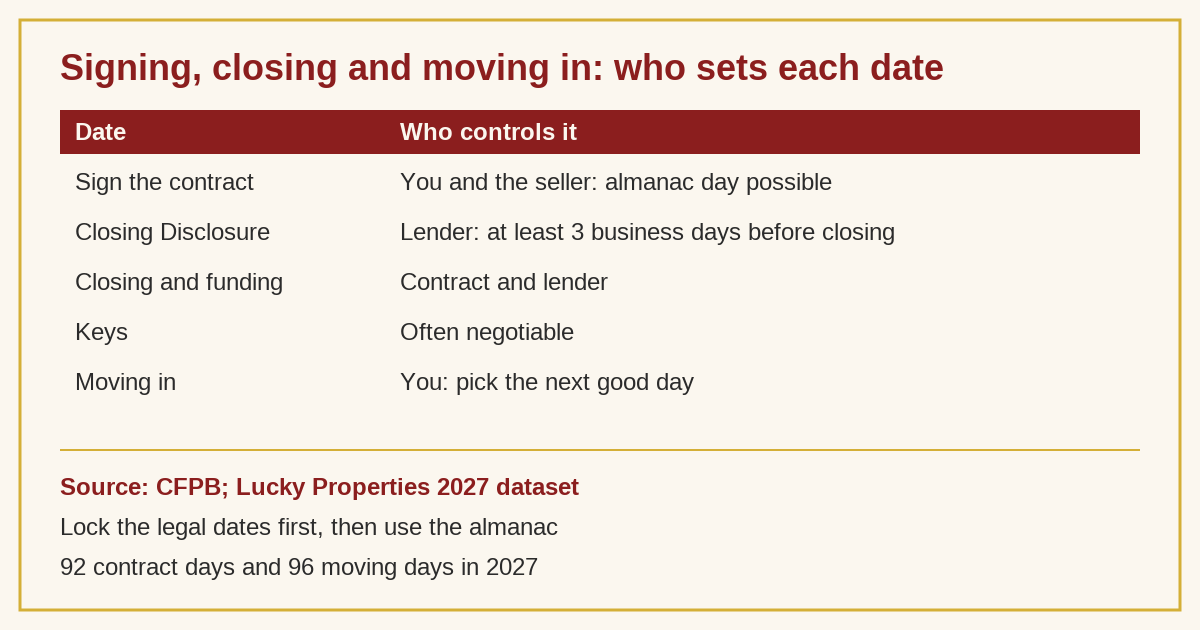
| Date | Who controls it | Can you pick an auspicious day? |
|---|---|---|
| Offer and acceptance | You and the seller | Often, if there is no deadline pressure |
| Signing the purchase agreement | You, seller, agents | Usually yes |
| Mortgage rate lock or approval deadline | Lender | No |
| Closing Disclosure delivery | Lender, by law | No |
| Closing and funding | Contract, lender, title company | Only within the contract's window |
| Getting the keys | Contract | Sometimes negotiable |
| Moving in | You | Yes |
The almanac term for signing is 立券, deeds and contracts. For moving in it is 入宅. In our 2027 dataset, 92 days qualify for contracts and 96 for moving.
Advertisement
What the law and the lender fix
The CFPB says the lender must send a Closing Disclosure that you receive at least three business days before closing. If it has not arrived, ask for it right away and do not go through with closing until you have received and reviewed it. Compare it with your Loan Estimate, check for errors, and understand any fee increases. There is no time limit at the closing itself, the CFPB adds, so nobody should rush you.
That CFPB page does not explain how business days are counted or which changes start a new waiting period. Ask your lender both questions. Some loans, such as reverse mortgages and HELOCs, do not get a Closing Disclosure.
Canadian closing steps differ and are not covered here. Ask your lawyer or notary about your closing timeline.
A worked example with stated inputs
Inputs: a buyer in 2027 who wants to sign on a weekday that is both a contract day and a moving day in the dataset, outside the 2 to 31 August Ghost Month window, and will then remove any day that clashes with their own animal.
- The dataset has 25 such weekdays outside Ghost Month. The first ones are 5 January, 8 January, 5 February, 8 February, 1 March, 9 March, 29 March, 5 April and 29 April.
- Pick 9 March (a Tuesday) as the signing day. It is in March, the month with the most contract days. The dataset lists Snake as its clash animal, so a buyer born in a Snake year would take 1 or 29 March instead.
- Closing then follows the contract. Suppose it sets closing a week or more later: ask the lender when the Closing Disclosure will arrive and work back from that date.
- If the contract's closing day is not an almanac day, keep it anyway. Collect the keys, then move in on the next moving day from the tool.
The same order works with any dates. Lock in the legal ones first, then let the almanac choose among the days still open.
Decision table: when to move the date and when not to
| Situation | What most families do |
|---|---|
| Signing day is a bad day and the deadline is weeks away | Move it to a nearby good day if the seller agrees |
| The deadline is close | Sign on time and hold a small blessing on a good day |
| Closing date is a bad day | Keep it, and choose a good day for the keys or the first night |
| A rate lock is about to expire | Meet the lender's date; no date is worth the money |
| Moving day is a bad day | Move in on the next good day and stay with family until then |
If the numbers in your offer price matter to you too, see lucky list prices and offer numbers.
Where date planning goes wrong
- Assuming signing and closing are the same day. In many purchases they are weeks apart.
- Pushing the seller for an almanac day at the last minute. A late change can cost you the deal.
- Skipping the Closing Disclosure review. The CFPB tells you to compare it with your Loan Estimate.
- Forgetting the personal clash. Check each day against your own animal, as the Tong Shu guide explains.
- Relying on a single almanac. Almanacs and teachers differ, so ask yours which one they follow.
FAQ
Does the closing date need to be an auspicious day?
No. Closing is set by your contract and lender and is often hard to move. Many families sign on a good day, close when the contract says, and move in on the next good date.
How early do I get the Closing Disclosure in the US?
The CFPB says your lender must send it so that you receive it at least three business days before closing. If it has not arrived, ask for it right away and do not go through with closing until you have reviewed it. Ask your lender how the business days are counted for your loan.
How many auspicious days are there in 2027 to sign a contract?
Our 2027 dataset counts 92 days suited to signing deeds and contracts, 25 on weekends and 67 on weekdays. Thirty-eight of them also suit moving in.
Can I change the signing date to a lucky day?
Sometimes, if the seller and the deadlines allow. Ask your agent early. Do not risk a rate lock, a deposit or the deal for a date.
What if my closing day is an unlucky day?
Keep the closing date and choose a good day for collecting the keys or the first night. Many families hold a small blessing on a good day and move in later.
Is the Closing Disclosure rule the same in Canada?
No. The Closing Disclosure is a US rule, and Canadian closing steps are not covered here. Ask your lawyer or notary about your closing timeline.
Your next step
Ask your lender when the Closing Disclosure will reach you and write down every fixed date. Then open the 2027 auspicious dates tool to pick a signing day and a moving day around them.
Sources
Checked November 2026.
- CFPB, what should I do if I do not get a Closing Disclosure three days before my mortgage closing
- Lucky Properties 2027 auspicious dates dataset, via the auspicious dates tool
We did not consult the CFPB rule text on counting business days or on changes that restart the wait, nor any Canadian closing rules, so nothing above comes from them.
Editorial note: Lucky Properties presents the almanac as a cultural tradition. This guide is educational; confirm legal, financial and closing questions with your lender, attorney or notary.