Short answer
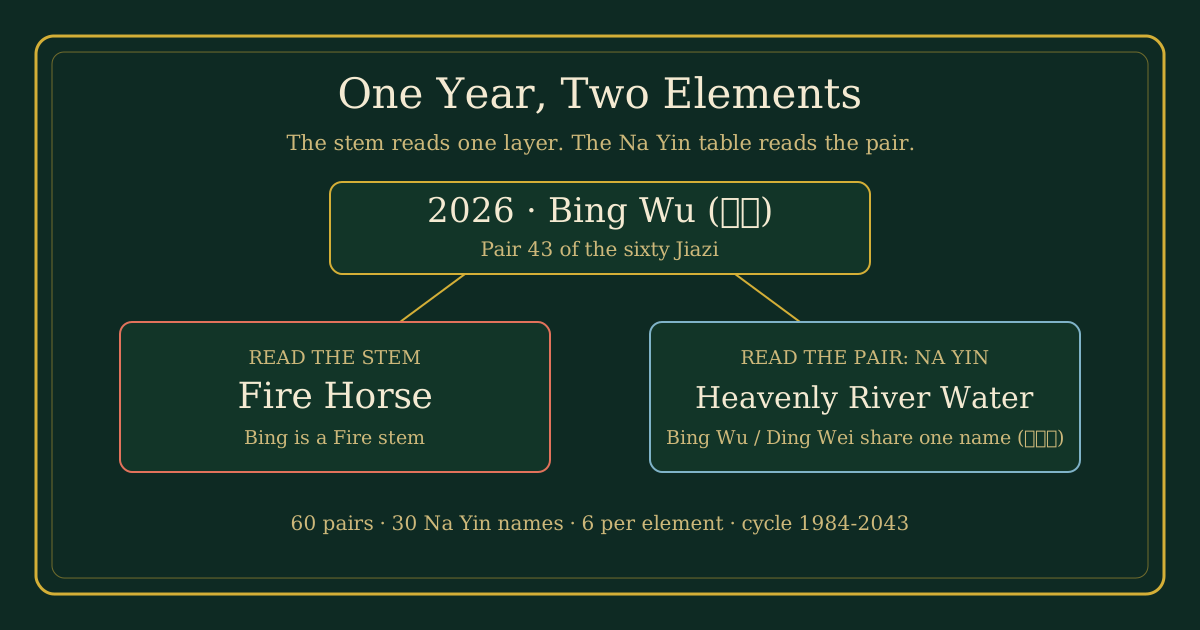
Every zodiac year carries two element labels, from two different layers of the same system. The familiar one reads the Heavenly Stem: 1990 has the stem Geng, a Metal stem, so 1990 is a Metal Horse year. The second layer is Na Yin (纳音, nayin, received tone). Na Yin ignores the stem on its own and files the whole stem-branch pair under a named element image. The pair for 1990, Geng Wu, sits in the pair group Geng Wu / Xin Wei, and its Na Yin is Earth by the Roadside. Same year, same pair, two labels, no error on either side. The sixty pairs of the cycle take thirty Na Yin names between them, six names per element, and the full table is printed below with the years of the current cycle, 1984 to 2043. If you only want your own: find your year's stem-branch pair, find that pair in the table, and read across. The rest of this guide explains the machinery, the lookup, and what the tradition does with the answer.
This page sits between three guides already on the site. The zodiac elements guide covers the first layer, the stem element and the last-digit rule that finds it. The birth year chart lists every year's animal and pair. The BaZi chart reading guide shows where the year pair sits inside a four-pillar chart. Na Yin is the layer none of those pages prints, and it is the layer behind a familiar moment of confusion: two references giving one birth year two different elements, each certain it is right.
Two elements for one year: 1990 and 2026
The cleanest way to see the two layers is to put four years side by side.
| Year | Stem-branch pair | Usual label (stem element + animal) | Na Yin |
|---|---|---|---|
| 1984 | Jia Zi (甲子) | Wood Rat | Gold in the Sea (海中金) |
| 1990 | Geng Wu (庚午) | Metal Horse | Earth by the Roadside (路旁土) |
| 2024 | Jia Chen (甲辰) | Wood Dragon | Fire of the Covered Lamp (覆灯火) |
| 2026 | Bing Wu (丙午) | Fire Horse | Water of the Heavenly River (天河水) |
Read the 1984 row slowly, because it breaks the pattern a reader expects. Jia is the first stem and a Wood stem, Zi is the Rat, and the standard label Wood Rat is correct as far as it goes. The Na Yin table files Jia Zi together with the next pair, Yi Chou, under Gold in the Sea: a Metal name on a Wood year. The 2026 row is the one readers will test first this year and next. Bing Wu is the Fire Horse pair, the stem is Fire, the posters say Fire, and the Na Yin for Bing Wu / Ding Wei is a Water name, the Heavenly River, the Milky Way read as a river of stars. Nothing has gone wrong in either row. The stem element answers the question "what element is this year's stem?" The Na Yin answers a different question: "what named image does this pair carry in the sixty-pair table?" A reference that prints only one of the two will look wrong to anyone holding the other. Most arguments about a birth year's element are this table mix-up and nothing deeper.
The machine under the table: stems, branches, and pairs of pairs
Three pieces of structure produce the Na Yin table, and all three can be checked with pencil and paper.
The first is the sixty-pair cycle itself. Ten Heavenly Stems (Jia, Yi, Bing, Ding, Wu, Ji, Geng, Xin, Ren, Gui) and twelve Earthly Branches (Zi, Chou, Yin, Mao, Chen, Si, Wu, Wei, Shen, You, Xu, Hai) advance together, one step each per year. Because both sequences move in lockstep, a yang stem only ever meets a yang branch and a yin stem only a yin branch, so 60 of the 120 arithmetic combinations occur and the other 60 never do. The 60 that occur are the sixty Jiazi, named after the first pair, Jia Zi. The current cycle opened with Jia Zi in 1984, a fact the sexagenary cycle table on Wikipedia prints in its current-cycle column, and it closes with Gui Hai in 2043.
The second piece is the pairing of pairs. Na Yin names are assigned two pairs at a time: positions 1 and 2 share Gold in the Sea, positions 3 and 4 share Fire in the Furnace, and so on down the cycle. Each shared name joins a yang pair to the yin pair that follows it, same element family in the stem sequence, one step apart on the wheel. Sixty pairs at two pairs per name gives thirty names. That is the whole arithmetic of the system, and it is why the table below has thirty rows for sixty years.
The third piece is the spread across the elements. The thirty names split evenly, six per element:
- Metal: Gold in the Sea, Metal of the Sword Edge, White Wax Metal, Gold in the Sand, Gold Foil, Metal of Hairpins and Bracelets
- Wood: Wood of the Great Forest, Wood of the Willow, Wood of Pine and Cypress, Wood of the Flatland, Wood of the Mulberry, Wood of the Pomegranate
- Water: Water of the Stream Below, Water of the Spring, Long Flowing Water, Water of the Heavenly River, Water of the Great Stream, Water of the Great Ocean
- Fire: Fire in the Furnace, Fire on the Mountain Top, Thunderbolt Fire, Fire at the Foot of the Mountain, Fire of the Covered Lamp, Heavenly Fire
- Earth: Earth by the Roadside, Earth of the City Wall, Earth on the Roof, Earth on the Wall, Earth of the Great Post Station, Earth in the Sand
The names are images, not grades. Sea gold is metal sunk and hidden in deep water. Sword-edge metal is metal hardened, sharpened, and ready. Gold foil is metal beaten thin enough to cover a statue. Tradition reads those pictures as different tempers of one element, and the picture, not the element alone, is what a Na Yin reading works with. Translation varies between books: Fire of the Covered Lamp also appears as Buddha Lamp Fire, Water of the Stream Below as Brook Water, Earth of the Great Post Station as Grand Post Road Earth. The Chinese names and the pairings do not vary; only the English renderings do.
Advertisement
Why the name mentions sound
Na (纳) means to receive or take in, and yin (音) means sound or tone. Classical explanations of the system tie the pairings to the pitch standards of old Chinese music theory, the tuned pipes whose lengths fixed the scale: the sixty pairs were matched against tones, and each pair grouping took its element from where it fell in that scheme. Modern writers on the system still call it a sound system for that reason. The derivation matters less than what it tells a reader about the layer's age and character. Na Yin is not a refinement added to chart reading later. It is an early way of filing the sixty pairs, older than many of the interpretive habits built on top of it, and it survives because the table is fixed, short, and easy to hand down: thirty names, learned once, applied to any year in the cycle.
The full table: thirty Na Yin for the sixty Jiazi
Years below are the current cycle, 1984 to 2043, one row per Na Yin name. For a year outside that span, add or subtract 60 until the year lands in the table: 1924 and 2044 read exactly as 1984 does. The pair names use the standard pinyin for the stems and branches.
| Cycle positions | Stem-branch pairs | Years | Na Yin | Element |
|---|---|---|---|---|
| 1-2 | Jia Zi (甲子), Yi Chou (乙丑) | 1984, 1985 | Gold in the Sea (海中金) | Metal |
| 3-4 | Bing Yin (丙寅), Ding Mao (丁卯) | 1986, 1987 | Fire in the Furnace (炉中火) | Fire |
| 5-6 | Wu Chen (戊辰), Ji Si (己巳) | 1988, 1989 | Wood of the Great Forest (大林木) | Wood |
| 7-8 | Geng Wu (庚午), Xin Wei (辛未) | 1990, 1991 | Earth by the Roadside (路旁土) | Earth |
| 9-10 | Ren Shen (壬申), Gui You (癸酉) | 1992, 1993 | Metal of the Sword Edge (剑锋金) | Metal |
| 11-12 | Jia Xu (甲戌), Yi Hai (乙亥) | 1994, 1995 | Fire on the Mountain Top (山头火) | Fire |
| 13-14 | Bing Zi (丙子), Ding Chou (丁丑) | 1996, 1997 | Water of the Stream Below (涧下水) | Water |
| 15-16 | Wu Yin (戊寅), Ji Mao (己卯) | 1998, 1999 | Earth of the City Wall (城头土) | Earth |
| 17-18 | Geng Chen (庚辰), Xin Si (辛巳) | 2000, 2001 | White Wax Metal (白蜡金) | Metal |
| 19-20 | Ren Wu (壬午), Gui Wei (癸未) | 2002, 2003 | Wood of the Willow (杨柳木) | Wood |
| 21-22 | Jia Shen (甲申), Yi You (乙酉) | 2004, 2005 | Water of the Spring (泉中水) | Water |
| 23-24 | Bing Xu (丙戌), Ding Hai (丁亥) | 2006, 2007 | Earth on the Roof (屋上土) | Earth |
| 25-26 | Wu Zi (戊子), Ji Chou (己丑) | 2008, 2009 | Thunderbolt Fire (霹雳火) | Fire |
| 27-28 | Geng Yin (庚寅), Xin Mao (辛卯) | 2010, 2011 | Wood of Pine and Cypress (松柏木) | Wood |
| 29-30 | Ren Chen (壬辰), Gui Si (癸巳) | 2012, 2013 | Long Flowing Water (长流水) | Water |
| 31-32 | Jia Wu (甲午), Yi Wei (乙未) | 2014, 2015 | Gold in the Sand (沙中金) | Metal |
| 33-34 | Bing Shen (丙申), Ding You (丁酉) | 2016, 2017 | Fire at the Foot of the Mountain (山下火) | Fire |
| 35-36 | Wu Xu (戊戌), Ji Hai (己亥) | 2018, 2019 | Wood of the Flatland (平地木) | Wood |
| 37-38 | Geng Zi (庚子), Xin Chou (辛丑) | 2020, 2021 | Earth on the Wall (壁上土) | Earth |
| 39-40 | Ren Yin (壬寅), Gui Mao (癸卯) | 2022, 2023 | Gold Foil (金箔金) | Metal |
| 41-42 | Jia Chen (甲辰), Yi Si (乙巳) | 2024, 2025 | Fire of the Covered Lamp (覆灯火) | Fire |
| 43-44 | Bing Wu (丙午), Ding Wei (丁未) | 2026, 2027 | Water of the Heavenly River (天河水) | Water |
| 45-46 | Wu Shen (戊申), Ji You (己酉) | 2028, 2029 | Earth of the Great Post Station (大驿土) | Earth |
| 47-48 | Geng Xu (庚戌), Xin Hai (辛亥) | 2030, 2031 | Metal of Hairpins and Bracelets (钗钏金) | Metal |
| 49-50 | Ren Zi (壬子), Gui Chou (癸丑) | 2032, 2033 | Wood of the Mulberry (桑柘木) | Wood |
| 51-52 | Jia Yin (甲寅), Yi Mao (乙卯) | 2034, 2035 | Water of the Great Stream (大溪水) | Water |
| 53-54 | Bing Chen (丙辰), Ding Si (丁巳) | 2036, 2037 | Earth in the Sand (沙中土) | Earth |
| 55-56 | Wu Wu (戊午), Ji Wei (己未) | 2038, 2039 | Heavenly Fire (天上火) | Fire |
| 57-58 | Geng Shen (庚申), Xin You (辛酉) | 2040, 2041 | Wood of the Pomegranate (石榴木) | Wood |
| 59-60 | Ren Xu (壬戌), Gui Hai (癸亥) | 2042, 2043 | Water of the Great Ocean (大海水) | Water |
Two patterns are worth seeing in the table itself. The Na Yin elements do not run in the tidy generating order the stem elements follow. Metal, Fire, Wood, Earth, Metal: the sequence jumps, because the names were fitted to pair groups, not dealt out in rotation. And the images within one element spread from the hidden to the exposed: Metal runs from gold sunk in the sea to gold foil spread over a surface, Water from a stream under a valley to the whole ocean. A reader who only records the element and drops the image has thrown away the part of the system that does the work in a traditional reading.
Find yours in three steps
Step 1: get the pair. One anchor is enough. Jia Zi is 1984, and the pairs advance one step per year in the fixed order printed in the table's second column. A 2000 birth is 16 steps past 1984, which lands on pair 17, Geng Chen. The birth year chart gives the pair directly for common years and saves the counting.
Step 2: settle the boundary. The pair changes once a year, and the two conventions for the changeover date disagree by a few weeks. Popular zodiac practice turns the year at Lunar New Year, which falls in late January or February. BaZi practice turns the year pillar at Li Chun, the solar term that falls on February 3, 4, or 5. A birth in that window can take either pair depending on the convention, and the Na Yin follows the pair, so it flips with the same choice. The elements guide works through the boundary in detail. Pick the convention your reader or book uses, and use it for both layers.
Step 3: read the row. Find the pair in the table. The name in that row is the year's Na Yin.
Worked through once, for a birth in 1996: the pair is Bing Zi (position 13), a Fire Rat year by the stem. Positions 13-14 share Water of the Stream Below, so the Na Yin is a Water name on a Fire year, the same shape of surprise as 2026. A second check, for 1967: subtract nothing, add 60, and read 2027's row, Ding Wei, Water of the Heavenly River. A 1967 birth is a Fire Goat by the stem, with the same Heavenly River Na Yin that 2026 and 2027 carry now. That sixty-year echo is the cycle doing exactly what it is built to do.
What tradition uses the layer for
Na Yin shows up in three places in traditional practice, always as a supplement, never as the main engine of a reading.
The first is the year fate, the short reading taken from the birth year's pair alone. Before a full chart is cast, the year Na Yin gives the reader a one-line sketch: the element, and the image that qualifies it. Folk verses grew up around exactly this use, rhymes that sort the thirty names by which ones the verse says fear water, fear fire, or hold up well. The verses disagree with each other between schools, which is normal for folk material, and they are quoted in practitioner writing as tradition, not as findings.
The second is compatibility between two people, read off the two year Na Yin names. Where the clash pairs guide works with the animal branches, a Na Yin match works with the pair images: the generating and controlling cycles applied to two named elements, Sea Gold with Stream Water, Furnace Fire with Pine and Cypress Wood, and so on. It is a coarser instrument than a full chart comparison, two data points against eight characters, and practitioners who use it say so.
The third is inside the full chart. A BaZi chart has four pillars, and each pillar is a stem-branch pair, so each carries its own Na Yin: four names per chart, year, month, day, and hour. Readers who work with the layer read those four images against the chart's main element balance, the standard stem and branch elements doing the structural work while the Na Yin names add texture. Almanacs print the day's Na Yin for the same reason: the day pair is public, fixed, and part of the daily stack of layers a printed Tong Shu lays out. In every one of these uses, the working rule is the same: the standard element is the structure, the Na Yin is the shading. A reading that reverses that order, and builds on the year Na Yin alone, has left the mainstream of its own tradition.
Three mistakes this table prevents
Treating Na Yin as the real element and the stem element as the mistake. Both are standard. A 1990 birth described as a Metal Horse in one book and Earth by the Roadside in another has been described twice, not wronged once. The fix is to ask which layer a source is using before comparing sources.
Looking up the Gregorian year without the boundary. A birth on January 20, 1997 belongs to the Bing Zi year that began in 1996 under both changeover conventions, because both turn dates fall later than January 20. Using the calendar year alone files that birth under Ding Chou and Thunderbolt Fire's neighbour row instead of Stream Below Water. The error is small, one row, and it is the most common lookup error there is. The same care applies at the other end of a life event: a ben ming nian year is counted by the pair, so the boundary decides that too.
Reading the image as a verdict. Pomegranate Wood does not certify a fruitful life and Sword Edge Metal does not certify a sharp one. The images are filing pictures, memorable handles for pair groups, which traditional readers then interpret inside a reading. The picture is the label on the drawer. It is not the contents, and it is not a promise about the person filed under it.
Limits, stated plainly
Na Yin is a classification scheme from a pre-modern calendar culture: elegant, internally consistent, and easy to verify as a table. The table in this guide was cross-checked against two published Na Yin tables and the standard sexagenary year table, and the pairings, names, and cycle anchors agree across them. That is the level of fact on offer here: the tradition really does file 1990 under Earth by the Roadside, and 2026 under Water of the Heavenly River.
What no source can supply is evidence that the filing predicts anything about a person born in those years. Used as cultural literacy, the layer is genuinely useful: it explains contradictions between references, it opens the older literature, and it shows how much structure the sixty-pair cycle carries. Used as a forecast about character, compatibility, money, or health, it goes past anything the evidence supports, and this site does not use it that way. Look yours up, enjoy the picture it hands you, and let it stay a picture.
Sources and further reading
- Sexagenary cycle, Wikipedia: the sixty-pair table with the current cycle years, 1984 as Jia Zi through 2043 as Gui Hai, read for the cycle anchors and pair order in this guide.
- Nayin Five Elements, Longhu Mountain: a full thirty-name Na Yin table with birth years, read for this guide and matched row by row against the table below it.
- Nayin Five Elements explained, Shunshi: a second full table, used as the cross-check; all thirty pairings and names agree with the Longhu Mountain table.
- Four Pillars of Destiny, Wikipedia: the four-pillar structure, the stem and branch element table, and the generating and controlling cycles the compatibility use relies on.