Most people who look up their Chinese zodiac sign stop at the animal. The animal is only the lower wheel of the calendar. Above it turns a second wheel, the ten Heavenly Stems, and that wheel is where your element comes from. Rat, Ox, Tiger, and the rest repeat every twelve years. The stem pairing repeats every sixty. A Fire Rat and a Water Rat share an animal and sit forty-eight years apart in the cycle, and inside the tradition they are not read as the same year at all.
This guide works the element layer on its own terms. It starts with the ten-second rule for finding your element from your birth year, then states the one boundary that can change the answer, then sets out the ten stems with their polarity, and prints the full twelve-by-five table so every one of the sixty combinations has a year attached to it. The associations tradition attaches to each element are reported as the tradition states them, in tradition's own language. They are not claims about any person's character or prospects.
The last-digit rule
Your element comes from the last digit of your birth year.
| Birth year ends in | Element | Stem pair behind it |
|---|---|---|
| 0 or 1 | Metal | Geng (Yang), Xin (Yin) |
| 2 or 3 | Water | Ren (Yang), Gui (Yin) |
| 4 or 5 | Wood | Jia (Yang), Yi (Yin) |
| 6 or 7 | Fire | Bing (Yang), Ding (Yin) |
| 8 or 9 | Earth | Wu (Yang), Ji (Yin) |
The rule is a shortcut over the stem cycle, and it holds because the stems step in a fixed order of ten against the year numbers. Each element owns two consecutive years, one under its yang stem and one under its yin stem, then hands over to the next element in the generating order: Wood, Fire, Earth, Metal, Water, and back to Wood. Worked against the years around this guide: 2024 ends in 4 and is Jia Chen, a Wood Dragon year. 2025 ends in 5 and is Yi Si, a Wood Snake year. 2026 ends in 6 and is Bing Wu, the Fire Horse year now running. 2027 ends in 7 and is Ding Wei, the Fire Goat year, read in full in the 2027 Fire Goat year guide. Two Wood years, then two Fire years. The digit gives the element. The full stem name, with its polarity, comes from the stem table further down.
A reader who wants the animal and the element together, year by year with exact start and end dates, can work from the Chinese zodiac sign by birth year chart, which prints the 1996 to 2032 run with both layers stated. The Find My Sign tool returns the sign for a single date with the boundary rule applied. This guide stays on the element wheel itself: where it comes from, how the sixty combinations fall out of it, and where the shortcut stops working.
The January and February boundary
The last-digit rule reads the zodiac year, and the zodiac year does not turn on January 1. It turns in late January or February, at Lunar New Year in festival counting and at Li Chun, the first solar term, in BaZi counting. A birth early in a calendar year can therefore belong to the zodiac year before the one printed on the birth certificate, and it takes that earlier year's element with it.
One worked case fixes the rule in place. Lunar New Year in 1990 fell on January 27. The year that begins that day is Geng Wu, the Metal Horse year, and the shortcut agrees: 1990 ends in 0, Metal. A child born on January 15, 1990, twelve days before the turn, belongs to the year still running, Ji Si, the Earth Snake year of 1989. That child's element inside the tradition is Earth, not the Metal the bare digit suggests. A child born on February 15, 1990 is a Metal Horse in both festival and BaZi counting, and the shortcut and the chart agree. The digit never misleads for a birth from March onward. Every January birth, and every February birth before the turn, needs the zodiac year settled first and the element read second.
The gap between the two turn dates adds a narrow second case, the same one the Fire Goat guide works for 2027. In a year when Li Chun falls before Lunar New Year, a birth between the two dates is the new year in BaZi counting and the old year in festival counting, element included. Teachers handle it by stating which count a reading uses. A family keeping the festival sign for celebrations and the chart sign for chart work never has to force the two to agree.
The ten stems: five elements, two polarities
The stem wheel has ten places, not five, and the extra five are the yin and yang split. Each element appears twice, once as a yang stem and once as a yin stem, and the pair covers two consecutive years before the wheel moves on.
| Order | Stem | Element | Polarity | Teaching image used in tradition |
|---|---|---|---|---|
| 1 | Jia | Wood | Yang | A standing tree |
| 2 | Yi | Wood | Yin | A vine, a young plant |
| 3 | Bing | Fire | Yang | The sun |
| 4 | Ding | Fire | Yin | A candle flame |
| 5 | Wu | Earth | Yang | A mountain, high ground |
| 6 | Ji | Earth | Yin | Field soil, garden ground |
| 7 | Geng | Metal | Yang | Raw ore, an axe head |
| 8 | Xin | Metal | Yin | Worked metal, jewellery |
| 9 | Ren | Water | Yang | A river, the sea |
| 10 | Gui | Water | Yin | Rain, a spring |
The images are teaching pictures, and teachers state them as pictures. They carry the polarity distinction in a form a student can hold: the yang stem of an element pictured at larger scale and in the open, the yin stem at smaller scale and close at hand. A candle flame and the sun are both Fire inside the system. They differ in the scale the tradition pictures, and a year reading that names its stem, Ding rather than only Fire, is keeping that distinction visible. The 2027 year is the worked example on this site: Ding Wei pairs the candle-flame stem with the Goat branch, and the year guide reads the pairing as Yin Fire over Earth, stem feeding branch in the generating cycle.
Polarity also fixes a pattern worth seeing once. Because the stem wheel has ten places and the branch wheel twelve, the parity of the two wheels locks together. Yang stems only ever pair with yang branches and yin stems with yin branches. That lock is why the cycle holds sixty combinations and not one hundred and twenty: half the theoretical pairings can never occur, and no year in any century carries one.
Advertisement
Two cycles between the elements
Teachers relate the five elements to each other through two cycles, and both cycles run through the year layer as well as through charts.
The generating cycle, sheng, runs Wood to Fire to Earth to Metal to Water and back to Wood. The pictures teachers attach to it are plain: wood feeds a fire, fire leaves ash that becomes earth, metal is drawn from the earth, metal gathers and carries water in the old image of a vessel or of condensation on a cold blade, and water grows wood. Adjacent in this cycle, one element is read as feeding the next.
The controlling cycle, ke, steps across the generating order. Wood controls Earth, pictured as roots holding and parting soil. Earth controls Water, as banks and dams hold a river. Water controls Fire, by putting it out. Fire controls Metal, by melting it. Metal controls Wood, as a blade cuts timber. Adjacent in this cycle, one element is read as pressing on the next.
Applied to years, the two cycles describe how a stem sits over a branch element, and applied to people they describe, inside the tradition, how one person's year element is said to sit beside another's. A Fire stem over an Earth branch, 2027's arrangement, sits on the generating side: fire feeds earth. A Fire stem over a Metal branch sits on the controlling side. Readers inside the tradition use that placement as a starting theme for a year's reading, and the Chinese zodiac love compatibility guide works the branch relationships, trines, harmony pairs, and clashes, in the same reported-as-tradition frame. This guide claims nothing further for either cycle. The cycles are the system's internal grammar, stated here so the tables around them can be read.
The full table: twelve animals by five elements
Stepping a ten-place wheel against a twelve-place wheel one year at a time returns both wheels to their starting marks after sixty steps. Sixty pairings, each with a stem, an element with its polarity, and an animal. The current sixty-year cycle opened in 1984 with Jia Zi, the Yang Wood Rat, and closes in 2043 with Gui Hai, the Yin Water Pig. The table below gives one year inside that cycle for every combination, so any birth year from 1984 to 2043 can be placed by finding its animal row and its element column, and any earlier year can be placed by adding or subtracting sixty.
| Animal | Wood | Fire | Earth | Metal | Water |
|---|---|---|---|---|---|
| Rat | 1984 | 1996 | 2008 | 2020 | 2032 |
| Ox | 1985 | 1997 | 2009 | 2021 | 2033 |
| Tiger | 2034 | 1986 | 1998 | 2010 | 2022 |
| Rabbit | 2035 | 1987 | 1999 | 2011 | 2023 |
| Dragon | 2024 | 2036 | 1988 | 2000 | 2012 |
| Snake | 2025 | 2037 | 1989 | 2001 | 2013 |
| Horse | 2014 | 2026 | 2038 | 1990 | 2002 |
| Goat | 2015 | 2027 | 2039 | 1991 | 2003 |
| Monkey | 2004 | 2016 | 2028 | 2040 | 1992 |
| Rooster | 2005 | 2017 | 2029 | 2041 | 1993 |
| Dog | 1994 | 2006 | 2018 | 2030 | 2042 |
| Pig | 1995 | 2007 | 2019 | 2031 | 2043 |
Read the table by its diagonals and the machinery shows itself. The five years in any column step by twelve down the cycle in one order, and each animal meets the five elements in the generating sequence across its row, sixty years apart each time the same cell comes round. The Horse row makes the recent run concrete: Metal Horse 1990, Water Horse 2002, Wood Horse 2014, Fire Horse 2026, Earth Horse 2038. Five Horse years a dozen years apart, five different stems, and no sixth possibility.
The table also settles a question the animal alone cannot answer. Two people born twelve years apart share an animal and never share an element, because twelve steps move the stem wheel two places past a full turn of ten. Two people born sixty years apart share both, animal and stem together, which is the calendar fact underneath the weight tradition gives the 60th birthday and the returning year of the ben ming nian guide, where the sign comes back every twelve years and the full pairing comes back once.
What tradition attaches to each element, stated as tradition
Year guides inside this tradition attach a short set of associations to each element, and readers use them as the first theme of a year or a birth-year reading. They are reported here in the form teachers state them. They describe the element inside the system. They are not findings about people, and no reader should take a birth-year element as a description of themselves or anyone else.
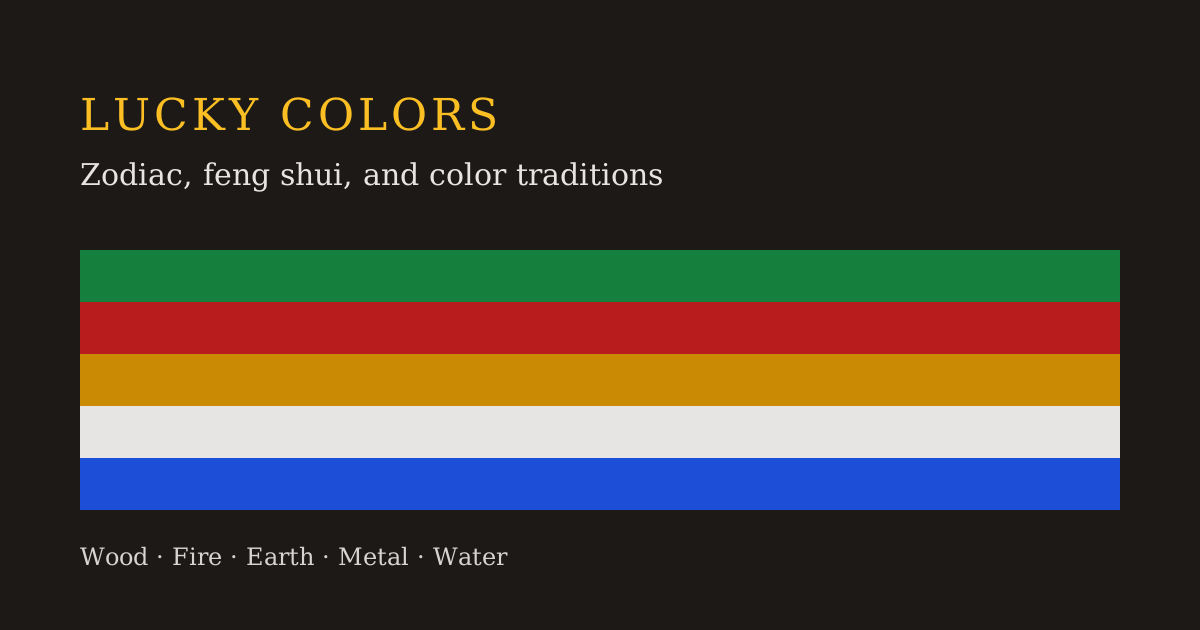
Wood is pictured growing: a tree upward, a vine along a trellis. Tradition reads the Wood layer as the growing and reaching part of a pairing, and colours, materials, and rooms get attached to it through that picture. The Chinese zodiac lucky colors by animal guide sets out how the colour layer is assigned sign by sign inside the same frame.
Fire is pictured as heat and light, sun-scale under Bing and candle-scale under Ding. Tradition reads the Fire layer as the visible, warming part of a pairing. Earth is pictured as ground: mountain under Wu, field soil under Ji, and tradition reads the Earth layer as the settling and holding part. Metal is pictured drawn from the ground and then worked, ore under Geng and finished metal under Xin, read as the hardening and shaping part. Water is pictured moving and gathering, river under Ren and rain under Gui, read as the flowing and storing part.
Two cautions belong with any such list, and teachers who work carefully state both. The first is that the year stem is one pillar of four. A BaZi chart casts the month, day, and hour pillars beside the year pillar, and the day stem, the Day Master, sits at the centre of the reading. Two people who share a Fire Horse birth year can carry charts that share nothing past that year pillar. The second caution is the boundary from earlier in this guide: the element belongs to the zodiac year, not the calendar year, and a January or early February birth takes the element of the year still running. A table lookup that skips either caution is using the calendar as a label, not as the calendar works.
The branch carries an element of its own
The year table above names one element per year, and that element always comes from the stem. Teachers also assign each branch a fixed element of its own, and the two assignments answer different questions. The stem element changes every year and gives the year its name: Fire Horse, Water Dragon. The branch element never changes. The Rat branch Zi is read as Water in every Rat year, the Horse branch Wu as Fire in every Horse year, and so on through the wheel.
| Branch | Animal | Fixed branch element in tradition |
|---|---|---|
| Zi | Rat | Water |
| Chou | Ox | Earth |
| Yin | Tiger | Wood |
| Mao | Rabbit | Wood |
| Chen | Dragon | Earth |
| Si | Snake | Fire |
| Wu | Horse | Fire |
| Wei | Goat | Earth |
| Shen | Monkey | Metal |
| You | Rooster | Metal |
| Xu | Dog | Earth |
| Hai | Pig | Water |
The four Earth branches, Ox, Dragon, Goat, and Dog, sit at the quarter points of the branch wheel, and teachers mark them as the storage branches of the system, the points where one season is read as settling into the next. The pattern behind the rest of the table is seasonal: the Wood branches stand in the spring quarter of the wheel, Fire in the summer quarter, Metal in the autumn quarter, and Water in the winter quarter, with the Earth branches closing each quarter.
A year reading inside the tradition weighs the stem element against the branch element before it says anything else. Three arrangements recur. In some years the two agree, a Fire stem over the Fire Horse branch, as 2026 does with Bing over Wu. Teachers read agreement as the year's two layers pulling in one direction inside the system's own terms. In other years the stem feeds the branch element or the branch element feeds the stem, a generating arrangement, as Ding Fire feeds Wei Earth in 2027. In the remaining years one layer controls the other, a Fire stem over a Metal branch, read inside the system as a pressing arrangement. Popular year tables print only the stem element, which is the named element of the year. The branch element sits underneath it in every chart, and it is one reason two readers can agree on the year's name and still describe the year differently: one is reporting the label, the other is reporting the weighing.
The same fixed table explains a habit in quick online lookups. A page that calls the Horse a Fire sign and a page that calls 1990 a Metal year are not contradicting each other. The first is naming the branch element, the second the stem element of that year. Both statements follow the calendar. They are reading different layers of it.
Checking a claimed element before you repeat it
Free zodiac pages disagree often enough that a thirty-second check pays. The cycle arithmetic in this guide is the check, and it needs nothing beyond the year itself.
First, fix the zodiac year. A birth from March onward takes the calendar year as printed. A January or February birth takes the earlier year when it falls before that year's turn, so settle the turn date before any element work. The birth year chart linked earlier in this guide prints the turn dates year by year.
Second, read the element off the last digit of the settled year: 0 or 1 Metal, 2 or 3 Water, 4 or 5 Wood, 6 or 7 Fire, 8 or 9 Earth. If a page names a different element for that year, the page is either applying a boundary rule it has not stated or it is wrong, and the digit rule shows which.
Third, when a page names a full stem and branch pair, cross-check it against the sixty table. Find the animal row and the element column. The year printed in the cell, or that year plus or minus sixty, should be the year on the page. A pair that no cell can produce, a Metal Rabbit claimed for a year the table puts in a different column, signals an error in the source rather than a variant tradition. The tradition's variants live in the turn-date rules and in how readings are framed. The stem and branch arithmetic itself has no variants.
Placing any year, including years outside the table
The 1984 to 2043 table covers most readers and their parents. For a year outside it, subtract or add sixty until the year lands inside the cycle, then read the cell. A birth in 1966 lands on 2026 after adding sixty, and 2026 is Bing Wu: the 1966 birth year is the Fire Horse year of its own cycle, stem for stem. A birth in 1954 lands on 2014, Jia Wu, the Wood Horse. The animal never moves under this shift, because sixty is a whole number of twelve-year turns. Only the century changes.
For a birth year before 1924, the cycle before the current one opened in 1924 with Jia Zi as well, sixty years before 1984, so the same table works by subtracting sixty or one hundred and twenty. The arithmetic is the whole method. There is no separate ancient table, and any source that prints a different element for the same year has either applied the January boundary or made an error the cycle arithmetic can check.
One last distinction keeps the record straight. Everything in this guide belongs to the lunar-solar calendar tradition and its festival and chart practices. The element of a year is a calendar fact inside that tradition, fixed by the stem, checkable by counting. What a reader builds on the fact, a colour choice, a date choice, a year theme, belongs to practice, and practice varies by teacher and by family. The calendar layer below it does not vary, and that layer is the part worth getting right.