The short version
Short answer: 2026 is a Fire Horse year (Bing Wu) in the Chinese zodiac, beginning at Lunar New Year on 17 February 2026. In five-elements (wu xing) tradition, fire is associated with reds, purples, and oranges; wood greens feed fire; earth yellows and browns are produced by fire; metal whites and golds are controlled by fire; and water blues and black control fire. Practitioners talking about a strong fire year tend to describe balance in those cycle terms, then apply the palette modestly: clothing accents, an entryway note, a desk object, celebration decor, and textiles rather than repainted rooms. The Horse's own traditional lucky colors in the popular animal lists are yellow, green, and red. All of this is tradition, recorded as practitioners describe it, and none of it is a promise about outcomes.
This guide sits inside the site's lucky colors pillar. The hub is the lucky colors complete guide, the animal chart that gives each zodiac animal its palette is Chinese zodiac lucky colors by animal, and the room-by-room application is feng shui colors by room. Where this page uses the cycle language in depth, it leans on the five elements balancing guide. Red's wider cultural career is covered in red in Chinese culture.
The calendar, verified
Start with the dates, because everything else in this piece hangs off them.
2026 is the Year of the Horse. More precisely, it is a Fire Horse year, designated Bing Wu in the sexagenary cycle that pairs ten heavenly stems with twelve earthly branches. The Smithsonian Institution's Lunar New Year page states it directly: in the Chinese zodiac 2026 is the Year of the Fire Horse, and the Chinese Lunar New Year begins February 17, 2026, starting the 15-day Spring Festival that concludes with the Lantern Festival. Independent festival coverage agrees on the same boundary, placing the first day of the Fire Horse year on 17 February 2026 and the close of the zodiac year on 5 February 2027.
Why fire, and why the emphasis on it? The Horse branch (Wu) already carries fire as its underlying element in the traditional scheme. When the heavenly stem is Bing, which is yang fire, the year pairs fire with fire. Commentators on the 2026 cycle often call this a doubled fire year for that reason: the stem and the branch point at the same element. The previous Fire Horse year was 1966, and the next arrives in 2086, which is part of why 2026 attracts more color commentary than an ordinary Horse year. The element is doing double duty, so the balancing conversation gets louder.
One calendar nuance belongs here because readers will meet it elsewhere. Some BaZi and feng shui practitioners time the year from Lichun, the solar term that marks the start of spring, which falls in early February, roughly two weeks before Lunar New Year. That is a different convention for a different purpose. Families choosing New Year outfits, reunion dinner dates, and red envelope timing use the festival date, 17 February, and that is the date this guide uses when it talks about the year beginning.
The five elements color system, in one table
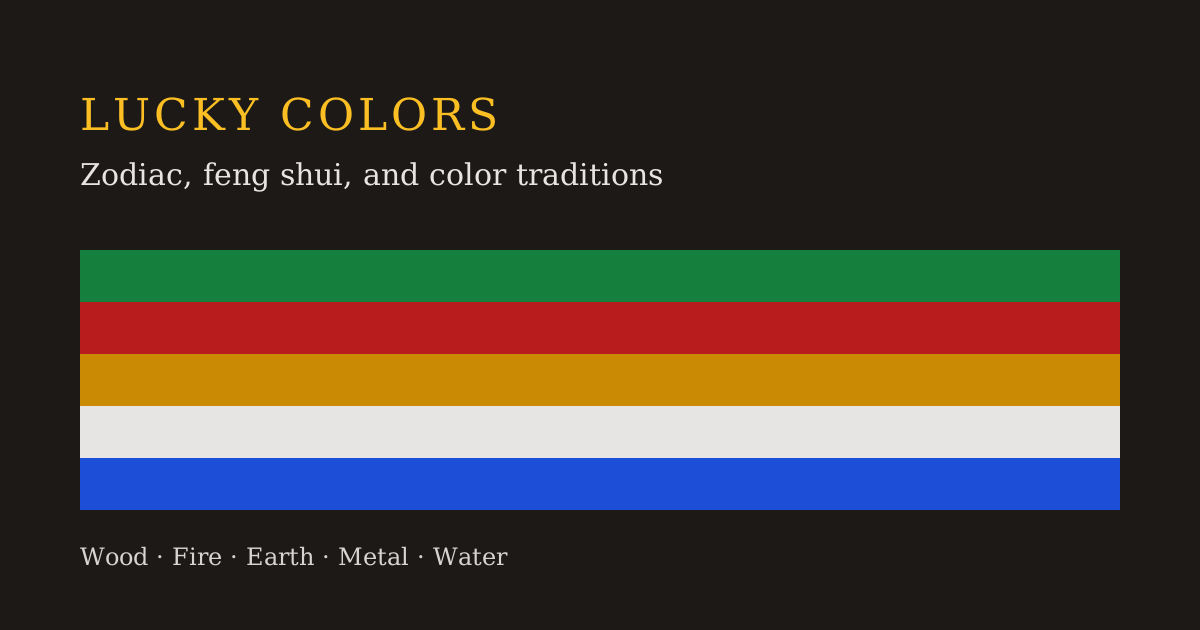
Wu xing, usually translated as five elements or five phases, is the framework underneath most traditional Chinese color talk. It names five phases, Wood, Fire, Earth, Metal, and Water, and relates them through two cycles. In the generating cycle (sheng), each phase feeds the next: Wood feeds Fire, Fire produces Earth as ash, Earth bears Metal, Metal collects Water, and Water nourishes Wood. In the controlling cycle (ke), each phase restrains another: Wood parts Earth, Earth dams Water, Water extinguishes Fire, Fire melts Metal, and Metal cuts Wood. Color associations attach to each phase and have stayed broadly consistent across classical and modern references.
| Element | Traditional colors | Relationship to Fire | How the tradition reads it |
|---|---|---|---|
| Wood | Greens, teal greens | Feeds Fire (Wood generates Fire) | Growth, spring, living plants; used in small amounts when fire is already strong |
| Fire | Reds, purples, oranges, strong pinks | The year's presiding element in 2026 | Celebration, visibility, warmth; the festival color family |
| Earth | Yellows, ochres, browns, warm neutrals | Produced by Fire (Fire generates Earth) | Stability and grounding; often described as draining excess fire into steadiness |
| Metal | Whites, greys, silver, gold tones | Controlled by Fire (Fire overcomes Metal) | Clarity and precision; gold also carries prosperity symbolism across the festival |
| Water | Blues, deep blue greens, black | Controls Fire (Water overcomes Fire) | Calm and depth; often described as cooling a strong fire year |
Read the table the way a practitioner reads it, as a set of relationships rather than a ranking. A color is never just lucky or unlucky in this system; it is feeding, produced by, controlling, or controlled by the element you are talking about. That relational logic is what makes the system usable for design decisions, because it gives you a reason you can say out loud. If a room already runs hot and bright, the tradition would not nominate more fire red for the walls. It would look along the cycle for earth to ground the palette or water to cool it, and it would treat wood green as an accent to use sparingly, since wood feeds the flame. Our five elements balancing guide walks through that reasoning room by room with materials as well as colors.
Lists vary slightly between publishers: some fold pink into fire, some list cyan with wood, and gold lives a double life as both a metal tone and a general prosperity symbol. The table above follows the most widely reproduced associations. The green of wood in classical Chinese (qing) also covers a range modern English splits into green, azure, and blue green, which is why sources sometimes seem to disagree about whether wood is green or blue.
What a strong fire year means in the tradition's own language
Because 2026 pairs a fire stem with a fire branch, practitioner writing about the year tends to use a consistent vocabulary: intensity, visibility, speed, and warmth. The Horse contributes its own folk character to the blend. In zodiac storytelling the Horse is movement, independence, stamina, and a dislike of fences. Put the two together and the year's traditional portrait is energetic and forward leaning, the kind of year in which the culture's storytellers expect bold starts and quick weather.
This guide reports that portrait as what it is, a piece of folk characterization with a long publishing history, not a forecast. Where practitioner advice follows from it, the advice is usually about pacing and balance rather than about luck objects. In color terms, the recurring counsel runs like this. If fire is the year's weather, earth tones are the ground: yellows, ochres, and warm browns that steady a palette the way a hearth steadies a room. Water tones are the shade and the drink: blues and deep blue greens that cool a scheme without arguing with it. Wood greens are the kindling, welcome in living form as plants and in small textile notes, but rarely recommended as the dominant note in a year already described as well lit. Fire colors themselves do not disappear. They concentrate at the festival moments where celebration is their job, New Year decor, envelopes, a garment worn to the reunion dinner, and then step back for the working year. Metal whites and golds appear as the clarity note, the clean surface and the precise object, with gold doing its separate prosperity work at celebrations.
The feng shui colors by room guide shows the same cycle reasoning applied space by space, where light and room function get their say alongside the elements.
Advertisement
Horse colors in folk tradition
Separate from the element cycle, the Horse carries its own small palette in the popular animal lists. The widely reproduced lists give the Horse yellow, green, and red. Our site's chart in Chinese zodiac lucky colors by animal records the same list alongside the other eleven animals, with the calendar years for finding your animal. The three colors are easy to picture in festival use. Yellow does harvest and earth work, green does spring and growth work, and red does the celebration.
Beyond the printed lists, the Horse in folk imagery wears red and gold at festival time. New Year pictures, paper cuttings, and procession trappings dress the horse in celebratory red with gold detail, because those are the festival's presiding colors of joy and prosperity wherever they appear. The literary Horse of Chinese tradition, the swift messenger and the tireless traveler, picks up the same coloring in popular art: red ribbons, red saddle cloths in illustration, gold bells. None of this is codified the way the element colors are. It is the decorative layer of the culture, and it is best reported as such. If you are choosing a gift for someone born in a Horse year, wrapping in their animal's yellow, green, and red, with a note naming the wish, is the kind of small legible gesture the system genuinely runs on.
2026 is also ben ming nian, the returning birth-sign year, for Horse-born readers. Tradition holds that in your animal's year you wear red, a red belt, red cord, or red underwear, often gifted by an elder. The custom is among the most widely kept color practices in the culture.
Color in clothing: what practitioners actually suggest
Clothing is where year-color advice gets worn, literally, and the practitioner conversation about a Fire Horse year is more nuanced than the headlines suggest. The festival itself belongs to red. Reunion dinners, temple visits, and family photographs at Lunar New Year run on red garments and red accessories across the culture, and no element calculation talks a grandmother out of a red New Year sweater. That red is doing celebration work, and the tradition treats the festival window as red's home ground.
The balancing conversation applies to the working year that follows. In that frame, writers who follow the cycle often suggest earth and water tones as the year's balancing accents: ochre, camel, and warm brown as the grounding notes; navy, deep teal, and black as the cooling notes; with fire reds and oranges used as deliberate accents rather than the whole outfit. Wood greens appear as the living accent, a scarf, a tie, a bag, in recognition that green feeds fire and a little goes a long way in a fire year. Metal whites and pale golds show up as the clean base that lets an accent read clearly.
What to avoid, in the same folk frame, is phrased as custom rather than prohibition. All-white outfits at celebratory New Year gatherings are avoided in many families because white is the traditional mourning color in Chinese culture, a matter of festival etiquette rather than element logic. Head-to-toe fire colors for ordinary working days are sometimes described by practitioners as wearing the weather instead of dressing for it, which is a stylist's point dressed in cycle language. And green hats carry a well-known idiom problem for men in Chinese culture, unrelated to elements, that our red in Chinese culture feature explains. That one is worth knowing before any festival photograph.
If an interview or examination falls in 2026, the same accent logic applies in miniature, and the site's guide to lucky colors to wear for job interviews and exams covers the dressing-for-confidence side of the tradition in detail. For clothing, practitioners themselves give this summary when pressed: wear the festival red at the festival, balance the strong year with earth and water tones if the cycle framing pleases you, and let fit, weather, and the room you are walking into outrank any chart. Tradition nominates. It does not tailor.
Color at the desk and in the workspace
The desk is the smallest room most people control, which makes it the natural scale for year-color practice. Practitioner suggestions for a Fire Horse year workspace cluster around the same balancing pairs. An earth tone within sight, a ceramic object, a warm brown desk pad, a stone paperweight, is described as grounding a fast year at the exact place where attention lives. A water tone, a navy notebook, a deep blue glass for water, a dark blue screen backdrop, is the cooling note. Fire is usually already present in any modern workspace in the form of screens, notifications, and warm task lighting, so the cycle argument rarely asks for more red at a desk. Where red does appear, it is as a single deliberate object rather than a scheme.
Plants do the wood work at desk scale, with the caveat the cycle suggests: a living green is welcome, a jungle overfeeds a fire year. Metal enters as the clarity tools most desks already own, a steel lamp, white storage, with gold tones kept sparing. The practical test is unchanged from ordinary workspace design: can you see clearly, does the light suit the task, and does the palette stay calm across the day?
The lucky colors complete guide keeps the three systems in their lanes: personal palettes for the person, element balance for the space, festival red for the festival.
Color in celebration decor for the Fire Horse year
Celebration decor is where the year's colors run at full saturation, because decor is temporary and the tradition knows it. Lunar New Year dressing for a home or a business front concentrates red and gold: lanterns, couplets on red paper with gold or black characters, paper cuttings, red envelopes, citrus fruit for its gold color and its name's nearness to words for luck in several dialects. A Fire Horse year adds two notes to that standard arrangement in practitioner tellings. The Horse itself appears as a motif, in paper cutting, in figurines, in children's red packets printed with the year's animal. And the balancing tones make a decor appearance they would never make at an ordinary New Year, a deep blue table runner under the red, earth toned ceramics on the reunion table, because the year's doubled fire invites a visible counterweight even in the festival dressing.
Weddings held in 2026 borrow from both palettes. The wedding tradition keeps its own counsel, red and gold for Chinese celebrations, with the couple's animal colors woven in where families enjoy that layer. The wedding lucky colors across cultures guide works through those choices culture by culture, including the modern sequence of a white ceremony gown followed by red for the banquet. A Fire Horse year does not rewrite wedding color. It adds the option of naming the year in the decor, a horse motif on the invitation, the year's balancing blue in the flowers, small storytelling touches that guests who follow the calendar will read with pleasure.
Business openings in Greater China use the same decor logic at commercial scale: red and gold carry the opening, the year animal appears in the display, and any balance story is told in the accents rather than the logo.
Using the year's colors at home, room by room
Homes are where this site applies the tradition most carefully, because rooms have jobs that outrank symbolism. The method we recommend across the lucky colors pillar is to let room function and light nominate first, then let the year's palette adjust the accents. The feng shui colors by room guide gives the full room-by-room element treatment. What follows is the Fire Horse year overlay, the small set of accent decisions the 2026 balance story actually suggests.
Entryway. The threshold is where feng shui symbolism concentrates, and it is the cheapest place in the house to mark a year. A wreath or door hanging in the year's colors, a mat in an earth tone, a bowl for keys in a metal tone. If your door color itself is in play, the direction traditions assign palettes by compass point, south-facing doors taking fire colors in the classical scheme, and our front door colors by direction guide separates that sourced tradition from folklore. For 2026, practitioners who follow the balance story often keep a beloved red door and add the water or earth note beside it rather than repainting against the year.
Living room. This is the textile room, and the year's advice is mostly textile advice. Earth toned cushions and throws ground a bright room. A deep blue accent, cushions, a rug border, a ceramic piece, cools a south-facing space that already runs warm. Red concentrates in the objects designed to be festive and temporary. Plants carry the wood note in living form. The wall color stays out of the year's business unless it was due for repainting anyway.
Kitchen and dining. The kitchen already contains fire in the most literal form the house offers, and the tradition has always noticed. Earth tones in ceramics, wood, and stone suit the room's work and satisfy the year's grounding story without trying. The dining table is celebration ground, where the reunion palette of red and gold belongs at festival time and earth toned tableware serves the rest of the year.
Bedroom. Sleep outranks symbolism when you plan a bedroom. The year's balance palette happens to agree with sleep hygiene here: water's blues and earth' warm neutrals are the colors both traditions nominate for rest, and fire brights are the ones both suggest keeping small in a room meant for winding down. If you keep one festive note, let it be an object you can put away.
Home office and study. The desk guidance above scales up. Earth for grounding, water for calm, metal whites for clarity, one living green, and fire handled as accent and warm light rather than as wall color. The room's real requirements, glare control, light temperature for video calls, and a background that reads as deliberate, decide most of the palette before the year gets a vote.
Across all five spaces the pattern is the same, and it is the pattern this site keeps returning to. The year nominates accents. The room keeps its job. Paint is the last thing a color tradition should touch, and in a well-kept version of this practice it rarely touches it at all.
The no-repaint toolkit: textiles, thresholds, and light
Because so much of the year's color story is accent work, it is worth collecting the reversible methods in one place. These are the tools practitioners reach for first, and they share a virtue the tradition values: they can be changed when the year changes, or when the room objects.
Textiles first. Cushion covers, throws, quilts, table runners, towels, and bedding carry more visible color per dollar and per hour than any other surface in a home, and they retire to a cupboard without a trace. A household that wants to live inside the Fire Horse palette for a season can do it entirely in textiles: earth toned cushions, a deep blue throw, one red runner for festival weeks, bedding in the calm end of the year's range.
Threshold objects. A door wreath, a seasonal door hanging, a mat, a pair of lanterns for the festival window. The entry carries the house's greeting, and changing its accent color is the single highest-visibility, lowest-commitment move in the whole repertoire. It is also the move guests can actually be told the story about, which is where color symbolism does its real social work.
Lighting warmth. Light temperature shifts a room's element reading without pigment. Warmer bulbs (in the 2700K range common for living spaces) push a palette toward fire and earth. Cooler daylight bulbs push it toward metal and water clarity. Swapping two bulbs in the lamps you use at night will tell you more about whether you enjoy living in the year's warm end than any swatch card.
Living green. A plant is wood you have to keep alive, which the tradition counts as a feature. It is also the only color source in the house that changes on its own schedule. Keep the number modest in a fire year if you follow the feeding logic, and choose plants the room's actual light can support, because a dead plant tells the wrong story in every system.
Paper and small art. Festival paper cuttings, a calendar, a print. Paper is the culture's oldest delivery system for this kind of symbolism, it costs almost nothing, and a piece kept each year builds a visual diary of the cycle.
The toolkit rewards sequencing: change the textiles first, live with them through a few evenings of real light, then adjust the threshold and the bulbs. The tradition is patient. Borrow its patience along with its palette.
What this tradition does not claim
A closing section this site keeps on every lucky colors page to state what colour can and cannot do. Color associations in the five-elements and zodiac systems are cultural tradition. They are real as history, as festival practice, as family custom, and as a shared visual language that millions of people use to mark a year on purpose. Color also has ordinary psychological effects on mood and perception, which designers and psychologists study without any reference to luck. What color does not do, in any evidence this site can stand behind, is change the price a home sells for, alter the outcome of an examination, or bend the odds of a business venture. No arrangement of cushions substitutes for pricing a property well, preparing for an interview, or doing the work.
The Fire Horse year will be celebrated with red lanterns and gold citrus, dressed in earth tones by people who enjoy the balance story, and greeted with horse motifs from paper cuttings to red packets. All of that is worth doing for the reasons the tradition itself gives when you listen closely: it marks time together, it dresses a fresh start in colors chosen on purpose, and it gives a household a story it can tell at the door. A year met that deliberately has received everything color was ever for. The rest belongs to the people living it.