The short answer: the room is not the investment, the scope is
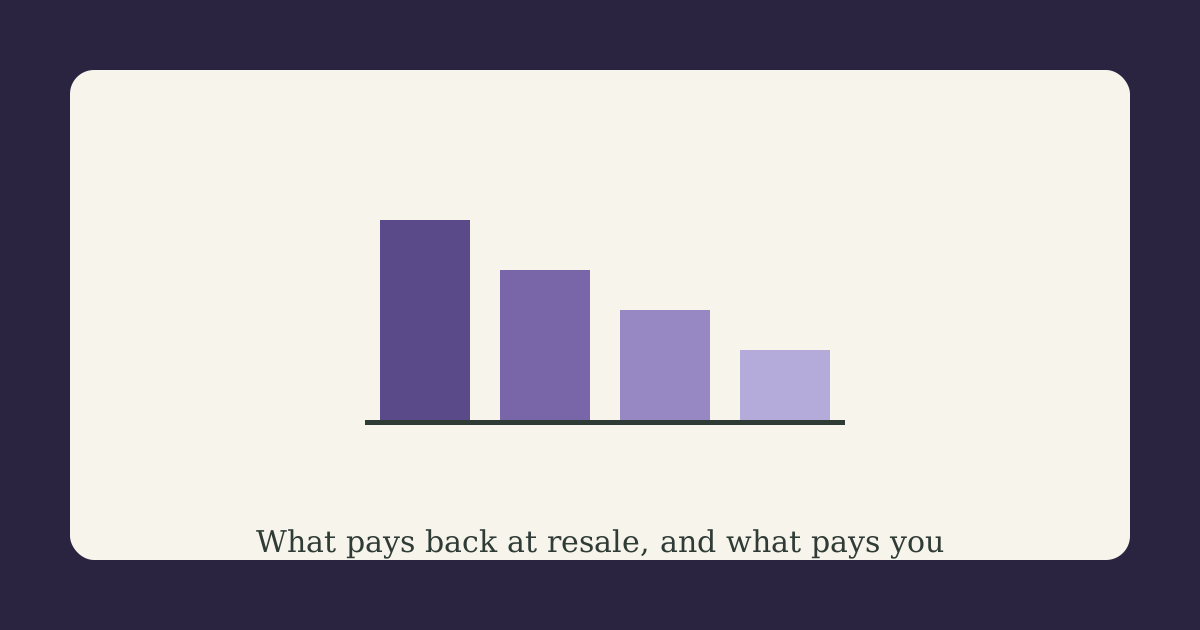
Short answer: Kitchen remodel ROI is not a property of kitchens; it is a property of scope. The Remodeling Magazine 2025 Cost vs Value Report puts a minor midrange kitchen remodel at 113 percent recouped nationally ($28,458 cost, $32,141 resale value), a major midrange kitchen at 51 percent ($82,793 cost, $42,130 value), and a major upscale kitchen at 36 percent ($164,104 cost, $58,561 value). Same room, same report, same year: the version that refreshes the existing layout pays back, and the versions that rebuild it return roughly a half and a third. Everything below is how to choose your scope without lying to yourself about which row you are in.
This page is the kitchen chapter of the home improvement ROI guide, which carries the full 2025 Cost vs Value table across 28 projects and the ceiling rule that outranks it. The bathroom sibling, bathroom remodel ROI, tells the same story in a smaller room. Selling around a kitchen decision? The home selling guide, the prepare your home for sale checklist, and how to price a home to sell handle sequence, presentation, and comparable sales. This is educational information, not construction or financial advice; report figures are U.S. national averages and your quotes and your street decide your project.
The 2025 kitchen rows, exactly as published
The Cost vs Value Report compares the average cost of defined remodeling projects with the resale value those projects retain, as judged across 119 U.S. markets. The kitchen rows below are the report's 2025 national averages, taken from the 2025 report tables hosted by the Journal of Light Construction (jlconline.com/cost-vs-value/2025); the report is published by Zonda Media and also distributed at costvsvalue.com. Read each row as the report defines it, because the definition is doing most of the work.
| Kitchen project (2025 national average) | Job cost | Resale value | Cost recouped |
|---|---|---|---|
| Minor Kitchen Remodel, Midrange | $28,458 | $32,141 | 113% |
| Major Kitchen Remodel, Midrange | $82,793 | $42,130 | 51% |
| Major Kitchen Remodel, Upscale | $164,104 | $58,561 | 36% |
Source: Remodeling Magazine Cost vs Value Report 2025, national averages across 119 U.S. markets (report tables at jlconline.com/cost-vs-value/2025; report home at costvsvalue.com). A recoup above 100 percent means the average resale value attributed to the project exceeded its average cost that year; it describes a modest, tightly defined refresh, not a law of kitchens.
Three facts in this small table organize every kitchen conversation.
First, the resale values bunch while the costs explode. The minor refresh is credited with $32,141 of value; the major midrange, at nearly three times the cost, is credited with $42,130; the upscale, at nearly six times the cost, with $58,561. Buyers and appraisers are telling you, in arithmetic, that a kitchen contributes a bounded amount to a home's value once it is clean, current, and functional. Every specification dollar beyond that bound is buying your enjoyment, at retail, which is a fine purchase and a poor investment thesis.
Second, the gradient is the guidance. Minor to major midrange loses 62 points of recoup. Major midrange to upscale loses 15 more. There is no kitchen row in the middle where spending bravely is rewarded proportionally; the table rewards restraint first and punishes escalation monotonically. Scope discipline is therefore not a taste preference. It is the financial content of the project.
Third, your street can move every row. These are national averages across 119 markets; the same report's regional tables move kitchen recoup rates substantially in both directions, and your comparable sales move them again. A minor refresh in a market where kitchens are the deciding feature can behave better than 113 percent of credited value in effect (shorter time on market is real money the table does not count), and a major kitchen above the neighborhood ceiling can return less than 36. The rows rank scopes reliably. They do not price your house.
What the report scopes actually include (and why your quote keeps escaping them)
Most kitchen ROI regret is a definitions accident: an owner approves a project that feels minor, scopes it like a major, and then judges it against the minor row. Anchor each report scope before anyone quotes.
The minor midrange kitchen: refresh in place
In the report's construction, the minor midrange kitchen keeps the existing layout and the existing cabinet boxes where they stand. The work is surfaces and signals: cabinet fronts refaced or replaced with hardware renewed, new countertops within standard specification, a new mid-grade appliance package (range or cooktop, ventilation, dishwasher, refrigerator in the report's defined set), sink and faucet replaced, flooring refreshed, walls and trim painted. Nothing moves: no wall surgery, no relocated plumbing or electrical runs, no footprint change.
What buyers are rewarding at 113 percent is legible from that list. This scope takes the photograph of the room from dated to current, removes every tired signal (stained counters, worn fronts, elderly appliances), and changes nothing the buyer needs to argue about. It is the kitchen equivalent of the report's top rows generally - garage doors, entry doors, stone veneer: a modest cheque that resets the first impression. The dollar gain is small (about $3,700 of credited value over cost at the national average) precisely because the cheque is small; the lesson is directional. Kitchens repay freshness per dollar, not ambition per dollar.
The major midrange kitchen: the room rebuilt
The major midrange row assumes the layout itself is redone: cabinetry replaced rather than refaced, counters at a higher specification, a fuller appliance set, upgraded lighting, flooring replaced throughout, and the plumbing, electrical, and often wall work that layout changes require. At $82,793 average cost and 51 percent recoup, the average owner funds about $40,700 of the project personally at resale. That is not an argument that no one should do it. It is the price tag of buying a kitchen you designed, in plain terms: roughly half of it returns through value, and roughly half of it was rent you paid for your own specifications.
The major upscale kitchen: specification as the product
The upscale row is the same rebuild at custom grade: bespoke cabinetry, premium stone and appliances, layout expansion in many executions, and the labor rates that custom work commands. At $164,104 and 36 percent, the owner funds about $105,500 at resale. Owners who choose this row well choose it as consumption across years - the cost-per-use case below - with the report open on the table. Owners who choose it as a resale strategy meet the neighborhood ceiling in its least forgiving form, because buyers at that total price point are comparing your kitchen against newer homes where the kitchen was not a retrofit at all.
The scope-creep bridge between rows
Real projects migrate. The minor refresh that adds a relocated sink becomes partial plumbing work; the major that opens one wall becomes structural; each migration quietly re-rows the project while the budget conversation stays anchored to the cheaper row. The defense is procedural: get the quote scoped in writing against the report definition you intend ("refresh within existing layout, no relocated services"), and treat every proposed addition by asking which row it moves you toward and what that move does to expected recoup at your ceiling. Contractors are not villains in this story; they quote what is asked. The scope is the client's job, and it is set before the first quote, not negotiated after the third.
Advertisement
Why buyers pay this way (the mechanism under the table)
The table is not arbitrary, and understanding the mechanism stops owners from arguing with it.
Buyers price the whole house against comparable sales first. The kitchen's contribution is filtered through the street: total value clusters around what similar homes sold for, adjusted. A kitchen can move a home from the bottom of its comparable cluster to the top, and that cluster width - often a modest band - is the financial space any interior project has to work in. The home improvement ROI guide calls this the neighborhood ceiling, and how to price a home to sell shows the comparable-sales method that finds yours.
Within the cluster, buyers pay for absence of objection. A clean, current kitchen removes the largest single renovation objection in most homes. That is why the refresh scores so well: it buys the exact thing buyers price (no project hanging over the purchase) at the lowest cost at which it can be bought. Buyers do not pay a second time for the same absence because the cabinets are bespoke; one absence is all there is to sell.
Specification is personal and transfers at a discount. Stone choices, exotic appliances, and custom configurations are worth their cost to the person who chose them and a fraction of it to everyone else, who would have chosen differently. Appraisers formalize this: without comparable sales supporting the transfer price, credited value stops well short of invoice total. The upscale row's 36 percent is that discount, averaged nationally.
Time is a return the table cannot see. A refreshed kitchen that sells in three weeks against a dated one that sits for three months has returned its cost again in carrying costs, price reductions avoided, and negotiating position, none of which appears in resale value. This cuts in both directions: it strengthens the pre-sale case for the minor refresh, and it does nothing for a major project that delays a listing by months while it is built.
The ceiling test for kitchens, worked fully labeled
Every property figure below is hypothetical; the report figures are the real 2025 national averages from the table above. Labeling matters because the worked example teaches a method, not a price.
The situation (hypothetical). Your home is worth about $520,000 as it stands, with a dated but functional kitchen. Recent comparable sales of similar homes with current kitchens on your street cluster between $545,000 and $565,000. Your realistic ceiling zone is therefore around $565,000 at the top of the cluster: roughly $45,000 of value headroom for a kitchen to explain.
Candidate A: the minor refresh, locally quoted. A contractor quotes $30,500 for a scope matching the report's minor definition (fronts and hardware, counters, mid-grade appliances, sink and faucet, flooring refresh, paint, no moved services). Against the report row ($28,458 cost, $32,141 value, 113 percent), your slightly higher local quote implies credited value around the low $30,000s if your street behaves like the average. The home moves from $520,000 toward $550,000: inside the ceiling cluster, converting the kitchen from an objection into a neutral-to-positive feature. For a sale within a year, this passes the hub's gates: purpose named (resale positioning), under the ceiling, smallest scope, recoup sanity-checked.
Candidate B: the major midrange rebuild, locally quoted. Quoted $88,000 for new cabinetry and a reworked layout. The report row says the average such project is credited at $42,130 (51 percent). Applied to your street, the arithmetic strains immediately: $520,000 plus even a generous $45,000 of kitchen contribution reaches $565,000, the ceiling, and only if the appraiser credits the kitchen at the top of what comparable sales support. The funded-at-resale share is roughly $43,000 to $46,000 of the quote. For a one-year horizon this fails the ceiling gate outright. For a ten-year horizon it re-enters as cost per use: $88,000 across ten years is $8,800 a year of kitchen before any resale credit, perhaps $4,300 a year net of the eventual $42,000 to $45,000 credit if it holds. Some households will sign that gladly, because they want the kitchen itself. The method's job is to make sure they know which reason they signed for.
Candidate C: making the dated kitchen someone else's project. Price the home within the range the as-is comparables support, disclose the kitchen plainly, and let the buyer renovate to their own taste with their own contractor rates and financing. The report's logic supports this more often than ego does: buyers routinely prefer a priced-in dated kitchen they can redo their way over a seller's fresh major remodel whose specification they inherit at a premium. The prepare your home for sale checklist exists to make the as-is presentation impeccable at presentation cost rather than renovation cost: deep clean, light, paint coherence, every drip and door fixed, and the kitchen's bones (layout, windows, services) presented clearly.
Kitchen decisions by horizon
| Your horizon | What the 2025 rows argue for | What to watch |
|---|---|---|
| Selling within about a year | Minor refresh at most, only if finishable pre-listing; otherwise presentation plus pricing based on comparables | Scope creep re-rowing your refresh; listing mid-project |
| Staying 3 to 7 years | Minor refresh for resale posture now; major scope only with eyes open on the funded share | Over-specifying cabinets and appliances against your own tenure |
| Staying a decade or more | Major scope judged on cost per year of use, with the ceiling as a resale footnote | Treating a consumption decision as an investment in family arguments |
| Landlord updating a rental kitchen | The minor-refresh logic, hardened for durability; see the rental expenses guide for how refresh costs sit in the stack | Tenant-grade durability beats buyer-grade sparkle; layout surgery almost never pays from rent |
Two landlord notes deserve emphasis because rental kitchens tempt the major scope. Rent responds to clean, functional, appliance-complete kitchens inside a layout tenants already accepted; it rarely responds proportionally to rebuilt layouts, and the expense lines that dominate rental returns are vacancy and turnover, not cabinetry grade. The durable minor refresh, priced inside the how to set rent ceiling of what your street achieves, is almost always the rental kitchen that pays.
Where kitchens repay the owner instead of the buyer
A kitchen can be the best money in the house while sitting in the table's bottom rows, provided the return is named correctly. Cooking daily for a decade in a room that works - ventilation that actually vents, storage fitted to your habits, light where the work is - returns value every day in time, health, and the restaurant spending it displaces, none of which an appraiser will ever credit. Energy and water efficiency in a new appliance set returns through bills, documented if you keep them. Accessibility fitted to your household (reachable storage, safer cooking layout) returns through years of independent living. Judge those returns on cost per year of use and cost of the alternative, keep the invoices and any utility history, and never borrow the minor row's 113 percent to bless a major decision. The home improvement ROI guide separates the three return types - resale, cost per use, and loss avoided - precisely so good lifestyle projects stop needing to dress as investments to get approved at the kitchen table.
The mirror error is skipping loss-avoidance kitchen work because its row does not exist in the table. The slow leak under the sink, the failing ventilation, the elderly wiring behind a hard-working range: these are not ROI projects, they are loss-avoidance projects, and the loss they avoid (cabinetry, flooring, structure, safety) is priced in the prepare your home for sale checklist order of safety and systems first. Fund them first, argue about cabinetry second.
Permits, layout changes, and the paper trail in kitchens
Kitchens concentrate the invisible variables that move real returns. Work that moves plumbing, gas, or electrical services, removes walls, or changes ventilation routes requires permits in most jurisdictions, and unpermitted kitchen work is among the most reliably punished at resale: it surfaces in inspection, it can exclude area or functionality from appraisal treatment, and it hands the buyer a rework argument priced far above the permit fees saved. This guide states no jurisdiction's permit list; your municipal building office is the source, and the check happens at scope time, not at listing time. Keep the full file: contracts scoped against the row you chose, permits and inspection sign-offs, appliance and material warranties (many transfer and genuinely persuade), and before, during, and after photographs. At resale the documented kitchen and the undocumented kitchen are different products even when they photograph identically, and buyers' inspectors price the difference.
Quality matching matters in kitchens more than anywhere, because the room is compared against the best comparable sales at close range. Finishes one grade above the street read as money buyers will not follow past the ceiling; finishes one grade below the refreshed surfaces around them read as a deferred bill. The profitable band remains current, coherent, and at the level your strongest comparable sales display, which you can inspect for free before committing a dollar.
Kitchen ROI mistakes that cost the most
- Scoping by room instead of by row. "We are redoing the kitchen" contains a 113 percent project and a 36 percent project. The sentence that protects you names the report scope and keeps services unmoved unless the ceiling and the horizon justify moving them.
- Quoting against the wrong row. A major project judged by minor expectations is the most common kitchen disappointment in the market. Write the row on the quote.
- Renovating past the street. The ceiling does not care what the cabinets cost. Find it in comparable sales before choosing scope, every time.
- Starting a major kitchen on a selling horizon. Months of disruption to sell a specification at 51 or 36 cents on the dollar, while pricing the dated kitchen as it stands might have cleared sooner.
- Skipping permits on moved services to save fees. The saving is collected back, with interest, in inspection, appraisal, and negotiation.
- Confusing your returns. A decade of cooking joy priced as a resale strategy, or a resale refresh skipped because it cannot also be a dream kitchen. Name the return; fund the named return.
Your kitchen scope checklist
Work this in order before signing any kitchen contract:
- Horizon named in one sentence: selling when, or staying how long, and which return (resale, cost per use, loss avoided, or a stated mix) the project is buying.
- Ceiling found from recent comparable sales, using the method in how to price a home to sell: current value, comp cluster, headroom written down.
- Scope chosen against the report rows above, with the minor version quoted separately even if you expect to reject it.
- At least two written quotes scoped to the same row, with services-moved or not stated explicitly on each.
- Recoup sanity check done against the 2025 table plus your local reasons for expecting better or worse than the average.
- Permit position confirmed with your building authority for any moved services, walls, or ventilation changes; file opened before work starts.
- Presentation alternative priced on comparables if selling soon: the prepare your home for sale checklist pass at presentation cost.
- If this is a rental, the refresh priced inside your street's achievable rent and the expense stack in rental property expenses landlords pay.
The table gives kitchens a clear, slightly unfashionable instruction: refresh the room you have, inside the ceiling you found, and let the major rebuilds be what they are - excellent ways to live, bought on purpose. Owners who follow that order rarely regret a kitchen. Owners who reverse it meet the same table again at appraisal, where it is read aloud by someone else.
This guide is educational information, not construction, real-estate, or financial advice. Report figures are U.S. national averages from the Remodeling Magazine Cost vs Value Report 2025 (119 markets; tables at jlconline.com/cost-vs-value/2025, report home at costvsvalue.com), published by Zonda Media. Costs, values, permit duties, and market ceilings are local; confirm scope, permits, and pricing with licensed local contractors, your building authority, and current comparable sales before committing money.