The short answer: remodel the bathroom you have before adding or upgrading one
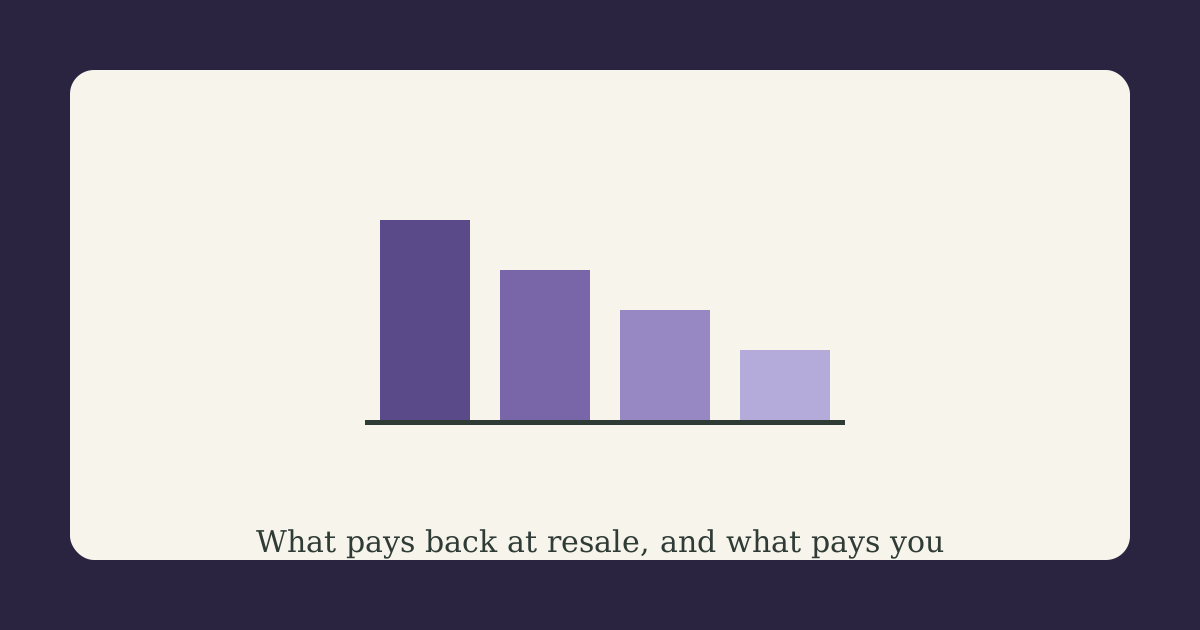
Short answer: Bathroom ROI rewards the wrench, not the expansion. The Remodeling Magazine 2025 Cost vs Value Report puts a midrange bath remodel at 80 percent recouped nationally ($26,138 cost, $20,915 resale value), a universal-design remodel at 61 percent ($42,183 cost, $25,812 value), a midrange bathroom addition at 53 percent ($60,645 cost, $32,347 value), an upscale bath remodel at 42 percent ($81,612 cost, $34,000 value), and an upscale bathroom addition at 36 percent ($111,255 cost, $40,526 value). Refreshing the existing room inside its footprint is the financial winner; building new wet space at premium specification is where the return goes to be spent. This guide shows how to pick your row and stay in it.
This page is the bathroom chapter of the home improvement ROI guide, which carries the full 2025 Cost vs Value table and the neighborhood ceiling rule. Its sibling, kitchen remodel ROI, applies the same scope logic to the larger room. Around a sale, sequence with the home selling guide, objections with the prepare your home for sale checklist, and value with how to price a home to sell. This is educational information, not construction or financial advice; report figures are U.S. national averages and your quotes and comparable sales decide your project.
The 2025 bathroom rows, exactly as published
The Cost vs Value Report compares the average cost of defined remodeling projects with the resale value those projects retain, as judged across 119 U.S. markets. The bathroom rows below are the report's 2025 national averages, taken from the 2025 report tables hosted by the Journal of Light Construction (jlconline.com/cost-vs-value/2025); the report is published by Zonda Media and also distributed at costvsvalue.com. The scope definitions matter as much as the numbers, and they are summarized under the table.
| Bathroom project (2025 national average) | Job cost | Resale value | Cost recouped |
|---|---|---|---|
| Bath Remodel, Midrange | $26,138 | $20,915 | 80% |
| Bath Remodel, Universal Design | $42,183 | $25,812 | 61% |
| Bathroom Addition, Midrange | $60,645 | $32,347 | 53% |
| Bath Remodel, Upscale | $81,612 | $34,000 | 42% |
| Bathroom Addition, Upscale | $111,255 | $40,526 | 36% |
Source: Remodeling Magazine Cost vs Value Report 2025, national averages across 119 U.S. markets (report tables at jlconline.com/cost-vs-value/2025; report home at costvsvalue.com).
Read the table as three lessons stacked.
Lesson one: in-place beats new-build at every grade. The midrange remodel (80 percent) beats the midrange addition (53 percent) by 27 points on a job costing less than half as much. The upscale remodel (42 percent) beats the upscale addition (36 percent) despite the addition creating an entire extra room. New wet space is expensive in ways buyers do not reimburse proportionally: structure, waterproofing, supply and waste runs, ventilation, and the finishes only arrive after all of that invisible money is spent. If a bathroom can be made functional and current where it stands, the table says to make it so there.
Lesson two: specification taxes bathrooms harder than kitchens. Moving from midrange to upscale inside the same footprint drops recoup from 80 to 42 percent, a 38-point penalty for premium specification, steeper than the kitchen gradient over the same move. Bathrooms are small, intensely compared rooms: buyers register working, clean, and current within seconds, and the premium in stone, fittings, and bespoke joinery transfers at the deep discount the hub predicts for personal specification generally. In a bathroom, the distance between midrange and jewelry is short in square feet and long in funded-at-resale dollars: about $47,600 of the upscale job's $81,612 at the national average.
Lesson three: credited values bunch tightly. The five rows span costs from $26,138 to $111,255, a range of about $85,000. Their credited resale values span $20,915 to $40,526, a range of about $19,600. That compression is the neighborhood ceiling operating inside one room type: once a home has clean, functional, sufficient bathrooms, additional bathroom spending buys the owner's mornings, not the buyer's appraisal. Which is a legitimate purchase, priced below.
What the report scopes include (so your quote stays in its row)
Bathroom regret usually starts as a labeling accident: a project priced like an upscale rebuild, judged afterward against the midrange row. Fix the definitions first.
Midrange bath remodel: the room renewed in place
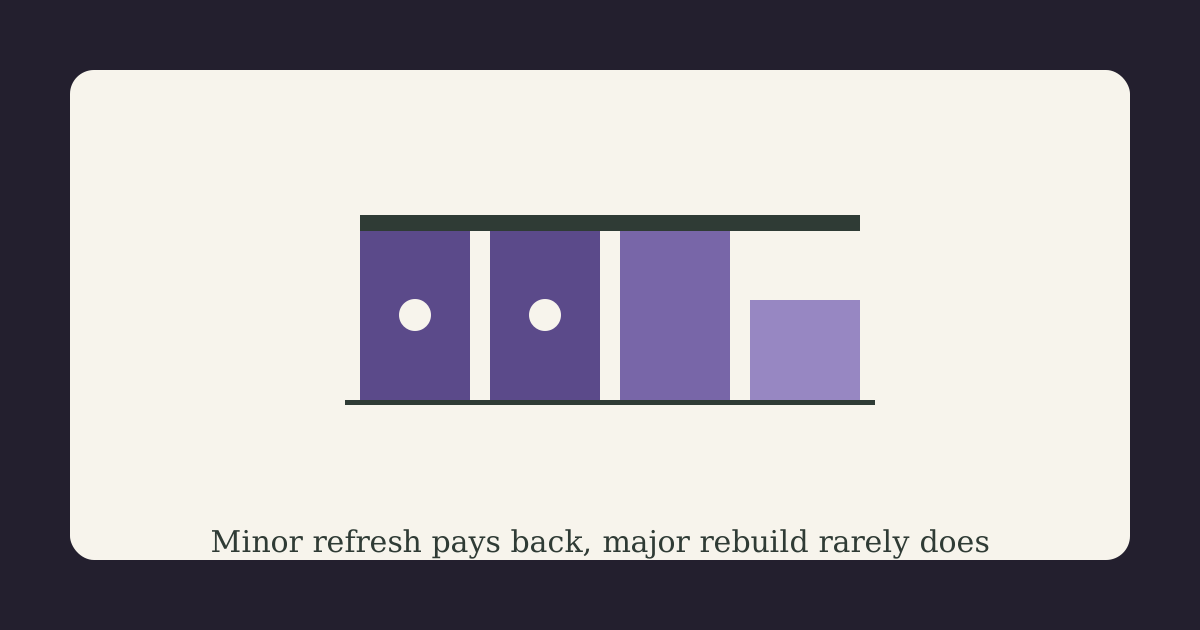
The report's midrange remodel works inside the existing bathroom: tub or shower renewed or replaced, tile and surrounds refreshed, vanity and counter replaced at mid-grade, fixtures and lighting updated, flooring and paint completed, plumbing layout essentially where it was. It is the bathroom version of the minor kitchen refresh that tops the kitchen table: every dated signal removed, no objection left standing, nothing moved that costs structural money to move. At 80 percent recouped it is the strongest interior remodel row in the 2025 table after the minor kitchen, and the gap between them (113 versus 80) is itself instructive: even the best bathroom refresh returns four fifths at resale, so a fifth of the cheque is the owner's even in the winning row.
Universal-design bath remodel: accessibility built in
This row rebuilds an existing bathroom around use by everyone: step-free or low-threshold showering, reinforced walls for support fittings, wider clearances, lever and reachable controls, layered lighting, and slip-conscious surfaces, at a $42,183 average cost and 61 percent recoup. It sits mid-table financially while out-paying every other bathroom row in daily usefulness where the features are genuinely needed. It is also the row most often justified across two return types at once: cost per year of independent, safer use for the owner, plus a resale credit that does not collapse the way pure luxury specification does, because the buyer pool for accessible main-floor bathing is real and undersupplied in many streets.
Bathroom additions, midrange and upscale: new wet space
An addition funds a room that did not exist: floor area created or converted, supply and waste plumbing extended, waterproofing and ventilation built from nothing, then fixtures and finishes on top. The midrange version ($60,645, 53 percent) is the only bathroom row where the functional case can overwhelm the financial one: a four-bedroom home with one bathroom is not merely undervalued, it is under-functioning, and comparable sales for its class may not exist until the count is fixed. The upscale addition ($111,255, 36 percent) layers premium specification onto that structural spend and returns the predictable third. Add the bathroom a house functionally needs at midrange specification; add the bathroom you dream about knowing roughly two thirds of it is consumption, priced below.
The scope-creep bridge in bathrooms
Small rooms creep quietly. The midrange refresh that moves the toilet "just a little" buys plumbing relocation; the tile upgrade that requires re-leveling buys carpentry; the freestanding tub that requires floor reinforcement buys structure. Each addition is small, defensible, and collectively re-rows the project from 80 percent territory toward 42 while the budget conversation stays anchored to the refresh. The defense matches the kitchen rule: the quote restates the report scope it claims ("renew in place, plumbing layout unchanged"), and every change order is priced twice, once in dollars and once in expected recoup at your ceiling. A bathroom can absorb one indulgence inside a disciplined scope. It cannot absorb five and keep its row.
Advertisement
When adding a bathroom is right despite the row
The table ranks financial return; it does not measure whether a house works. Three functional cases regularly justify an addition, and each should be argued from comparable sales rather than from recoup percentages.
The count fails the house. Bedrooms and bathrooms are read together by buyers and appraisers. A home persistently short a bathroom against its bedroom count and its street's standard sits below its own cluster, and the addition's job is to bring it into the cluster rather than above the ceiling. That is the one addition case where credited value can beat the national row materially, because the project removes a structural discount rather than adding a luxury.
The only bathroom is failing as the only bathroom. One aging full bathroom serving a full household concentrates every loss-avoidance risk in the home (a single shower failure is a habitability event) and every morning into a queue. A modest second bathroom, often a small ensuite or a converted space at midrange discipline, buys function the table prices at 53 percent and the household prices daily. State it as cost per use across the years it will serve, fund it at midrange, and let the resale row be the floor of the argument rather than the argument.
Accessibility requires a main-floor full bathroom the plan lacks. Where aging or mobility makes the existing bathroom arrangement genuinely unworkable, the addition or conversion conversation belongs with the universal-design row's logic: daily, durable usefulness, with resale as a secondary credit. Scoped modestly and permitted properly, this is among the soundest spending in the bathroom family; scoped as a luxury suite, it is the 36 percent row wearing an accessibility justification.
What none of these cases justifies is specification escalation inside the fix. The functional deficit is count, location, or access; it is answered by a sound midrange room in the right place. The stone is optional in every sense, and the table prices the option with every cost in.
The ceiling test for bathrooms, worked fully labeled
Every property figure below is hypothetical; the report figures are the real 2025 national averages from the table above.
The situation (hypothetical). A three-bedroom house with one tired full bathroom and a powder room, worth about $480,000 as it stands. Comparable sales cluster between $495,000 and $515,000 for similar homes with a renewed main bathroom, and reach $520,000 to $535,000 only where a genuine second full bathroom exists. Your ceiling therefore depends on which project you mean, which is precisely the point of the test.
Candidate A: midrange remodel of the existing bathroom, locally quoted. Quoted $28,000 against the report row of $26,138 cost and $20,915 value (80 percent). The home moves from $480,000 toward the $495,000 to $515,000 cluster: the project explains most of its cost through value, removes the room buyers would otherwise price as a project, and finishes in weeks. For a sale within a year or a decade of use, this passes the home improvement ROI guide gates cleanly.
Candidate B: upscale rebuild of the same bathroom, locally quoted. Quoted $86,000 against the report row of $81,612 cost and $34,000 value (42 percent). The credited value, even taken generously against your cluster, reaches the low $30,000s; roughly $52,000 of the quote is funded by the owner at resale, and the home still has one full bathroom. As a resale project it fails the ceiling test on arrival ($480,000 plus the cluster's top leaves no room for this scope). As a ten-year cost-per-use project it prices at about $8,600 a year before the resale credit, nearer $5,200 a year after it: a number a household may accept for the room they start every day in, chosen as consumption with the report open.
Candidate C: midrange addition of a second full bathroom, locally quoted. Quoted $64,000 against the report row of $60,645 cost and $32,347 value (53 percent). Here the ceiling moves with the project: the $520,000 to $535,000 cluster exists only for homes with the second bathroom, so the credited value has comparable sales behind it rather than hope. The funded share at resale is roughly $31,000 nationally, and the functional gain (a four-person household off one shower) accrues daily. If the house is staying, this can be the right spend, argued as function plus ceiling, at midrange specification. The moment the same addition is specced upscale toward six figures, the credited cluster does not follow it, and the 36 percent row collects the difference.
Candidate D: sell the bathroom as it stands - cleaned, repaired, and photographed as it is. The prepare your home for sale checklist version: leaks and water damage repaired at the source, ventilation made to work, grout and sealant renewed, light and paint made coherent, fixtures that fail replaced, deep clean to the standard the photographs will claim. Presentation cost, not renovation cost, priced into the as-is cluster by how to price a home to sell. For a dated-but-functional bathroom on a short horizon, this routinely nets more than Candidate B and finishes before the listing appointment rather than after the buyer's.
Bathroom decisions by horizon
| Your horizon | What the 2025 rows argue for | What to watch |
|---|---|---|
| Selling within about a year | Fix function and water issues; midrange refresh only if finishable pre-listing; otherwise presentation plus pricing | Listing mid-renovation; upscale scope justified as staging |
| Staying 3 to 7 years | Midrange remodel for posture and use; universal design where genuinely used | Scope creep from refresh toward rebuild; addition specced past its functional case |
| Staying a decade or more | Universal design and needed additions argued on cost per year of use; upscale only as named consumption | Borrowing the 80 percent row to bless a 42 percent project |
| Landlord renewing a rental bathroom | Durable midrange renew-in-place; waterproofing and ventilation first, see the rental expenses guide and the landlord guide | Porous luxury finishes; layout moves that rent cannot repay |
For landlords the bathroom logic tightens further. Rent responds to bathrooms that work flawlessly, clean easily, and do not leak into the structure: waterproofing integrity, ventilation that clears moisture, fixtures that can be serviced and replaced for years. It does not respond proportionally to stone. The most expensive bathroom sentence in rental property is not the remodel quote; it is the slow, unreported leak behind a beautiful wall, which is why the expense stack budgets maintenance as a funded line and why durability at midrange specification beats sparkle at upscale specification in every tenancy that lasts.
Where bathrooms pay the owner, in resale value and daily use
The bathroom is the room where cost per use is easiest to feel and hardest to appraise. A shower that works at proper pressure and temperature, light that allows shaving, medication, and makeup without squinting, ventilation that keeps paint and lungs clear, storage that ends the counter archaeology: these return value every single day, and a midrange remodel buying ten years of them prices at roughly $2,600 a year before its 80 percent resale credit, under $600 a year net if the credit holds. Universal design extends the same arithmetic across the years it keeps a household safely in its own home, which no recoup table pretends to price. Loss avoidance runs underneath both: water is the most destructive ordinary force in a house, and the bathroom is where it lives. Resealing, re-grouting, functioning exhaust, sound supply and waste lines, and prompt repair of every weep and stain are the cheapest insurance in this guide, and they belong ahead of finishes in every scope, at every grade, exactly as the prepare your home for sale checklist orders safety and systems first.
Name the return before funding it. "This bathroom is mostly cost per use for the next decade, some accessibility we will use now, and perhaps sixty to eighty cents on the dollar back if we sell sooner than planned" is a decision. "Bathrooms add value" is the slogan that built the 42 percent row.
Permits, plumbing, and the bathroom paper trail
Bathrooms concentrate permit and quality risk in wet, hidden places. Work that moves supply or waste plumbing, adds a bathroom, changes electrical in wet zones, or alters ventilation generally requires permits and inspections in most jurisdictions, and the consequences of skipping them are amplified by water: unpermitted work discovered at sale draws insurer and lender objections, may exclude the room from credited area, and converts a finished bathroom into a negotiation about what is behind its walls. This guide states no jurisdiction's list; your municipal building office is the source, consulted at scope time. Keep contracts scoped to the row, permits and sign-offs, waterproofing and fixture warranties, and dated photographs of the room before walls close (the one moment the hidden work can ever be evidenced again). At resale, that file is the difference between a bathroom an inspector credits and a bathroom an inspector prices as a question mark, and in wet rooms the question mark is always priced wet.
Matching the street matters here as it does in kitchens: finish a grade above the comparable cluster and the ceiling collects the excess; a grade below and buyers read a deferred bill in the one room where deferred bills leak. The profitable band is current, coherent, watertight, and at the level of your strongest comparable sales, which are free to inspect before you spend.
Bathroom ROI mistakes that cost the most
- Adding space to fix a finish problem. A tired bathroom needs renewing; a house needs a second bathroom only when count, function, or access says so. The rows differ by 27 points and about $34,000 of average cost.
- Speccing the refresh into a rebuild. Each moved fixture and premium surface migrates the project from the 80 percent row toward the 42. Write the scope on the quote and price every change order against its row.
- Renovating past the street. The credited values above bunch within about $20,000 across an $85,000 cost range. The ceiling is not being rude; it is being a ceiling.
- Starting an upscale bathroom on a selling horizon. Weeks-to-months of the home's only bathroom under construction, to sell specification at 42 cents on the dollar, while the as-is option was reachable with a checklist.
- Skipping permits where plumbing moved. In wet rooms the saving is repaid to the buyer's inspector, with moisture as the collection agent.
- Ignoring ventilation and waterproofing for visible finishes. The returns that never appear in the table - the leak that never starts, the structure that never rots - are the largest bathroom economics most owners will ever own.
Your bathroom scope checklist
Work this in order before signing any bathroom contract:
- Horizon and return named in one sentence: selling when or staying how long, and whether the project buys resale value, years of use, accessibility, loss avoidance, or a stated mix.
- Ceiling found from recent comparable sales with the method in how to price a home to sell, including whether your street's cluster even contains a second-bathroom price.
- Scope chosen against the 2025 rows above: remodel in place before addition, midrange before upscale, with the addition argued from function where it is argued at all.
- At least two written quotes scoped to the same row, stating plumbing layout moved or unmoved on each.
- Recoup sanity check done against the table row plus your local reasons for expecting better or worse than the average, including time-on-market effects if selling.
- Permit position confirmed with your building authority for any plumbing, electrical, ventilation, or added-room work; file opened before work starts, in-wall photographs planned.
- Water defense funded inside every scope: waterproofing, ventilation, seals, and any deferred leak or damage repaired at the source first.
- If selling soon, the presentation alternative priced from the prepare your home for sale checklist before any rebuild is approved; if renting, the durable-specification version priced inside the maintenance logic of the rental expenses guide.
Bathrooms repay the landlordly virtues: watertight, functional, current, and in place. The 2025 table rewards exactly one expansion instinct - the household that genuinely needs another bathroom or a safer one - and it pays that instinct at midrange specification, in the right location, under the ceiling. Everything beyond that is mornings, bought on purpose, which is what the upscale rows are for and what they should be called.
This guide is educational information, not construction, real-estate, or financial advice. Report figures are U.S. national averages from the Remodeling Magazine Cost vs Value Report 2025 (119 markets; tables at jlconline.com/cost-vs-value/2025, report home at costvsvalue.com), published by Zonda Media. Costs, values, permit duties, and market ceilings are local; confirm scope, permits, and pricing with licensed local contractors, your building authority, and current comparable sales before committing money.