The short version
Short answer: People buy white, gray, black, and silver cars in huge numbers for plain reasons that have nothing to do with luck: the colors suit many buyers at resale time, they handle heat and dirt in predictable ways, fleets order them by the thousand, and light shades are easy for other drivers to see. Layered on top sit older and more interesting beliefs. Red is honored as a color of joy and prosperity in China, white carries ideas of purity and a fresh start in Japanese and in many modern Indian wedding fleets, black reads as power and formality almost everywhere, and some feng shui practitioners match a car color to the driver birth element. Both layers are real. Only one of them is measurable. This page keeps them side by side, names its sources, and ends with a decision order you can actually use: safety and climate first, resale second, tradition and joy third, with your own liking as the final vote.
If you want the wider map first, our lucky colors complete guide compares the main systems, the red in Chinese culture guide follows the single most honored lucky color in depth, and the five elements balancing guide explains the elemental cycle that the car matching later in this page borrows.
What the sales charts actually say
Every year the big automotive paint makers count what factories sprayed, and the top of the chart barely moves. Axalta, which has published its Global Automotive Color Popularity Report since 1953, put white at about 31 percent of new cars globally in its 2024 report and gray at about 23 percent. Silver, which led the world in the 2000s, had fallen to about 9 percent, while blue sat near 6 percent and yellow and gold combined registered at less than 1 percent. In North America the same 2024 report put white first at about 33 percent, gray near 20 percent, and black near 19 percent. Four pale to mid neutral shades take the large majority of orders, year after year.
That chart is better read as a record of incentives than as a verdict about taste. A color reaches the top only if it satisfies factories, dealers, fleet buyers, rental companies, leasing firms, and private owners at the same time. White and gray sit at the top because they pass every one of those tests at once, which is a less romantic story than luck and a much more useful one for a buyer. Regional tables also differ in ways that matter locally, with white stronger in hot sunny markets and black stronger in some northern European luxury segments.
Why the boring colors win: five practical reasons
Resale breadth. A used car sells to whoever opens the listing next. Neutral colors offend almost nobody, photograph well in poor light, and suit both a family buyer and a business buyer, so the pool of plausible next owners stays large. That breadth is the core of the claim that neutrals hold value: not that a white car is worth a fixed sum more than a red one, which no source can promise for an individual car, but that more buyers will consider it, sooner. Color is one factor among mileage, condition, and service history, and rarely the largest. It is simply the one you choose in advance.
Heat. Dark surfaces absorb more incoming solar radiation than light surfaces, so a black roof reaches higher temperatures in summer sun than a white roof, and the cabin follows. Air conditioning then works harder at the start of every trip. Interior color, window film where legal, and where you park all matter as much, so a white car with a black interior in full sun is still a hot car. Paint is one lever among several, but in a hot climate it is a lever you feel daily, which is why white dominance is strongest where the sun is strongest.
Dirt, dust, and scratches. Silver and mid gray hide road dust and light film better than any other family, which suits drivers who wash rarely and drive far. Black shows dust, pollen, water spots, and fine swirl marks quickly, and rewards owners who enjoy polishing. White hides fine scratches well but shows mud and winter road film plainly. None of this is luck. It is housekeeping, and the right answer depends on your roads and your patience.
Fleet and rental orders. A large share of new cars are bought by organizations, and organizations order conservatively. White reads as a clean base for signage, gray and silver look professional without a brand statement, and all three simplify remarketing when the fleet is sold on. When one buyer orders ten thousand units in one shade, that shade moves up the global chart regardless of private taste.
Visibility. Other road users need to detect your car early, against asphalt, concrete, vegetation, snow, and dusk sky. Light shades, above all white, contrast strongly with dark road surfaces in most daylight conditions, which is the plausible mechanism behind the safety findings in the next section. No color is conspicuous in every condition, white can lose contrast against snow, and silver and gray can merge with wet roads, but light and bright shades are generally easier to pick out than dark ones in low light.
What the safety research does and does not say
The most cited work comes from Australia. Researchers at the Monash University Accident Research Centre analyzed police reported crashes in Victoria and Western Australia between 1987 and 2004, using crashes where visibility was unlikely to be the cause as a comparison group. In that analysis white vehicles had the lowest crash risk of the colors compared. Black cars showed about 12 percent higher crash risk than white, gray cars about 11 percent higher, silver about 10 percent higher, and blue and red about 7 percent higher. Later summaries describe white cars as roughly 10 percent less likely to be involved in a crash in daylight than lower visibility colors, with the effect reported as larger at dawn and dusk.
Three limits apply to that finding. It is an association across a large older dataset, not a controlled experiment, and daytime running lights, automatic headlights, and better street lighting have since compressed the visibility gap between colors. A group level percentage is also small next to the main determinants of crash risk, which are speed, attention, impairment, following distance, tires, and brakes. No responsible summary licenses the claim that a white car is safe or a black car is dangerous. The defensible sentence is narrower: in at least one large well designed study, light colors were associated with somewhat lower crash involvement, plausibly through visibility, by a margin worth knowing about without being worth fearing.
Advertisement
Luck beliefs by culture, stated carefully
Practical reasons explain the top of the sales chart. They do not explain the feelings that gather around particular shades, and those feelings are old and worth describing accurately. The rule here matches our wedding lucky colors across cultures guide: report what traditions teach, credit believers with intelligence, and never convert a belief into a promise.
Red and prosperity in China. In Chinese tradition red is the color of happiness, good fortune, and celebration, and it is believed to ward off evil. That is why red dominates Lunar New Year, why wedding dress and decoration lean on it, and why red envelopes carry money gifts. A red car bought in that frame is a moving version of a familiar wish, prosperity and protection traveling with the family. China is also a market where white sells extremely strongly for the practical reasons above, so red cultural honor and white sales dominance coexist in the same showrooms without contradiction.
White, purity, and wedding fleets in Japan and India. Japan gives white a formal ceremonial dignity that long predates Western influence. The traditional all white shiromuku bridal ensemble reads as a fresh beginning, and white cars in wedding and formal hire fleets borrow some of that calm. In India, white cars are widely chosen for weddings in modern practice, where white reads as clean and photographic against colored decoration, even though practice varies by region, religion, and family, and white carries mourning associations in some Hindu contexts. The careful statement is that white wedding cars are a common modern preference in both countries with locally understood meanings, not a single ancient rule.
Black as status and formality. Across Europe, North America, East Asia, and the Middle East, black cars carry associations of formality, authority, and occasion, which is why official fleets, executive cars, and luxury flagships so often launch in black. Buyers who choose black knowing it shows dust and heats up in sun are trading daily upkeep for a social signal. That is not superstition. It is semiotics, and it works because other people read the signal the same way. Our black white green color meanings guide traces how black and white swap meanings across regions.
Gold and champagne in Gulf markets, in context. In the Gulf states and wider Middle Eastern luxury markets, gold, champagne, sand, and warm beige tones appear frequently on large luxury sport utility vehicles and in dealer showrooms. The accurate frame is taste and status within a wealthy car culture that favors large vehicles and bright sun, where pale metallic shades reflect heat better than black while still reading as precious. It would be wrong to invent an ancient desert luck custom to explain a modern preference. Where gold carries explicit prosperity symbolism in jewellery, gifts, and celebration dress, buyers may enjoy the echo. Enjoying an echo is different from citing a custom.
Green and growth, blue and calm. Green is linked with growth and renewal in both Western symbolism and the five element system below, and dark green has a long history on European sporting cars tied to national racing colors. Blue is the color buyers most often describe as calm and trustworthy, which is why it anchors corporate fleets and family cars and why it is usually the most popular true color after the neutrals. A color that makes its owner feel calm or hopeful has done real work, even if the work is mood rather than fortune.
Feng shui and the five element car
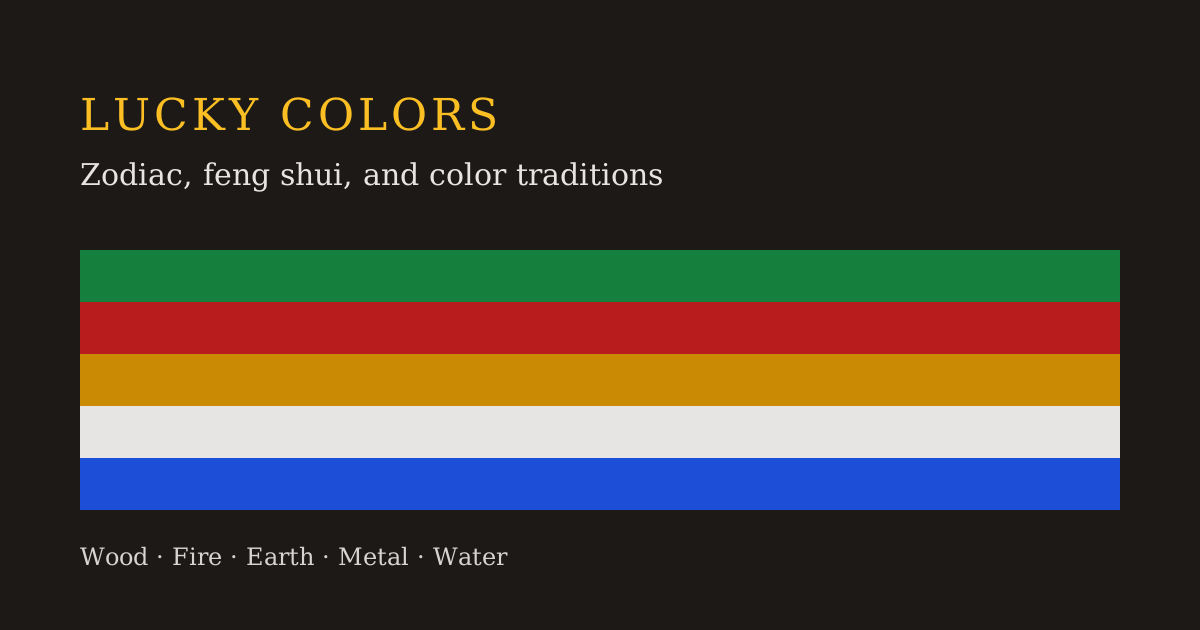
Feng shui enters car choice through the five elements, Wood, Fire, Earth, Metal, and Water, a framework this site also uses for rooms in our feng shui colors by room guide. Each element owns a family of colors. Wood takes green and brown. Fire takes red, orange, and vivid purple. Earth takes yellow, ocher, beige, and sandy browns. Metal takes white, gray, silver, and gold metallic tones. Water takes blue and black. Some practitioners match the exterior to the driver birth element, derived from the birth year in the Chinese calendar cycle. A Water element driver might be advised toward blue or black as the same element choice, toward white or silver because Metal is said to generate Water in the traditional generating cycle, and away from heavy earth tones on the theory that Earth controls Water. A Fire element driver hears the mirror image advice.
The five element scheme is a coherent traditional language for balance and temperament, and many drivers enjoy choosing within it the way others enjoy the chart in our lucky colors by zodiac sign guide. As a tiebreaker between two colors you already like, on a car that already suits your climate and budget, it costs nothing and can make the car feel personally chosen. What it cannot do is repeal physics. A black Water matched car still heats up in a desert summer and still relies on your headlights at dusk. Anyone who sells elemental matching as protection from accidents is selling something the tradition does not promise and no study supports.
The table: why each color is really bought
| Color | What buyers actually choose it for | Luck traditions attached |
|---|---|---|
| White | Heat reflection, strong daylight visibility, broad resale appeal, clean fleet base | Purity and a fresh beginning in Japanese ceremonial dress; modern wedding car favorite in India and Japan |
| Black | Formality, executive and luxury signaling, design lines on large cars | Power and authority in many modern readings; Water element color in feng shui |
| Gray | Hides dust and film well, reads modern and neutral, suits many body styles | Metal element family in feng shui; understated balance in Western readings |
| Silver | Best known dirt hiding of any shade, metallic finish flatters shape, wide appeal | Metal element color; clarity and precision in feng shui readings |
| Red | Sporting image, visibility in daylight, personal statement, statement color energy | Joy, prosperity, and protection from evil in Chinese tradition; Fire element color |
| Blue | Calm and trustworthy feel, family and corporate suitability, most popular true color | Water element color in feng shui; fidelity and calm in several Western readings |
| Green | Nature association, distinctive without shouting, sporting heritage in Europe | Growth and renewal in Western symbolism; Wood element color in feng shui |
| Gold and champagne | Pale metallic luxury look, reflects sun better than dark shades, suits large vehicles | Prosperity echo in jewellery and gift traditions; Metal element family |
Read the middle column first when money is committed, because it describes effects you will experience every week. Read the right column second, as meaning you may enjoy honoring. Trouble starts only when the columns trade places, when a lucky tradition is asked to do the work of heat management or visibility.
The tradeoffs, gathered in one place
Heat is the tradeoff you feel. Every dark car in a hot climate taxes its owner a few minutes of discomfort at the start of summer trips, every day, for years. Every light car in a snowy climate can blend into a bright roadside in flat winter light unless lights and cleanliness compensate. If you park outside in Phoenix, Riyadh, Delhi, or Darwin, put exterior lightness near the top of your list. If you drive long dusk commutes on wet northern roads, put contrast and lighting there instead. Geography is not romantic, which is why it should vote early.
Visibility peaks at the edges of the day. The Monash findings and ordinary experience agree that color matters most when light is failing and matters least at noon. A driver who chooses a dark color for its looks can recover most of the difference with habits that cost little, daytime running lights kept on, headlights switched on early, clean lenses, and reflective plate frames where legal. Color is a static choice made once. Lighting is a dynamic choice made daily, and the daily one carries more weight.
Resale neutrality is a strategy, not a law. Neutral colors keep the buyer pool wide, which tends to mean a faster private sale and fewer dealer objections, but wide is not the same as passionate. A well kept car in a less common color that suits the model can find its right buyer at a fair price, sometimes after a longer wait. Anyone who quotes you a fixed dollar premium for a color, in either direction, without inspecting your car and your market, is decorating a guess.
Maintenance is a color choice too. Black and very dark blue are a hobby. White and silver are a chore reduced. Mid gray is close to permission to think about something else. Buyers who choose with their calendar as well as their eyes keep cars that look cared for, and a car that looks cared for, whatever its shade, is the one the next buyer trusts.
A decision framework that respects both layers
Work down this list in order. Each step narrows the field so the next step has less to carry.
- Safety and climate first. Rule out colors that fight your conditions. Very dark shades where you park in extreme heat without shade, unless you accept the daily cost knowingly. Very pale shades where you drive long hours against snow glare without good lighting habits. Light colors carry a modest visibility edge in the published record.
- Budget and maintenance second. Price any premium paint charge against years of washing reality. Choose the finish that suits both your taste and your tolerance for visible swirls and chips on your roads.
- Resale breadth third, and only if resale is near. If you will sell within three to five years into a general market, lean neutral. If you keep cars a decade, buy for the owner in the mirror.
- Tradition fourth, as a tiebreaker with meaning. Inside the surviving shortlist, consult the systems you care about, the five element match, the cultural meanings in the table, a Chinese zodiac lucky colors year color, or a family custom. A tradition used to choose between two good options enriches the purchase. A tradition used to overrule heat and visibility taxes it.
- Joy last, and joy counts. After safety, climate, upkeep, and resale have spoken, the color that makes you look back at the car in the parking lot is a legitimate final vote. You will see this object almost every day for years. Liking it is a use, arguably the main one, and neither a sales chart nor a symbolism chart outranks the person who has to live with the choice.
What color cannot do, said plainly
No exterior shade changes the luck of a journey in any sense a careful person can test. Red does not summon prosperity into a bank account, white does not purify a loan, and an element matched car is not shielded from other drivers. What color genuinely does is threefold and enough. It changes small physical facts, how hot the cabin gets, how early another driver notices you at dusk, how often you wash. It changes social facts, the formality or friendliness strangers read before you speak. And it changes a personal fact, how you feel walking toward your own car on a thousand ordinary mornings. Those are real powers, worth choosing with care. They are also the only powers on offer. Readers comparing year specific traditions may also enjoy our lucky colors for 2026 fire horse year guide, read with the same rule in mind: meaning first, promises never.
Choose the color the way you would choose a front door, a subject covered in our front door colors by direction guide, where the same discipline applies. Let physics pick the shortlist, let your circumstances rank it, let your traditions bless it, and let your own eye cast the deciding vote. A car chosen that way needs no luck to defend the choice, which is the closest thing to good fortune a paint code can provide.