The short answer
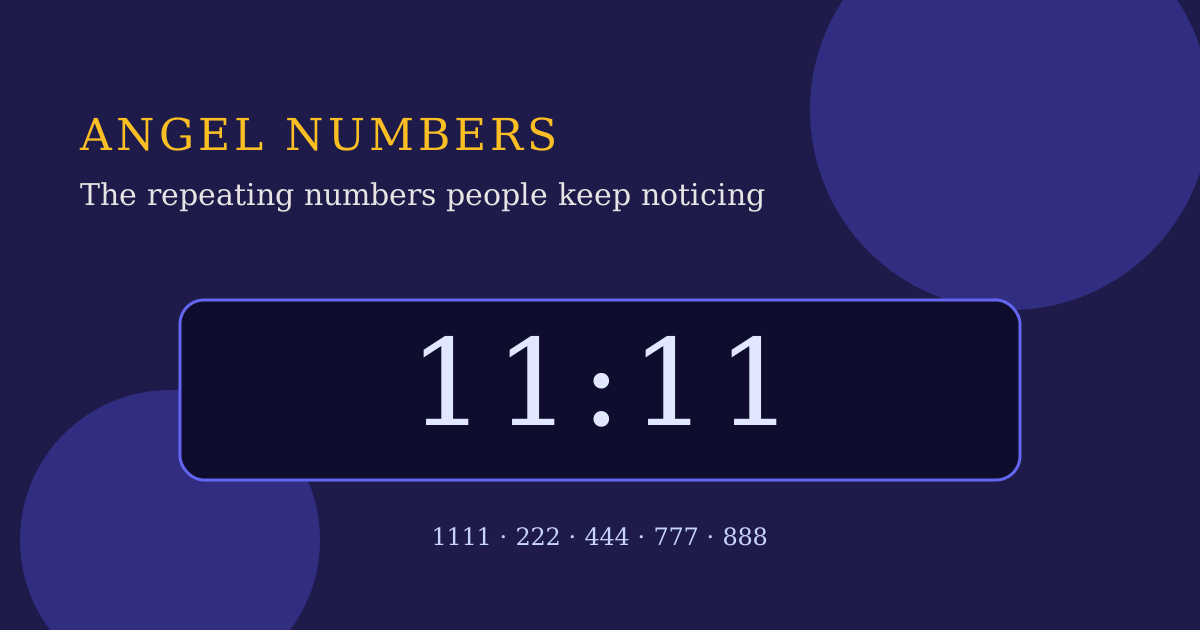
Short answer: You keep seeing repeating numbers because your brain has learned to flag them, and because modern life puts an enormous number of digits in front of your eyes every day. Once a sequence like 111, 333, or 11:11 becomes meaningful to you, attention promotes it from background noise to headline, remembers each sighting, and quietly forgets the hundreds of ordinary numbers that passed unrecorded in between. Psychologists call the core effect the frequency illusion. In numerology tradition, the same sightings are read as symbolic prompts - a nudge to pause and reflect on beginnings, balance, change, or steadiness. This page explains both accounts without forcing you to pick a team: the psychology of why the numbers seem to multiply, the everyday arithmetic of how often you actually encounter them, why sightings cluster during transitions, what the tradition fairly claims, and a practical way to tell when noticing is a pleasant pause and when it has started to cost you.
This is the psychology anchor for our angel numbers pillar. The complete guide to angel numbers maps every major sequence in one place, and the individual guides go deep on each number, from 1111 to 333 and 555.
What repeating numbers are
Repeating numbers are short digit sequences in which the same digit repeats, or in which a simple pattern repeats. The family that most people mean by the phrase is small:
- Doubles: 11, 22, 33, 44, seen on house numbers, ages, scores, and page counts.
- Triples: 111, 222, 333, 444, 555, 666, 777, 888, 999, seen on receipts, totals, odometer readings, and timers.
- Quadruples and clock specials: 1111 above all, seen almost exclusively on clocks and timestamps.
- Mirrored and patterned forms: 1212, 1234, 1010, which the tradition also tracks, though triples and 1111 dominate search and conversation.
Two properties make this family stand out from the general flood of digits. First, repetition is the easiest pattern for human vision to detect: a row of identical shapes reads as one object rather than three separate digits, so it can be caught in peripheral vision or in a half-second glance. Second, the family is tiny. There are only ten possible triples from 000 to 999, and only a handful feel culturally charged. Your attention is not being asked to watch for one needle; it is watching for a small, bright set of shapes that the number system itself produces constantly.
That smallness matters for everything that follows. If you were watching for the sequence 847, you would still encounter it from time to time, but you would wait longer between sightings and the habit would likely fade. Watching for any of ten triples, plus their doubles and clock forms, guarantees a steady drip of hits - enough to keep the habit alive, spaced irregularly enough to feel personal. The tradition builds its readings on top of this drip. The psychology explains why the drip feels like a downpour once you have started collecting it.
Why your brain flags them: the frequency illusion
The central mechanism has a plain name. The frequency illusion is the experience of noticing something everywhere shortly after it first becomes meaningful to you. Linguist Arnold Zwicky coined the term, and the compact version of his point is this: the world did not change; your recording of it did.
The effect runs in two steps. The first step is selective attention. Human attention cannot process everything the eyes deliver, so it works from a shortlist of what currently matters: a new word you just learned, a car model you just bought, a name you just heard, a number sequence a friend just explained to you. Items on the shortlist get flagged in real time. Items off it pass through unlogged. This is not carelessness; it is the only way a finite brain copes with an effectively infinite stream.
The second step is confirmation through memory. Each flagged sighting is stored as an event - I saw 333 again - while the unflagged majority leaves no trace at all. There is no mental counter running for 847 or for 2:47, so at the end of the week your memory holds a tidy pile of hits and an empty file of misses. Reviewing that lopsided ledger, you conclude the number is following you. The conclusion feels data-driven. It is, but the data was filtered twice before you ever saw it.
Nothing about this requires the number to be mystical. The same two steps explain why a newly learned word appears in three articles in a day, why a rare surname starts turning up after you meet one bearer of it, and why an unfamiliar bird seems to colonize your neighborhood the week after you identify it. Repeating numbers are simply the purest case: the stimulus is identical every time, visually unmistakable, and emotionally pre-loaded by a large popular tradition that has already told you the sighting matters.
Pattern-finding: apophenia and the useful overdetector
Underneath the frequency illusion sits a deeper habit. Psychologists use the word apophenia as a general term for the human tendency to perceive patterns and connections in unrelated or random material. The word is deliberately neutral in everyday use: pattern-finding is not a defect. It is the engine of language learning, face recognition, music, weather sense, and every act of reading a room. A mind that waited for proof before detecting any pattern would miss most of what matters in a day.
Like any detector, this one is tuned toward false positives, and sensibly so. In ancestral terms, mistaking wind in the grass for a predator costs a moment of alarm; mistaking a predator for wind costs considerably more. A system biased toward seeing agency and pattern - toward assuming that a rustle, a face in a cloud, or a repeated digit might mean something - errs on the survivable side. Modern life inherited the tuning without the predators. The detector now fires on cloud shapes, song lyrics that seem to answer a private worry, and strings of identical digits on a receipt.
Seen this way, noticing repeating numbers is not a malfunction to be embarrassed about. It is a high-quality general-purpose system doing exactly what it evolved to do, applied to a stimulus environment - a world printed with numbers - that it was never tuned for. The interesting question is never why the detector fires. It is what you do in the seconds after it fires, and whether the firing rate has started to interfere with the rest of your life. The later sections of this page take up both questions directly.
Advertisement
Memory bias: the ledger you never see
Attention explains the flagging; memory explains the conviction. Three ordinary features of memory make the frequency illusion feel like hard evidence.
First, distinctive events are remembered out of proportion to plain ones. A total of 11.11 on a coffee receipt encodes itself; a total of 9.47 does not. Second, memory stores no denominator. You carry a felt count of sightings - lots, constantly, three times today - with no corresponding count of clock glances, receipts, plates, or page numbers that showed nothing special. A rate cannot be computed from a numerator alone, but the feeling of a rate arrives anyway.
Third, retelling polishes the pile. Each time you mention a sighting, to a friend or in a search bar, you rehearse and strengthen that memory while the unremarkable exposures fade on schedule. Within a few weeks, a person can be fully certain they see 111 daily, while a neutral log - and people who keep logs out of curiosity are often surprised - shows a modest number of sightings scattered among thousands of unlogged digit encounters. None of this involves dishonesty. It is the standard bookkeeping of a brain that evolved to remember the berry bush and the snake, not to audit its own sampling.
Knowing about the ledger does not have to spoil anything. Many people, told plainly that their attention is curating the phenomenon, keep the habit anyway and enjoy it as a mindfulness trigger: the number is not a message, but the pause is real. That position - mechanism understood, ritual retained without claiming a message - is the one this site recommends, and it is available for every sequence in the pillar, from 222 onward.
Why clocks, plates, and receipts guarantee sightings
Set psychology aside for a moment and count the raw material. A single ordinary day exposes you to a startling quantity of numbers, and it is worth walking through the inventory slowly, because most people dramatically underestimate it.
Start with time. A phone lockscreen is checked scores of times a day in ordinary use: waking, messages, directions, music, boredom. Every check displays a time, and times cycle through a constrained set. Within any twelve hours, a clock will display doubles and triples of minutes, palindromes, and the famous 11:11. You do not need to watch for them; you need only to keep living with a clock in your pocket. Add the kitchen clock, the car dashboard, the microwave, the oven timer counting down through 3:33 and 2:22, meeting software timestamps, and the departure board at the station.
Move to money. Receipts print subtotals, taxes, totals, item codes, loyalty points, and change. Prices themselves cluster on psychologically set endings, and totals land where arithmetic puts them, which includes the triples and round patterns your eye prefers. Bank balances, step counters, battery percentages, and file sizes add a second financial layer: a balance of 1,111 dollars, a step count passing 7,777, a download at 88 percent. Every dashboard is a number fountain.
Move to the street. License plates carry three and four digit groups by design, house numbers repeat along a block, bus routes are short numbers, and scores, temperatures, and jersey numbers scroll past in media all day. Speedometer and odometer readings sweep sequentially through every pattern in order: a car that passes 111,111 kilometers shows you the cathedral of the entire family in one glance, and it will have swept past 111,110 through 111,119 on the way, any of which your peripheral pattern detector could catch.
The conclusion from the inventory is not that sightings are meaningless. It is that sightings are guaranteed. Given thousands of daily digit encounters and a watchlist of the most visually obvious patterns in the system, a person who never saw a repeating number would be the statistical puzzle. The tradition's question - what does this sequence mean - is therefore always asked downstream of a prior certainty: the sequence will appear. What varies between people is not exposure. It is whether the exposure gets flagged, remembered, and woven into a story.
Why sightings cluster in transitions, grief, and new beginnings
Ask people when repeating numbers first started appearing and a pattern emerges that both psychology and the tradition can explain in their own vocabularies. The clusters gather around beginnings and endings: a new job or a lost one, a move, a diagnosis in the family, a birth, a death, a relationship forming or dissolving, recovery, a course of study started in earnest.
Psychology reads the cluster from the scanning side. Transition is the season of heightened vigilance. When the map of life is being redrawn, the brain raises its sampling rate: more glances at clocks, more checking of phones, more attention to signs, headlines, lyrics, and overheard phrases - anything that might bear on the open question of what happens next. Grief does similar work, because the bereaved mind is quite literally searching for a person, and a searching mind finds candidate signals in neutral material. Under raised sampling, an always-present drip of repeating numbers becomes a collected stream, and the stream arrives exactly when its owner most wants the world to be speaking.
The tradition reads the same cluster from the meaning side. In numerology tradition, sequences are prompts whose themes match transitional needs: 111 and 1111 for beginnings, 222 for patience inside uncertainty, 555 for change already in motion, 444 for steadiness when the ground moves. A person in transition who encounters the matching theme experiences recognition - the right word at the right time - and recognition is a powerful glue for memory. Both accounts agree on the observable facts: sightings cluster in transitions, the cluster is real, and the moment of noticing tends to deliver a genuine pause in which people think about their situation with unusual directness.
That shared ground is worth keeping in view, because it suggests the healthiest use of the phenomenon. A repeating number during a transition is a free, randomly scheduled appointment with yourself. What you do in that appointment - grieve plainly, admit the fear, name the next small step - is the entire substance. The digit is the bell, not the lesson.
The tradition's reading, stated fairly
It would be poor craft to explain the psychology and caricature the tradition, so here is the tradition's own account in its strongest ordinary form.
In modern numerology, each single digit carries a thematic field built up over a long popular literature: 1 for beginnings and initiative, 2 for balance and partnership, 3 for expression and creativity, 4 for structure and home, 5 for change and freedom, 6 for care and responsibility, 7 for reflection and luck in the inward sense, 8 for flow and return, 9 for completion. A repeated digit is read as that theme amplified and underlined. A sequence is called an angel number when it is encountered repeatedly in daily life and taken as a prompt rather than a coincidence.
Within that system, the claim being made is modest, and it is worth noticing how modest. The mainstream tradition does not usually assert that a number causes events, guarantees outcomes, or transmits verifiable information about other people. It asserts that the sighting is a well-timed occasion for reflection along a specific theme: if you keep catching 555, consider what is changing; if 444 keeps pace with you, consider what needs steadying. Read this way, the tradition functions as a randomized reflection prompt with a memorable filing system - ten themes, each with a number for a name.
Where popular writing goes further - promising wealth, certifying soulmates, dating revelations - it leaves both the tradition's modest core and this site's standards behind. No sequence of digits carries information about another person's feelings, a market, or a diagnosis, and any reading that asks you to spend, risk, or decide on that basis has stopped being a reflection prompt and become a sales funnel. The pillar on this site keeps to the modest core throughout: 1111 as the doorway of conscious beginning, 333 as encouragement toward expression, 555 as the emblem of transition, each with the same note about attention that you are reading here.
Comfort versus cost: a decision table
Noticing repeating numbers sits on a spectrum, and the same habit can be a small pleasure at one end and a genuine burden at the other. The table below is the practical heart of this page. Read down the left column for the version worth keeping, and the right column for the signals that the habit has started to steer rather than accompany your life.
| The pause is working for you when | It is starting to cost you when |
|---|---|
| A sighting produces a brief, pleasant pause and a useful question | A sighting produces urgency, dread, or a sense of being watched |
| You enjoy the tradition's theme as a prompt and hold it lightly | You feel you must find the correct interpretation before acting |
| Ordinary decisions still run on evidence, advice, and timing | Decisions wait for, or are vetoed by, the next sighting |
| Spending is unaffected; the habit costs nothing | You pay for readings, courses, or objects to decode the numbers |
| You can go days without noticing and feel nothing about it | A day without a sighting feels like abandonment or a bad omen |
| The habit stays private amusement or gentle conversation | It is straining relationships or replacing needed conversations |
| Uncertainty feels tolerable between sightings | Uncertainty feels unbearable and only a sign relieves it |
Two rows deserve emphasis. The money row matters because the moment a free quirk of attention becomes a paid dependency, someone else is profiting from your frequency illusion, and the interpretations will grow more urgent in proportion to what you spend. The decision row matters because it marks the line between symbolism and steering. A prompt you consult after deciding is a ritual. A signal that must approve the decision in advance is a transfer of authority, and clocks are not qualified to hold it.
One further signal sits beyond the table. If pattern-noticing of any kind - numbers, phrases, coincidences - begins to feel compulsory, distressing, or impossible to set aside, that experience deserves care in its own right. A calm conversation with a doctor or therapist is the appropriate next step, exactly as it would be for any attention habit that has started to hurt. That is not a judgment on belief; it is the same advice this page would give about any mental loop that has begun to cost sleep or peace.
Grounded practices that keep sightings as a pause
If you enjoy repeating numbers and want to keep them in the pleasant-pause category, a few small practices keep sightings in that pause category without draining the pleasure.
Keep a real log for one week. Write down every sighting and, beside it, a rough count of clock checks or receipts that day. Most people find the denominator more instructive than the numerator, and many find the habit becomes more enjoyable, not less, once the sampling is visible. You are not debunking yourself; you are learning the size of the ocean your fish come from.
Assign the pause a job. Decide in advance what a sighting will trigger: three slow breaths, one direct sentence about what you are avoiding, a glass of water, a look out of the window. A ritual with a fixed, wholesome payload cannot easily be upgraded into an oracle, because its meaning is already spoken for.
Let the theme prompt, never decide. Borrow the tradition's filing system freely. Seeing 555 during a house move can prompt a useful ten minutes on what the change requires. The prompt ends where evidence begins: contracts, conversations, and arithmetic still make the call.
Keep it free. The moment the habit asks for money - a paid reading to interpret what a clock showed you - close the tab. Everything true about the phenomenon is on this page, and it cost nothing but attention, which is the currency the numbers were already paid in.
Review monthly, lightly. If you keep a log, glance back once a month. Notice which sequences clustered around which life events. Read as autobiography, the log is often genuinely revealing: not about the universe's messaging schedule, but about when you were scanning, hoping, grieving, or beginning. That is real information, drawn from your own record.
Where to go next in the pillar
If a particular sequence has your attention, its dedicated guide gives the tradition's full reading alongside the same grounding you found here. Begin with the complete guide to angel numbers for the whole family in one table. Then follow your number: 1111 for the clock moment and conscious beginnings, 333 for expression and encouragement, 555 for change in motion, and 222 for balance and patience. Each page will tell you what the tradition says, why your attention delivers the number so reliably, and how to use the pause well. None of them will ask you to believe more than the evidence carries, and none will ask the number to carry more than a pause.
The phenomenon, in the end, is a collaboration. The world supplies the digits in industrial quantity; your attention, tuned by meaning, selects a shining few; memory binds them into a story; and you, in the seconds after each sighting, decide what the story is for. Keep that last step and the habit stays what it was at its best: a small, free, recurring invitation to notice your own life while you are in the middle of living it.