Designing for the $120 Oil Reality: The Rise of Resilient Architecture in 2026
By Architect Lin Wei March 30, 2026
As the global energy markets grapple with the most significant disruption in decades, the architectural community is facing its own existential crisis. In March 2026, the question is no longer how to build "sustainably," but how to build Resiliently. When Brent Crude sits at $120 per barrel and the Straits of Hormuz are effectively closed, the "standard" home—one that relies on a constant flow of fossil fuels for heating, cooling, and material logistics—has become a liability.
Today's architecture must go beyond the "greenwashing" of the previous decade. We must design for Passive Survivability.
Passive Survivability: The 2026 Architectural Baseline
Passive survivability is the ability of a building to maintain habitable conditions for its occupants in the event of a total loss of power or water. In the volatile environment of 2026, where the grid has become as unpredictable as the climate, this is no longer a luxury; it is a fundamental requirement.
The "Thermal Battery" Home
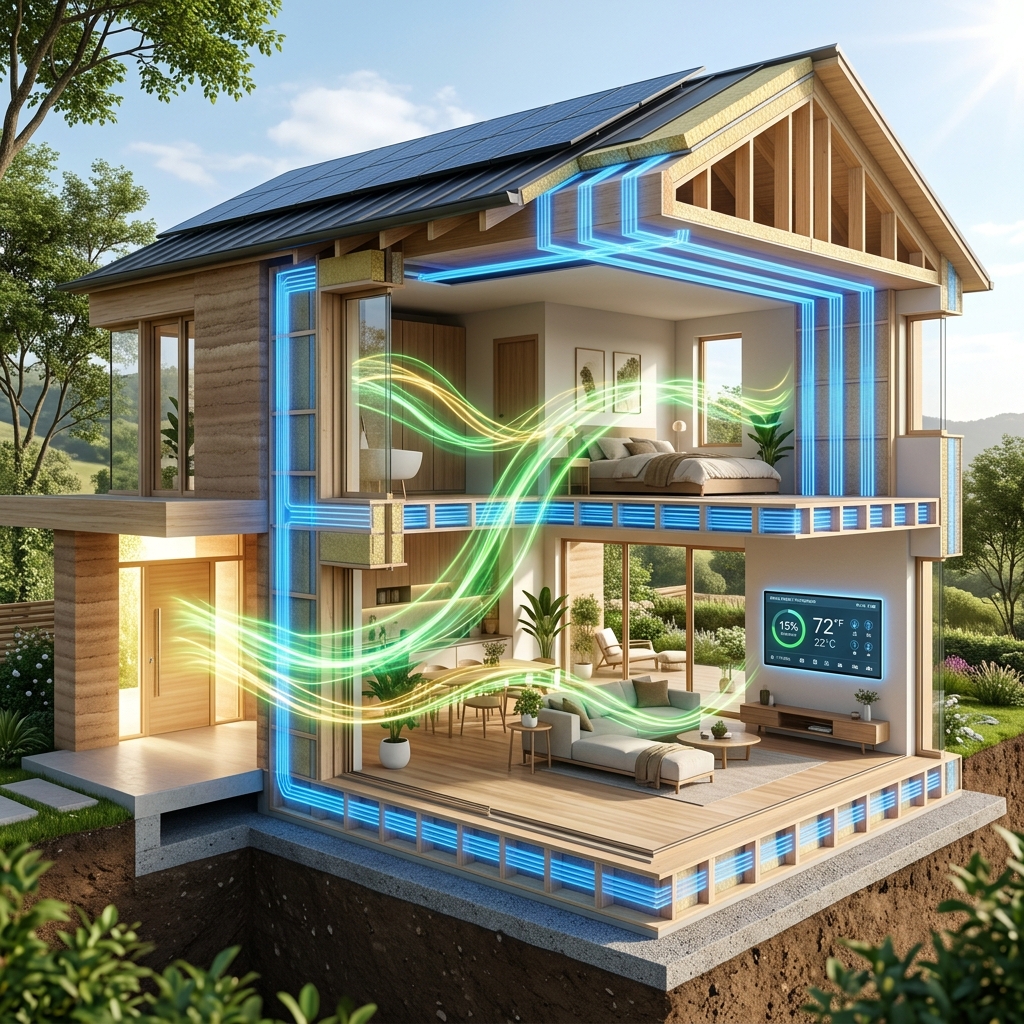
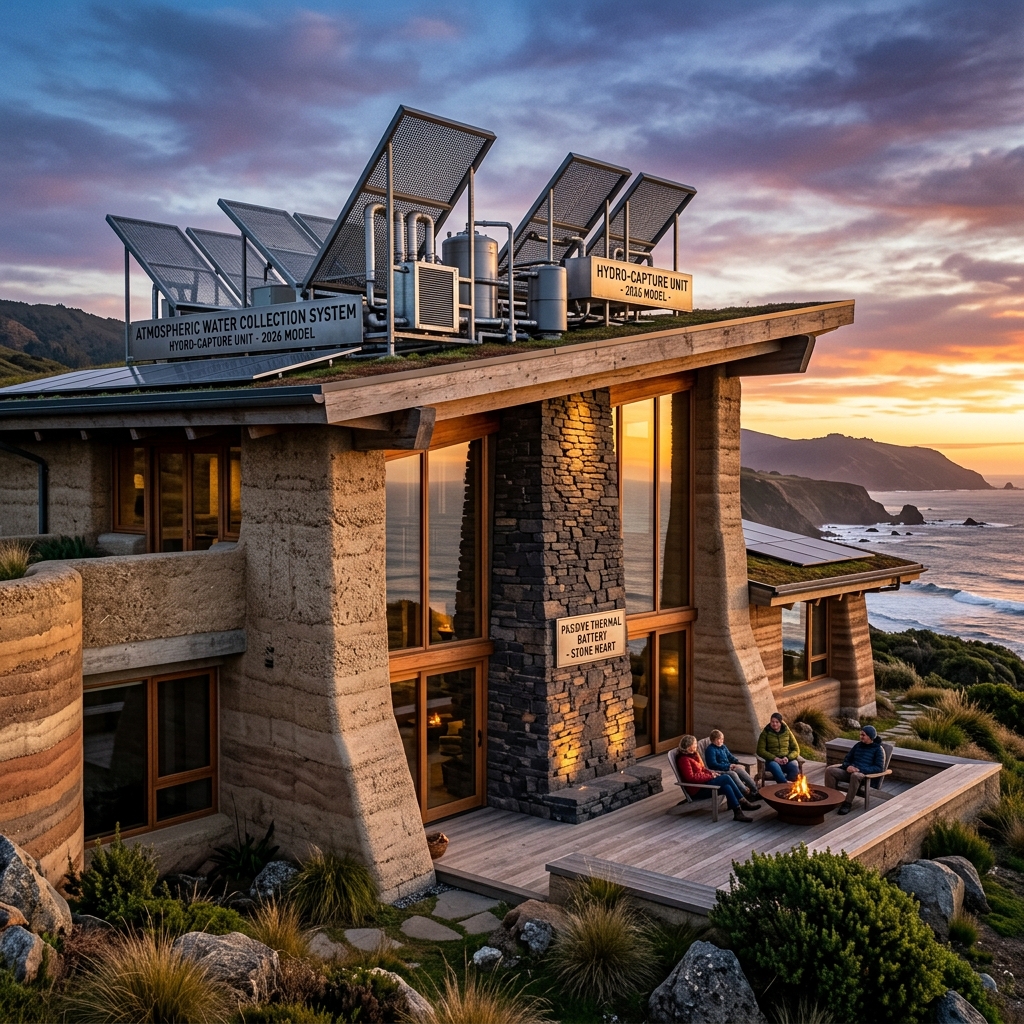
In our latest project in British Columbia, we have implemented what we call the "Thermal Battery." By using high-density materials like rammed earth and concrete with phase-change materials (PCMs) embedded in the walls, the home acts as a heat sink during the day and a radiator at night.
- Key Data: At 0°C (32°F) external temperature and ZERO power, the "Thermal Battery" home maintains an internal temperature of 21°C (70°F) for up to 72 hours.
- Why it Matters: In the 2026 "grid-outage" year, this means the difference between survival and disaster.
The Materials Revolt: Localism vs. Global Logistics
The 2026 energy crisis has effectively ended the era of "just-in-time" global logistics for construction materials. The cost of shipping a ton of steel or glass from China has tripled since 2024. This has led to a "Material Revolt," where architects are returning to local, bio-based materials.
The Rise of Hempcrete and CLT
- Hempcrete: This material is carbon-negative, incredibly insulating, and fire-resistant. In 2026, it is the primary wall-filler for mid-tier residential builds because it can be grown locally and processed with minimal energy.
- Cross-Laminated Timber (CLT): For larger buildings, CLT has replaced steel and concrete as the "high-tech" choice. It is lighter to ship, faster to assemble, and provides better natural insulation—all critical in the high-cost 2026 economy.
The Atmospheric Water Collection Room: A New Architectural Necessity
As the "Water Tax" has become a reality in many Western cities due to infrastructure decay and climate drought, we are seeing a new room type emerge in home design: the Atmospheric Water Collection Room (AWCR).
In 2026, relying solely on municipal water is seen as a risk. The AWCR uses high-efficiency condensation technology to "pull" water from the air, which is then filtered and stored in huge underground cisterns.
- The Feng Shui of Water: In ancient architecture, the "Cistern of Life" was the heart of the home. In 2026, the AWCR represents the ultimate Water Element—the source of life and abundance in a scarcity environment.
The "Dragons-Belly" Ventilation: Cooling without Energy
One of the most striking innovations of 2026 is a return to "Low-Tech" ventilation. By using the natural chimney effect—warm air rising and drawing in cool air from below—we can cool a home by 15°C without a single watt of air conditioning.
- The "Taiji Vent": A central atrium or "light well" that acts as the Dragons-Belly. In Feng Shui, this is the center of the Bagua, where the most vital energy flows. By allowing this energy to move, we are also allowing the air to move.
Case Study: The "Surplus Home" in suburban Vancouver
Last week, Lucky Properties visited the "Surplus House," a net-zero-energy home that actually generates more electricity than it consumes, even during the dark winter months of March. It achieves this through a combination of high-efficiency perovskite solar windows and a geothermal heat pump system.
The homeowner, a software designer, reported that since the 2026 energy price spike, his home has become his most valuable asset—not just as real estate, but as a Power Plant.
Conclusion: The Final Shift from Consumption to Creation
The architecture of 2026 is no longer about human dominance over nature; it is about human integration into nature. We cannot live in a bubble that consumes more than it produces.
As we move forward into this new age of scarcity and resilience, the homes we build will be our most important survival tool. Those who design for the reality of $120 oil, climate instability, and water scarcity will be the ones who thrive. The home of 2026 is not just a place to sleep; it is a place of Resilience, Stability, and Flow.
Lucky Properties Resilience Index:
- Average HVAC Savings in Resilient Builds: 60-80%
- The "Passive Thermal" Standard 2026
- Architectural Trends: The End of the All-Glass Skyscraper
[mermaid chart showing The Resilient Home: Thermal Batter, AWCR, and Dragon-Belly Ventilation]