Short answer
Liu Yao (六爻, Six Lines divination) is the method most Chinese I Ching practitioners actually use, and it barely opens the book. You cast a hexagram the ordinary way, six tosses of three coins, exactly as the three-coin casting guide on this site sets out. Then, instead of turning to the Judgment and the line texts, you install a chart on the figure. Every line receives a Heavenly Stem and an Earthly Branch from the calendar, a system called najia (纳甲). The hexagram is filed under one of the eight palaces, and the filing fixes two marked lines: the Shi line (世爻), which stands for the querent, and the Ying line (应爻), which stands for the other party or the matter asked about. The five elements of the six branches are then compared with the element of the palace, and each line is dealt one of five family roles, the six relatives (六亲). Finally the six spirits (六神) are laid over the lines from the stem of the day. What started as six broken and solid lines is now a small working model of the question, with named parts that generate, control, clash, and combine. The reading is done on that model.
This guide covers the installation only: the four steps, the tables they run on, and one cast carried through all of them. It sits between three pages already on the site. The casting guide teaches the toss. The Meihua Yi Shu guide teaches a rival way to read the same hexagram, through trigram images. The fortune-telling methods comparison sets Liu Yao's cousins, BaZi, Zi Wei Dou Shu, face reading, and palm reading, side by side. Liu Yao is the missing piece in that set: the hexagram method that reads wiring instead of words or pictures.
Four names for one system
The method travels under four names, and a reader searching in English meets all of them.
Liu Yao (六爻) means six lines, and names the object being read. Wen Wang Gua (文王卦) means King Wen's hexagrams, an honorific that credits the figure tradition names as the I Ching's author; the elemental machinery itself is far later than King Wen. Najia (纳甲) names the core technique, the fitting of stems and branches onto lines, and takes its name from Jia, the first stem, standing in for the whole set. Huo Zhu Lin (火珠林), Fire Pearl Forest, is the name of a classical manual tradition in this line, and is sometimes used for the method itself.
The written record starts with Jing Fang (京房, 77 to 37 BCE), a Western Han dynasty scholar of the Changes. The Wenwanggua article on Wikipedia, read for this guide, puts it plainly: the method was first described in writing by Jing Fang, and the scholar Larry Schulz's summary, quoted there, credits Jing Fang with the earliest appearance of the eight-palace arrangement and of the najia theory, the systematic fitting of stems, branches, and the five phases onto the linear figures. Later centuries turned that Han scaffolding into a working diviner's craft, recorded in case manuals. The best known is Zeng Shan Bu Yi (增删卜易), a collection of hundreds of worked cases credited to the figure known as the Wild Crane Elder, which modern practitioners still read first. In the twentieth century the system stayed largely invisible in English: Wilhelm's standard translation mentions the coin oracle that uses the five stages of change and the cyclic signs only in an appendix, as something Chinese practitioners used. Inside Chinese practice it was, and remains, the mainstream way to work a cast.
Step one: najia, stems and branches on the lines
Najia assigns each of a hexagram's six lines a stem-branch pair. The pair comes from the two trigrams the hexagram is built from. The lower trigram supplies lines 1 to 3, the upper trigram lines 4 to 6, and each trigram carries a fixed pattern: one stem (two, for Qian and Kun, which change stem between the lower and upper position) and a run of three branches.
Yang trigrams (Qian, Zhen, Kan, Gen) take yang stems, and their branches run forward through the yang branches, two steps at a time. Yin trigrams (Kun, Xun, Li, Dui) take yin stems, and their branches run backward through the yin branches, two steps at a time. The full pattern for the eight pure hexagrams, which is the template every other hexagram borrows from, is:
| Trigram | Element | Lines 1 to 3 (lower position) | Lines 4 to 6 (upper position) |
|---|---|---|---|
| Qian (乾), Heaven | Metal | Jia: Zi, Yin, Chen | Ren: Wu, Shen, Xu |
| Kun (坤), Earth | Earth | Yi: Wei, Si, Mao | Gui: Chou, Hai, You |
| Zhen (震), Thunder | Wood | Geng: Zi, Yin, Chen | Geng: Wu, Shen, Xu |
| Xun (巽), Wind | Wood | Xin: Chou, Hai, You | Xin: Wei, Si, Mao |
| Kan (坎), Water | Water | Wu: Yin, Chen, Wu | Wu: Shen, Xu, Zi |
| Li (离), Fire | Fire | Ji: Mao, Chou, Hai | Ji: You, Wei, Si |
| Gen (艮), Mountain | Earth | Bing: Chen, Wu, Shen | Bing: Xu, Zi, Yin |
| Dui (兑), Lake | Metal | Ding: Si, Mao, Chou | Ding: Hai, You, Wei |
Read one row slowly. Zhen, Thunder, is a yang trigram, so it takes the yang stem Geng in both positions, and its branches climb the yang sequence: Zi, Yin, Chen below, then Wu, Shen, Xu above. Li, Fire, is a yin trigram: the stem is Ji in both positions, and the branches descend the yin sequence, Mao, Chou, Hai below, You, Wei, Si above. Qian and Kun are the exceptions that keep two stems, Jia below and Ren above for Qian, Yi below and Gui above for Kun. Any hexagram at all is then mechanical: identify its two trigrams, take the lower trigram's lower row and the upper trigram's upper row, and the six pairs are set.
Each branch carries its own element, and the branch elements, not the stems, do most of the work in a reading: Zi is Water, Chou Earth, Yin Wood, Mao Wood, Chen Earth, Si Fire, Wu Fire, Wei Earth, Shen Metal, You Metal, Xu Earth, Hai Water. After najia, every line of the cast has an element, a place in the calendar cycle, and a set of fixed relations to every other line: the six combinations (such as Zi with Chou), the six clashes (Zi against Wu, Chou against Wei, and so on around the wheel), and the generating and controlling cycles. The figure has stopped being a picture and become a small calendar machine.
Advertisement
Step two: the eight palaces, and the Shi and Ying lines
The second step files the hexagram. Jing Fang's eight palaces (八宫) sort all 64 hexagrams into eight families of eight. Each palace is headed by a pure hexagram, a trigram doubled, and takes that trigram's element as its own: the Qian palace is Metal, the Kun and Gen palaces Earth, Zhen and Xun Wood, Kan Water, Li Fire, Dui Metal. The other seven members are generated from the pure hexagram by a fixed routine. Change the first line and you have the first-generation hexagram. Change the second line as well, the second generation. Continue through the fifth line for the fifth generation. Then flip the fourth line back, which produces the wandering-soul hexagram, and flip the whole lower trigram back, which produces the returning-soul hexagram, the member that sits closest to home.
The filing matters because it fixes the two marked lines. The Shi line stands for the querent, the self side of the question. The Ying line stands opposite: the other party, the counterpart, the place or the matter itself. Their positions follow the palace sequence exactly:
| Palace slot | Shi line | Ying line |
|---|---|---|
| Pure hexagram | 6 | 3 |
| First generation | 1 | 4 |
| Second generation | 2 | 5 |
| Third generation | 3 | 6 |
| Fourth generation | 4 | 1 |
| Fifth generation | 5 | 2 |
| Wandering soul | 4 | 1 |
| Returning soul | 3 | 6 |
Two patterns in the table are worth seeing. The Shi line climbs the hexagram as the generations proceed, first line, second, third, up to the fifth, and the wandering and returning souls step back down the same ladder. And the Ying line is always three positions from the Shi line: lines pair off inside a hexagram as 1 with 4, 2 with 5, and 3 with 6, lower trigram answering upper trigram, and Shi and Ying always occupy one of those pairs. A reading in this system is, at its core, an account of the relation between those two marked lines and the line the question is about: do they generate each other, control each other, clash, or combine.
Step three: the six relatives, dealt by element arithmetic
The third step gives every line a role. The comparison point is the palace element, which plays the part of "me" in the system's grammar. Each line's branch element is set against it, and one of five relations results:
| Line element against palace element | Relative | The tradition reads it for |
|---|---|---|
| The same element | Siblings (兄弟) | Peers, friends, partners at the same level, rivals |
| It generates the palace element | Parents (父母) | Elders, documents, contracts, certificates, housing, shelter |
| The palace element generates it | Offspring (子孙) | Children and juniors, relief, enjoyment, the line read as medicine in health questions |
| It controls the palace element | Officer (官鬼) | Office and rank, bosses, pressure, illness, lawsuits, worry |
| The palace element controls it | Wealth (妻财) | Money, goods, stock, anything managed or held; by convention, the partner in a man's relationship question |
Five roles, six lines: the roles are dealt one per line, so in most hexagrams one role appears twice and, in some, one role does not appear at all. A missing role is not left blank. The tradition supplies it from the palace's pure hexagram, at the position it occupies there, as a hidden line (伏神, fu shen) filed under the corresponding line of the cast. The worked example below has to use that rule, because its hexagram has no Fire line and therefore no Parents line on the surface.
The names are family words, but the use is wider. A question about a rental contract is read on the Parents line, because the tradition files documents and housing there, whether or not any parent is involved. A question about a fever is read against the Officer line, filed as illness, and the Offspring line, filed as the medicine that controls it, since in the controlling cycle the Offspring element controls the Officer element. The relatives are best understood as five folders the system sorts the world into, labelled with the oldest filing words it had.
Step four: the six spirits, set by the day
The last layer is decoration with a job. The six spirits (六神) are six named figures laid over the lines in a fixed order, bottom to top: Azure Dragon (青龙), Vermilion Bird (朱雀), Gou Chen (勾陈), Teng She (螣蛇), White Tiger (白虎), and Black Tortoise (玄武). Which spirit lands on line 1 is decided by the stem of the day of the cast:
| Day stem | Spirit on line 1 |
|---|---|
| Jia or Yi | Azure Dragon |
| Bing or Ding | Vermilion Bird |
| Wu | Gou Chen |
| Ji | Teng She |
| Geng or Xin | White Tiger |
| Ren or Gui | Black Tortoise |
From line 1 the sequence runs upward in its fixed order, wrapping from Black Tortoise back to Azure Dragon. The spirits do not change the structure of the chart. In a reading they colour the lines they sit on: tradition associates the Azure Dragon with glad and fortunate matters, the White Tiger with injury, mourning, and roads, the Vermilion Bird with words, documents, and disputes, the Black Tortoise with hidden and underhand matters, Gou Chen with delay and entanglement, and Teng She with alarm and strange turns. Readers treat this layer as commentary on the relatives, never as a verdict on its own, and a beginner can install a chart correctly while leaving the spirits for later.
Reading the finished chart
With the chart installed, a reading runs in a set order, and the order is most of the discipline.
First, the reader picks the focus line, the yong shen (用神), by the type of question, following the folders in the relatives table: Wealth for money, Officer for a post, Parents for a document or a house, Offspring for relief and medicine, Siblings for a partner or a rival. Second, the focus line is measured against the calendar of the cast. The branch of the month (月建, the month commander) sets the seasonal ground: a line whose element the month generates or matches is read as strong, a line the month controls or that clashes with the month branch is read as weak or broken. The branch of the day (日辰) is the second yardstick, able to generate, control, combine with, or clash a line. Third, any moving lines are read: a line cast as old yang (9) or old yin (6) flips, the flipped figure is the changed hexagram, and the changed line's new branch and relative join the reading as the direction of movement. A quiet cast, with no moving lines, is read on the original hexagram alone.
Two consequences follow for anyone used to the book. A Liu Yao cast that is not dated is unfinished: without the day and month, the strength half of the reading cannot be done at all, which is why practitioners record the date beside every cast as a matter of routine. And the Judgment text of the hexagram plays no part. A reader who wants the text reads the text, by the method the casting guide describes; a Liu Yao reader reads the chart. The two crafts share the coins and nothing else.
Worked example: hexagram 11 installed line by line
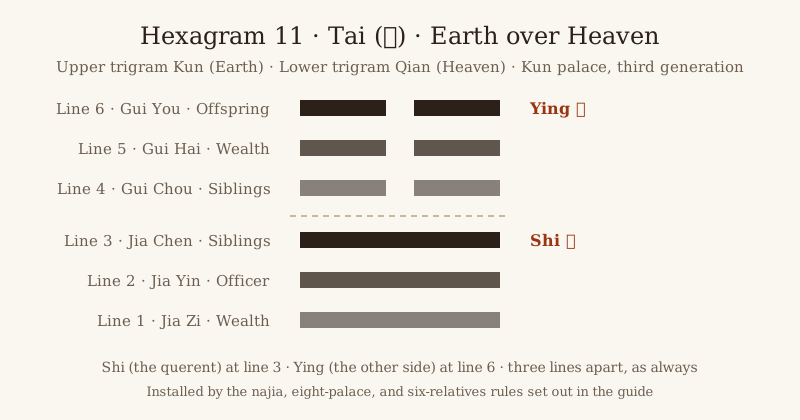
The cast below is a teaching cast, constructed for this guide so every step can be checked against the tables above. It is not the record of a real sitting. The six tosses came out as young yang, young yang, young yang, young yin, young yin, young yin: totals of 7, 7, 7, 8, 8, 8, with no moving lines. The figure is hexagram 11, Tai (泰), Earth over Heaven: the Qian trigram below, the Kun trigram above. Suppose the cast was made on a Jia day.
Najia. The lower trigram is Qian in the lower position: Jia Zi, Jia Yin, Jia Chen on lines 1 to 3. The upper trigram is Kun in the upper position: Gui Chou, Gui Hai, Gui You on lines 4 to 6.
Palace. Build the Kun palace by the generation routine. Kun doubled is the pure hexagram. Changing line 1 gives Fu, Return (hexagram 24). Changing line 2 as well gives Lin, Approach (hexagram 19). Changing line 3 as well turns the whole lower trigram into Qian, and the result is Tai itself. Tai is therefore the third-generation hexagram of the Kun palace, the palace element is Earth, and the table in step two puts the Shi line at line 3 and the Ying line at line 6.
Relatives. Compare each branch element with Earth. Line 1, Zi, is Water: Earth controls Water, so the line is Wealth. Line 2, Yin, is Wood: Wood controls Earth, so the line is Officer. Line 3, Chen, is Earth: the same element, Siblings, and this is the Shi line, the querent's place in the chart. Line 4, Chou, is Earth: Siblings again. Line 5, Hai, is Water: Wealth again. Line 6, You, is Metal: Earth generates Metal, so the line is Offspring, and it is also the Ying line, the other side of the question. No line carries Fire, so no Parents line appears on the surface. The hidden Parents line is borrowed from the Kun pure hexagram, whose second line is Yi Si, Fire: a hidden Parents line sits under line 2.
Spirits. The day stem is Jia, so the Azure Dragon starts at line 1 and the sequence climbs: Azure Dragon, Vermilion Bird, Gou Chen, Teng She, White Tiger, Black Tortoise.
The finished chart, drawn as practitioners draw it, top line first:
| Line | Form | Spirit | Stem and branch | Element | Relative | Mark |
|---|---|---|---|---|---|---|
| 6 | Yin | Black Tortoise | Gui You | Metal | Offspring | Ying |
| 5 | Yin | White Tiger | Gui Hai | Water | Wealth | |
| 4 | Yin | Teng She | Gui Chou | Earth | Siblings | |
| 3 | Yang | Gou Chen | Jia Chen | Earth | Siblings | Shi |
| 2 | Yang | Vermilion Bird | Jia Yin | Wood | Officer | Hidden Parents (Yi Si) below |
| 1 | Yang | Azure Dragon | Jia Zi | Water | Wealth |
Read in the system's own terms, the chart already says several structural things before any question is attached. The querent's line and the other side's line sit in the 3 and 6 pair, Earth against Metal, and Earth generates Metal: the Shi line feeds the Ying line, which tradition reads as the self side giving toward the other side. The Wealth role appears twice, at the bottom and near the top, and the Officer line, the seat of pressure, is also the line carrying the hidden Parents line underneath it. Attach a question and the reading narrows to one folder: for a question about a contract, the reader goes to the hidden Parents line and asks after its strength against the month and day; for a question about payment, to the two Wealth lines and their relation to Shi. The example stops at the installation, because the strength half of any real reading needs a real month and day, and a teaching cast has neither.
Three crafts, one hexagram
The same figure, Tai, can be carried into three different workshops on this site, and it is worth being clear about what each one does with it.
| Zhou Yi text reading | Liu Yao | Meihua Yi Shu | |
|---|---|---|---|
| What is read | The Judgment and the line texts of the book | The installed chart: branches, palace, relatives, spirits | The two trigrams as images, host against guest |
| Role of the classic's text | The whole reading | None | None, the images carry the reading |
| Calendar used | No | Yes: day and month branches, day stem | Yes: the date and hour supply the casting numbers |
| Moving lines | The changed line's text is read | The changed line's branch and relative are read | The single moving line splits host from guest |
| Output | Counsel in the book's language | A structured account of the parties and the focus line | A short verdict from the element relation of the trigrams |
None of the three is the original from which the others decayed. The text is the oldest layer, the najia machinery is a Han dynasty construction on top of the figures, and Meihua is traditionally attached to Shao Yong in the Song dynasty. They coexist because they answer different appetites: the text for reflection, the chart for a detailed account of a specific matter, the images for a fast read.
Limits
Liu Yao is internally exact and externally unproven. The installation in this guide can be checked line by line, and two careful readers will build the same chart; that consistency is a property of the arithmetic, not evidence that the reading describes the future. No controlled test has shown Liu Yao readings, or any hexagram method, predicting events better than chance, and the case manuals that preserve the tradition record the hits a practising diviner chose to write down, which is a selected sample by construction.
Reader weighting is the second limit. The manuals agree on the installation and argue about almost everything after it: which line is the true focus for a mixed question, how much a clash with the month branch weakens a line, when a hidden line counts. Two readers with the same chart can and do reach different conclusions, and the tradition has no referee for the disagreement beyond reputation and results remembered by clients.
So the guide's framing is the site's framing for every method in this pillar. Liu Yao is a sophisticated piece of Han dynasty systems thinking that turned a book of counsel into a calendar-driven chart craft, and it rewards study on those terms: as history, as structure, and as a record of how a culture organised uncertainty. It is not a tool for deciding medical treatment, contracts, investments, or any other matter with real stakes, and no reading produced by it should outrank evidence, professional advice, or the querent's own knowledge of their situation.
Sources
The method's history, the Jing Fang attribution, the eight-palace construction, and the trigram stem correspondences follow the Wenwanggua article on Wikipedia and the sources it cites, including the Jing Fang Yi Chuan and Schulz's dissertation on Lai Chih-Te. The najia table for the eight pure hexagrams, the Shi and Ying positions, the six-relatives rules, and the six-spirits starting table were checked against the Liu Yao reference guides at FateForge (fateforge.me/guides/liuyao-najia, liuyao-shiying, liuqin, and liushen) and against the I Ching Stream Six Lines course notes on installing the six relationships, all read for this guide. The worked example was installed from those tables and re-derived from the palace generation routine as a check; where one reference's Shi and Ying offset list disagreed with the line-pair geometry, the geometry (pairs 1 with 4, 2 with 5, 3 with 6) was followed.