Face reading has a barrier to entry: the full system, the twelve palaces, the hundred positions, the five features in balance, takes real study. Mole reading is the door most people actually walk through. It asks for a mirror, a chart, and one mark you have wondered about since you were twelve. That accessibility is why mole reading, zhi xiang, is the most widely practised branch of Chinese physiognomy and also the most garbled, reduced online to lucky mole and unlucky mole lists with no method underneath.
This guide puts the method back. A mole in this system is judged three ways before any position is consulted: by its character, by whether it is hidden or exposed, and only then by where it sits. The guide works in that order, then walks the face region by region with the traditional readings, covers the points where schools disagree, and finishes with a complete example and the boundary that outranks everything else in it: the medical one.
First judgement: what kind of mole is it?
Classical mole reading starts with the mole itself, not the map. Two moles in the identical position are read differently if one is a good mole and the other is not, and the criteria are physical and checkable in a mirror.
| Feature | Good mole (shan zhi), as tradition classes it | Problematic mole (e zhi) |
|---|---|---|
| Colour | Deep glossy black, or a clear dark red | Grey, brown, yellowish, mixed or washed out |
| Shape | Round, clean-edged | Irregular, blurred edges |
| Surface | Raised, smooth, slightly shining | Flat, rough, dull |
| Hair | A hair growing from it is read as vitality in that spot | Not a negative in itself |
The logic underneath is the same logic mian xiang applies to the whole face: clear, bright, and well-formed features are read as clear fortune; dull, mixed, and broken features are read as friction. A good mole makes its position's meaning come out well. A problematic mole makes the same position an area to be careful with. This is why the lucky and unlucky lists online contradict each other so often: they print positions and drop the character judgement that decides half the reading, so the same forehead mole is a blessing in one list and a curse in the next.
Second judgement: hidden or on show?
The second classical principle is concealment. A well-formed dark mole that sits hidden (inside the eyebrow, in the hairline, behind the ear, under the chin's curve, anywhere normally covered) is widely read as stored fortune: something kept in reserve that shows itself when needed. The popular phrasing is that a hidden black mole holds luck the way a savings account holds money. A red mole is the partial exception, often read as better displayed, its colour being part of its virtue. Visible moles on exposed ground are read at face value, for good or ill, with character deciding.
Practically, this principle does one useful thing for a modern reader: it explains why eyebrows matter so much in the charts. A mole hidden inside the brow is among the most consistently favoured marks in the whole system, read as talent and resources kept in reserve, helped by influential people, and it is favoured precisely because it is both well-placed and hidden.
Advertisement
The map: positions and their traditional readings
The readings below are the chart tradition as standard references state it, organised by the face's own regions, which follow the palaces of the mian xiang guide. Positions are described as the charts describe them; exact placement within a region is what does the work.
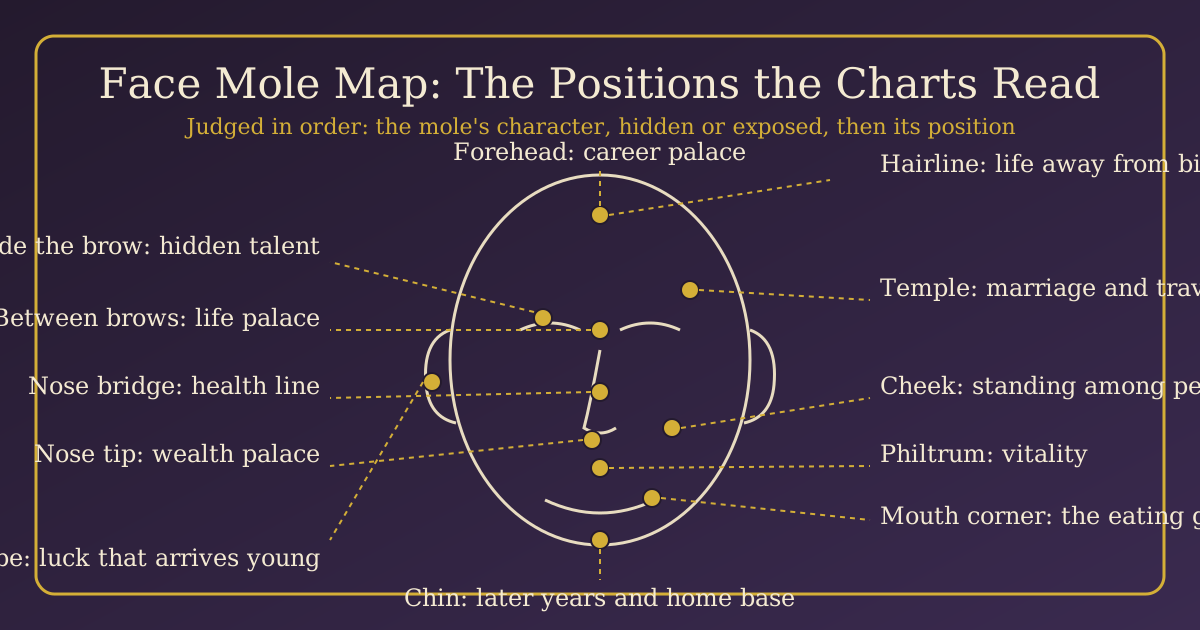
Forehead. The forehead is the career palace and the territory of the early years, roughly fifteen to thirty. A well-formed mole high and central is read against support and standing: in some charts as distance from parents or an early move away from the home place, in others as ambition that has to make its own backing. A mole at the hairline's centre is the classic separation reading, a life made away from the birthplace. Forehead readings split more by school than any other region, and a reader should hold them lightly.
Between and inside the brows. The space between the brows is the life palace, and a mole dead centre there is read as blockage in the life path in the stern charts, which is why it appears on unlucky lists. Inside the brow itself is the opposite finding, the hidden mole of talent described above, one of the most favoured marks in the system. The two positions are a centimetre apart and carry opposite readings, which is the whole character of mole reading in miniature: precision is not decoration, it is the method.
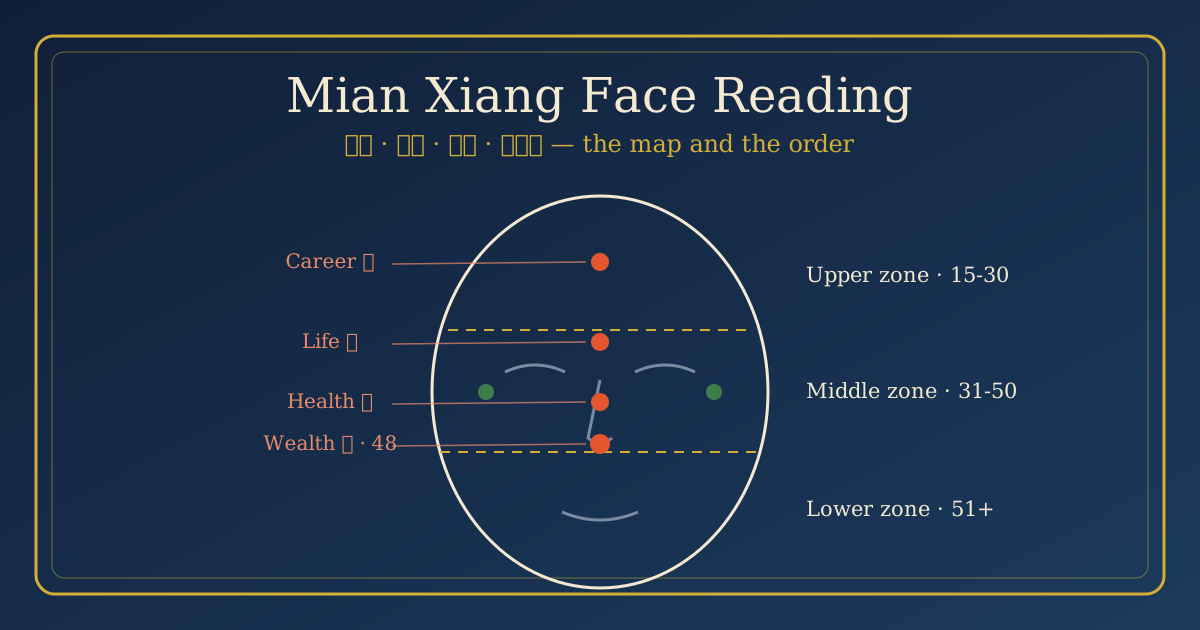
The nose. The nose is the wealth palace, and its centre line is also the health palace. A mole on the bridge is read on the health side: a position the charts treat cautiously, associated with a constitution to look after. A mole on the tip, the exact centre of the wealth palace, is read as money moving: income from several directions, with the recurring chart note that what arrives easily also leaves easily. A mole on the wing or side is read as leakage in the storing of money, weighted toward mid-life. The nose is where the tradition's money language is most literal, and a reader should notice that the readings are about flow and keeping, never about amounts.
The cheeks. Cheek moles are read socially. The cheek carries the area of standing among people: a well-formed mole here is read as presence, being noticed, a face that carries authority in a room; the sterner charts add a caution about disputes and being drawn into others' conflicts, since visibility cuts both ways. Lower on the cheek, the reading shades toward the support a person receives from others rather than the impression they make.
The philtrum and the lips. The philtrum, the groove between nose and upper lip, is read against vitality and children in the classical scheme, and a mole centred there is one of the positions the careful charts treat seriously and the popular ones skip. The mouth itself governs appetite and expression. A mole at the corner of the mouth is the famous eating god mole: a love of good food and the luck of being fed well by life, with eloquence and charm in the same reading, and a standing caution in the older texts about talk and gossip following the charming. A mole on the upper lip leans toward sentiment and expression; on the lower lip, toward appetite and family life. Lip readings are among the most stable across schools.
The chin. The chin governs the later years, determination, and the home base. A mole at the chin's centre is read as a settled later life with property under it, the chin's own territory confirming itself. A mole off-centre carries the movement reading: many homes, an unsettled base in the earlier decades, steadiness later. The side-of-chin mole's popular nickname, the busybody mole, reads the same spot socially, as an inquisitive, involved temperament. These are not contradictions so much as the same position read at different ages of a life.
The ears and temples. Ears reflect childhood fortune and natural endowment in mian xiang. A mole on the ear, especially the lobe or the inner ear, is among the most favourably read marks in the charts: intelligence, a comfortable early life, luck that arrives young. Behind the ear the hidden-mole principle applies and the reading stays kind. The temple region is the marriage and travel palace in the twelve-palace map, and a mole there is read into that territory: partnership and movement, its character deciding the tone.
Where the schools disagree, stated plainly
Three disagreements run through every mole chart ever printed, and an honest guide names them. First, the forehead, where readings diverge most and where a reader should trust any single chart least. Second, the weighting of side: older texts apply a gendered left-right convention, modern charts mostly do not, and the popular lists rarely say which they are using. Third, tone: the stern classical charts read far more positions cautiously than the modern popular ones, which have drifted steadily luckier over a century of magazine reprinting, because lucky lists sell. A reader comparing charts will get the most from the positions where all three versions agree, the brow, the ear, the mouth corner, and should treat a position that flips between charts as unmapped territory rather than as a verdict.
A labelled hypothetical: one face, read in order
The example below is invented to show the order of judgement. The face is illustrative.
A reader checks three moles in the mirror. The first is a small, raised, glossy black mole with a single hair, hidden inside the left eyebrow. Character: good mole by every criterion. Concealment: fully hidden. Position: inside the brow, the most consistently favoured finding in the charts. The reading, in the tradition's terms, is talent and resource in reserve, with help from well-placed people arriving when it is needed. The second is a flat, grey-brown mole on the bridge of the nose. Character: problematic. Position: the bridge, read on the health palace line. The reading is a caution, an area of life the charts say to look after, and in practice the reader files it exactly there, as a prompt to keep ordinary health housekeeping in order, nothing more dramatic. The third is a round dark mole at the right corner of the mouth. Character: good. Position: the eating god spot. Reading: appetite, eloquence, pleasure in food and company, with the old caution about talk attached. Three moles, three different weights of finding, and the order of the judgements (character, concealment, position) is what kept each one in proportion. That order, not any single position's fortune, is what this guide asks a reader to keep.
Removing moles, and the rule that outranks the chart
Because charts call some moles bad, a cosmetic trade exists in removing them, and the tradition itself is ambivalent about it: removal leaves a scar, and a scar is also a mark that gets read, so the exchange is not clearly favourable even on the system's own terms. Practitioners who do read removal cases usually advise reading what remains, not celebrating an erasure.
The governing rule is not traditional at all. It is dermatological. A mole that appears in adulthood, grows, changes shape or colour, develops an irregular edge, itches, crusts, or bleeds is a mole to have examined by a doctor promptly; those changes are the screening signs for skin cancer, and they outrank every chart in this guide and every chart anywhere. Equally, a lifelong, stable, unchanged mole is a normal feature of skin, and no reading in these pages is a medical reason to touch it. Mole reading is a way of looking at a face. It is not a way of triaging one.
Limits of this guide
Zhi xiang is reported here as its tradition states it: a branch of a centuries-old interpretive system (one of the methods set side by side in Chinese fortune telling methods compared), internally consistent, culturally rich, and without scientific standing as a description of character or fate. The readings are the charts', not this site's findings. What the practice genuinely offers is narrower and more durable than fortune: a close look at one's own face, a vocabulary for its marks that families have handed down for generations, and the small pleasure of finding that the mole you have always had has a name, a palace, and a story. Enjoyed on those terms, it needs no stronger claim, and this guide makes none.