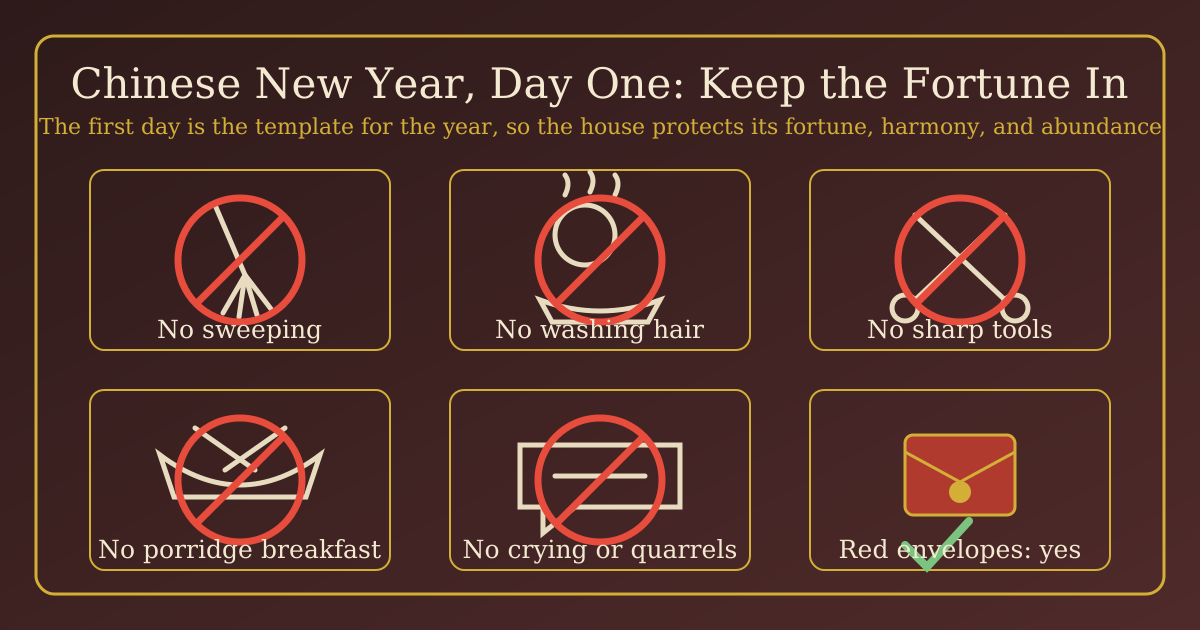
The taboos are the part of Chinese New Year that outsiders notice first, usually by breaking one. A guest reaches for a broom on New Year's Day and the room reacts. A dish slips and three people say the same phrase at once. None of it is random: the prohibitions form one coherent system, documented for Singapore by the National Library Board and summarised for travellers by China Highlights, and the system has a single organising idea. The first day of the year is a template for the twelve months that follow it, so the household spends that day protecting three things: its fortune, which must not be swept, washed, cut, or lent away; its harmony, which must not be cracked by tears, arguments, or unlucky words; and its abundance, which must be displayed at the table rather than contradicted by poor food or broken dishes.
This guide is the practical version of that system. It opens with the master table, then gives the preparation sequence as a numbered method, then works through each taboo with the reason tradition gives, the days it covers, and the recognised alternative. It finishes with the remedies for when a rule is broken anyway, because the tradition, sensibly, has those too, and with the modern adaptations that city households actually use. Everything here is presented as tradition, because that is what it is.
The taboo list at a glance
| Taboo | Reason tradition gives | Observed |
|---|---|---|
| Sweeping and taking out rubbish | Sweeps the new year's fortune out of the house | Day 1 strictly; many wait to day 5 |
| Washing hair | "Hair" (fa) shares its character with "prosperity" (facai); washing reads as washing wealth away | Days 1 to 2 |
| Cutting hair | Folk saying links a first-month haircut to a maternal uncle's bad luck | Whole first month, strict households; lifts on Longtaitou (2nd day, 2nd month) |
| Knives, scissors, needles | Sharp things "cut the thread of good fortune" and invite quarrels | Day 1 mainly; prep food on New Year's Eve |
| Breaking dishes or glass | Breakage reads as a broken family or broken fortune | Whole festival; remedy phrase said immediately |
| Porridge for breakfast | Historically the poor household's meal; sets a poor table for the year | Day 1 morning |
| Crying, arguing, scolding | Sets a sorrowful, quarrelsome tone for the year | Day 1 especially; festival generally |
| Unlucky words (death, sickness, loss) | Words spoken at the year's start are treated as invitations | Whole festival |
| Black or white clothing | Colours of mourning | Whole festival; red and bright colours preferred |
| Lending, borrowing, collecting debts | Money flowing out on day 1 reads as a year of paying out | Settle before New Year's Eve |
| Laundry | First two days linked to the Water God's birthday; washing reads as washing fortune away | Days 1 to 2 |
| Visiting hospital, taking medicine | Illness at the year's start reads as a year of illness | Avoided if avoidable on day 1 |
| Daytime nap on day 1 | A lazy first day reads as a lazy year | Day 1, in stricter households |
Getting ready: the eight steps before New Year's Eve
The taboos only work because the preparation happens first. The sequence households follow is this:
- Clean the whole house before New Year's Eve. This is the deep clean of the year, and it is done early precisely because cleaning on day 1 is forbidden. Dust is a homophone for "old" in Chinese, so sweeping before the festival is read as sweeping the old year out.
- Take out all rubbish before midnight. Whatever the clean produces leaves the house before the new year arrives, so nothing needs to leave on day 1.
- Settle debts and loose financial ends. Money owed is repaid before the festival so that nobody is lending, borrowing, or collecting during it.
- Do the festival haircuts now. Anyone who wants a cut gets it before the new year, because the first month is off limits in strict households.
- Wash hair and do the laundry on New Year's Eve or before. The same logic as the haircut: everything washed in advance, so days 1 and 2 need no washing.
- Prepare day 1 food in advance. The first day's eating leans on dishes cooked earlier, the reunion dinner's deliberate surplus plus vegetarian dishes prepared ahead, which also keeps knives out of use on day 1.
- Put the sharp things away. Knives, scissors, and sewing needles go into a drawer for the first day, both as symbolism and as a practical way to keep a busy kitchen calm.
- Lay out red and bright clothing. Day 1 outfits are chosen in advance, in the colours of celebration rather than mourning.
Advertisement
The fortune-keeping taboos: sweeping, washing, cutting
The largest group of rules protects fortune, and all of them picture fortune the same way: as something that has just arrived in the house and can be physically carried back out of it.
Sweeping and rubbish. The National Library Board's account of the taboos calls sweeping on New Year's Day an absolute taboo, akin to sweeping good luck out of the house. The rule is about direction as much as action. Dust and rubbish that accumulate during the first days are treated as fortune settling, and they stay put. Households that cannot stand a full day of crumbs use the recognised compromise: a gentle tidy that sweeps inward, toward the middle of the room, gathering rather than expelling, with the pile left in the corner until the fifth day. The fifth day, Po Wu, Breaking the Five, is the formal end of the arrangement: rubbish that has waited since day 1 goes out, firecrackers traditionally mark the moment, and the house gets its first proper clean of the year.
Washing hair. The pun is the whole rule. The character fa, hair, is the character that opens facai, to prosper. Washing hair on the first day therefore reads, in the folk logic, as washing the year's prosperity down the drain. China Highlights lists it among the core festival taboos, alongside not sweeping and not wearing mourning colours. The Eve wash is the standard workaround, and most households quietly relax the rule after day 2.
Cutting hair. The longest of the fortune rules. The folk saying is blunt: a haircut in the first month brings bad luck to your maternal uncle. Historians generally trace the saying to a Ming dynasty order and a phrase about remembering the old (si jiu) that slid, over generations, into a near-identical sounding phrase about the uncle (si jiu, in the folk reading, "death of uncle"). Whatever its origin, the observance is real: barbershops in China famously sit quiet through the first month and then face their busiest day of the year on Longtaitou, the second day of the second month, when the dragon raises its head and haircuts become auspicious again.
Sharp objects. Knives and scissors are put away because they cut, and what they are said to cut is the thread of good fortune; the National Library Board also notes the practical undertone, that sharp tools on a day of feasting and visitors are an argument and an accident waiting to happen. Kitchens handle it by doing the chopping on New Year's Eve. Sewing and needlework rest for the same reason, with the added folk reading that needles tangle things.
The harmony taboos: tears, quarrels, and words
The second group guards the household's mood, on the template theory that a year beginning in tears or anger will keep producing both.
No crying, no arguing, no scolding. Children are famously indulged through the festival, and the National Library Board notes the reasoning: a child punished during the new year period is believed to be set up for a boisterous, rebellious year, so discipline waits. Adults hold the same truce with each other, and grievances are meant to be settled, or at least shelved, before the Eve dinner.
Mind your words. Words for death, sickness, loss, poverty, and ghosts are avoided, along with their homophones, because words spoken at the start are treated as seeds. The most famous application is the number four, si, which sounds like the word for death, and the most practised application is the broken-dish remedy below, which is essentially a word deployed to out-talk an accident. When a child blurts out something inauspicious, elders traditionally answer with the formula "children's words carry no taboo," which formally cancels it.
Black and white stay in the wardrobe. Both colours belong to mourning dress, and mourning is the one register the festival excludes. Red dominates because it is read as joy, luck, and protection, with gold and other bright colours alongside it. This is also why decorations, envelopes, and couplets are red: the colour scheme is the harmony taboo made visible.
The abundance taboos: the first table
The third group is about the first meals of the year, which are staged as evidence of plenty.
No porridge on the first morning. Plain congee was the meal of a household with nothing else, so it cannot open the year. The first breakfast is deliberately better than an ordinary breakfast, and in many families deliberately vegetarian, both out of respect for the day and because the dishes were prepared the day before.
Eat the surplus. The reunion dinner on New Year's Eve is cooked in deliberate excess, and the leftovers are eaten on day 1 as the physical form of the greeting nian nian you yu, "may you have surplus year after year." The fish course carries the same pun: yu, fish, is yu, surplus. A whole fish is served, and in careful households not entirely finished, so the surplus is literal as well as spoken.
Care with crockery. Food is not served in chipped or cracked dishes during the festival. The National Library Board gives the reason plainly: eating from broken ware signifies eating into your own wealth. The good set comes out for the festival, which anyone who has washed up after a reunion dinner already knew.
Breaking a rule: the recognised remedies
The tradition is not brittle. It assumes accidents will happen in a house full of visitors, children, and good dishes, and it supplies repairs.
Something broke. Say "sui sui ping an" at once, peace year after year, converting sui (broken) into sui (year). Wrap the pieces in red paper before they go out. Do not scold the breaker; harmony outranks crockery.
Someone cried or quarrelled. The reset is social rather than ritual: reconcile the same day, ideally before the day ends, so the quarrel does not sit across the year's threshold. Sweet food is the traditional peace offering, and it is not a subtle metaphor.
An unlucky word slipped out. The cancellation formula, "children's words carry no taboo" for a child, and a quick auspicious phrase from anyone else, is treated as sufficient. The system polices intention more than accidents.
You swept before you remembered. The folk answer is to stop, sweep what remains inward, and leave the pile until day 5. The taboo system has survived centuries of real households; it bends around honest mistakes and reserves its seriousness for deliberate disregard.
Money had to move. Red envelopes are gifts, not transactions, and they continue as normal. A genuine emergency debt settled during the festival is handled quietly and without ceremony, and nobody in the tradition pretends otherwise.
The first five days, day by day
Day 1 carries nearly all of the strict rules: no sweeping, no washing hair, no sharp tools, no porridge, red clothing, greetings to elders first, and the template-of-the-year mood kept deliberately cheerful.
Day 2 is traditionally the day married daughters return to their birth families, and the hair and laundry rules are still observed in careful households.
Day 3 is kept quiet in many families, nicknamed the day of the red mouth in some regions, a day when arguments are thought likeliest and visiting is light: a built-in rest day after two days of ceremony.
Day 4 is a transitional day of preparation, welcoming back the household gods in folk practice and getting ready for ordinary life.
Day 5, Po Wu, ends the strict period. Rubbish goes out, shops and businesses reopen with firecrackers, dumplings are eaten in several regions, and sweeping, washing, and spending return to normal.
After day 5 the festival continues in a celebratory rather than prohibitive key through the seventh day, everyone's birthday in the folk calendar, to the fifteenth and the Lantern Festival, which closes the season.
Gift taboos that apply all year
Several of the system's rules are really about gifts, and they are observed year-round, surfacing at New Year because that is the great gift-giving season. Clocks are the famous one: song zhong, giving a clock, echoes song zhong, seeing out the dying, so clocks are never a gift for an elder. Pears cannot be shared or gifted to a couple, because li, pear, is li, separation. Umbrellas carry san, parting, in their name, and are given, if at all, as a practical item between people who do not mind the pun. Sharp gifts, knives and scissors, cut the relationship in the folk reading, unless the receiver returns a coin and makes it a purchase. And gifts and envelopes are given and received with both hands, with crisp new notes in the envelope, because a blessing presented carelessly is read as a blessing meant carelessly.
The modern household version
City life has negotiated with the taboos, and the negotiations are consistent enough to describe. The sweeping rule survives almost intact because it costs one day of crumbs. The hair rule survives as an Eve wash. The haircut rule genuinely empties barbershops. The hospital and medicine rule is observed only in its sane form: non-urgent appointments are not booked for day 1, and nobody in the tradition skips needed medicine, which is why the careful phrasing is always "if it can wait." The clothing rule is kept for visiting, loosely at home. The debt rule has become a calendar habit, bills settled before the holiday, which accountants would endorse on non-folk grounds. And the harmony rules, no quarrels and careful words at the family table, are the ones younger generations most often say they keep on purpose, superstition or not.
For the Fire Goat year that begins on 6 February 2027, the mechanics are identical to any year: the dates move, the rules do not. If 2027 is also your ben ming nian, your own zodiac year, the red in the day 1 outfit is doing double duty, since wearing red through the year is that tradition's central custom. Prepare in the days before the Eve, keep day 1 clean of brooms, water, blades, and cross words, eat like a household with surplus, and let the fifth day put everything back in motion.
Sources and standing
The taboo list, the sweeping rule's absolute framing, the broken-crockery reading, and the note on children and discipline are documented in "Chinese New Year taboos," published by Singapore's National Library Board (nlb.gov.sg, read October 2026). The hair-washing, sweeping, and mourning-colour rules and the festival's overall shape follow China Highlights' Lunar New Year guides (chinahighlights.com, read October 2026). The homophone explanations (fa and facai, si and death, yu and surplus) are standard to the tradition and common to every source above. Regional practice varies, Cantonese, Hokkien, Teochew, and northern households each keep a slightly different list, and this guide gives the widely shared core rather than any one family's house rules. None of the taboos are claims about the world; they are claims about what celebrating families do, and they are reported that way.