Short answer
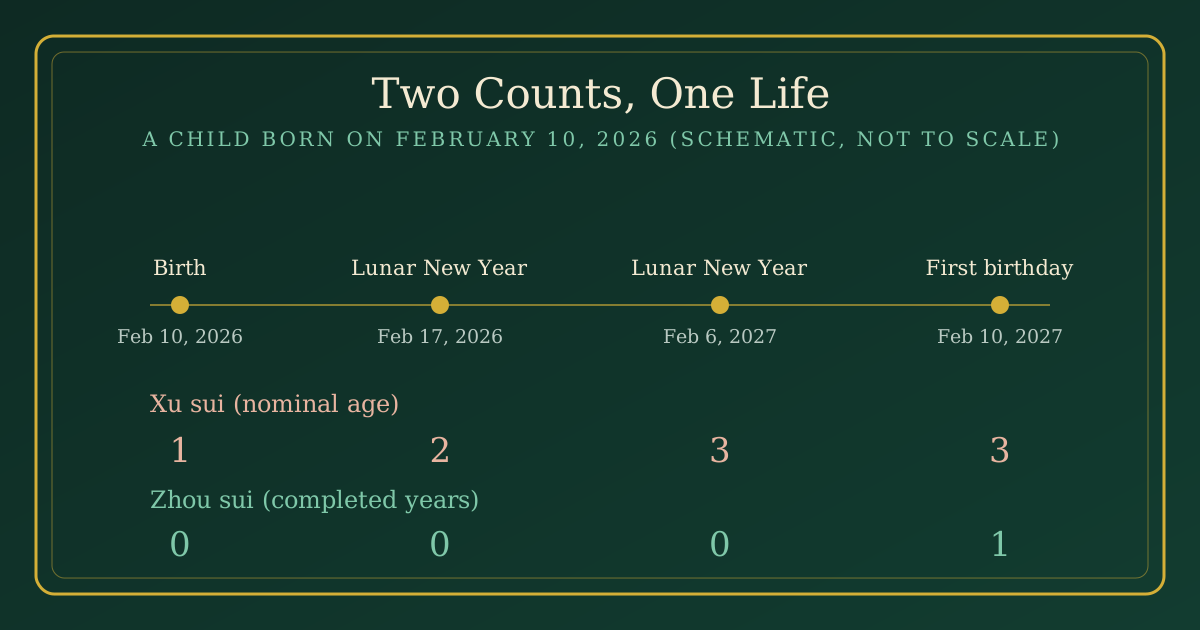
Traditional Chinese age counting runs on a different rule from the birthday count most readers grew up with. In the old count, called xu sui (虚岁, nominal age), a baby starts life at one, and the whole population gains a year together at Lunar New Year. In the modern count, zhou sui (周岁, completed years), a baby starts at zero and gains a year on each birthday. Run both counts on the same person and the old count is always one or two higher. A baby born on February 10, 2026 is two sui old a week later, on February 17, while still being zero years old in the count that goes on documents. Neither figure is wrong. They are answers to two different questions: how many calendar years has this life touched, and how many full years has this person completed.
This is not a museum detail. The old count is the one baked into the zodiac material on this site. The ben ming nian guide gives the ages of your own zodiac years as 12, 24, 36 and so on, in completed years. Inside the tradition that built those customs, the same years were counted in sui, and the numbers come out one higher. Anyone who has been told by an elder or a chart reader that they are a year or two older than they thought has met the gap between the counts. This guide sets the two systems side by side, gives the formula, works dated examples, and shows where each count still applies.
The two counts side by side
| Xu sui (虚岁) | Zhou sui (周岁) | |
|---|---|---|
| Starts at | 1 at birth | 0 at birth |
| Goes up on | Lunar New Year, for everyone at once | Your birthday, one person at a time |
| Counts | Calendar years a life has touched | Full years completed |
| Also called | Nominal age, traditional age | Real age (shi sui, 实岁), international age |
| Used today for | Family conversation, festival custom, horoscope and Tai Sui paperwork, some funeral and longevity customs | Law, medicine, school, insurance, every official document in China |
Read the third row twice, because it explains everything else. Zhou sui measures elapsed time, which is why a person born in June is one age in May and another in July. Xu sui counts membership in calendar years. A life that begins in one lunar year and continues into the next has been present in two years, and the count says so, however few days separate the two New Years from the birth.
That is also why the old count cannot be converted with a single fixed offset. Xu sui is one more than zhou sui for part of each year and two more for another part, depending on where the birthday and the New Year fall relative to today. Section four works the arithmetic in full.
Where sui came from: a count of years, not birthdays
The character sui (岁) does double duty in Chinese. It names a year of age, and in older usage it is tied to the year cycle itself, the cycle governed in early astrology by the planet Jupiter and its counterweight, Tai Sui. Reference summaries of East Asian age reckoning describe the original logic this way: a person's age was a count of the yearly powers they had lived under, one for each turn of the twelve-year Jupiter cycle, not a tally of days since birth. The zodiac animals are the popular survival of that cycle. Each Lunar New Year brings a new year's star and a new animal, and a life collects one sui for each year it has lived under.
Two consequences follow from that origin, and both still show up in practice.
Age belonged to the year, not the person. Because sui stepped up for everyone on the same morning, your age group was your birth-year group. Everyone born in the same lunar year shared a sui age all their lives, which made the count useful for census, hierarchy, and ritual long before birthdays were recorded precisely for ordinary people.
The count was built for cycles. Zodiac returns, Tai Sui relationships, and the sixty-year Jiazi cycle all run on calendar years, so a calendar-year age slots straight into them. The Tai Sui guide on this site works the year relationships; the ages attached to them in traditional sources are sui ages. The Zi Wei Dou Shu guide shows the same habit inside chart work, where major limits begin at a stated nominal age rather than a birthday age.
By the Song dynasty the reckoning had spread across the region, and local versions of it survived in Japan, Korea, and Vietnam as well as China. The modern legal systems then peeled away from it one by one, which is the story in section six.
Advertisement
The formula, and why the gap is one or two
The working formula for the Chinese version is short:
Xu sui = (current lunar year) − (your birth lunar year) + 1
The only judgement call is the birth lunar year. Your birth belongs to the lunar year that contains your birth date, and Lunar New Year falls between January 21 and February 20, so January and early February births often belong to the previous lunar year. The birth-year chart lists the exact start dates year by year; use it before doing the subtraction.
Four dated examples cover every case.
A baby born February 10, 2026. Lunar New Year in 2026 falls on February 17, so February 10 still belongs to the lunar year 2025, the Snake year. The baby is 1 sui at birth. On February 17, 2026, one week later, the baby turns 2 sui. Zhou sui stays 0 until the first birthday on February 10, 2027. For most of 2026 this child is 2 in the old count and 0 in the new one: the maximum gap, reached in the first week of life.
A baby born February 20, 2026. Three days after the New Year, this birth belongs to lunar 2026, the Horse year. The baby is 1 sui at birth and turns 2 sui at the next New Year, February 6, 2027, at eleven and a half months old, still 0 in zhou sui until February 20, 2027. Same gap of two, reached near the end of the first year instead of the start.
An adult born in November 1990. The birth belongs to lunar 1990, a Horse year. During lunar 2026 the formula gives 2026 − 1990 + 1 = 37 sui. In completed years this person is 35 in October 2026 and turns 36 in November. So the gap is two before the birthday and one after it, and a relative quoting 37 and a passport saying 35 are both right, in different counts.
The school-age version of the same rule. Everyone born in one lunar year shares one sui figure, so a classroom of children born across a single lunar year can span nearly two full years of actual age while all being, say, 8 sui together. The old count flattens a cohort into a single number. The new count spreads it out. Systems that need fairness per child, school entry cutoffs and sports age groups among them, run on the new count or on a stated birth-date cutoff, not on sui.
The zodiac case where the two counts collide: fan Tai Sui
The place most readers meet the old count is a zodiac year reading, because the traditional literature counts the ages in sui. Reference works on East Asian age reckoning use a fixed example, and it is worth working slowly.
A child is born in June 2000. That is a Dragon year. The next Dragon year opens at Lunar New Year in 2012. In the traditional count the child is 13 sui for the whole of that year: 2012 − 2000 + 1 = 13. In completed years the child is 11 when the Dragon year opens and turns 12 in June 2012. So the fan Tai Sui year, the year a sign meets its own year's presiding power again, arrives at 13 sui and at 11-going-on-12 in the birthday count.
Nothing about the zodiac changed between the two sentences. The cycle, the animal, and the year are identical. Only the age label moved, because one system counts the birth year as year one and steps at New Year, and the other counts from zero and steps at the birthday.
Practical fallout, stated plainly:
- Traditional texts that say a ben ming nian pattern shows at ages 13, 25, 37, 49, and 61 are counting in sui. The same returns in completed years are the years a person turns 12, 24, 36, 48, and 60. Same years, labels one apart, because the sui label during the return year is the turning age plus one.
- A reader who works in sui and a client who thinks in birthdays can argue about an age for an entire session without either being wrong about the year itself. Ask which count is on the table.
- The Chinese zodiac compared with the Western zodiac makes the same point from the other side: the Chinese system's unit is the calendar year, the Western system's unit is the moment of birth. Age counting follows the unit each system chose.
One boundary stays firm through all of this. These ages are labels inside a tradition. A fan Tai Sui year is a customary frame for care and steadiness, not a forecast, and no age in either count changes what a year will actually contain.
Milestones the old count shaped
Age rituals make more sense once the count behind them is visible.
One hundred days. Many families mark a baby's hundredth day with a gathering, a custom shared across the region; in Korea the hundredth day, baegil, is a named celebration with the same root logic, honouring survival through the fragile first stretch. A hundred days in the old frame is a baby already counted as one, well into a first sui.
Zhua zhou, the first-birthday grab. At the first birthday celebration, zhou, the child is set before a spread of objects, a book, a seal, an abacus, money, a ruler, and the first object grabbed is read, playfully, as a hint of a future path. The ceremony's own name contains the other count: it marks one completed year, one zhou. Held under the old count the same child was two sui that morning, or about to be. Families ran both counts side by side without confusion, one for the ritual calendar and one for the party.
The sixtieth. Sixty completed years close a full Jiazi cycle, the year stem and branch of 1966 repeating in 2026, and the sixtieth birthday, hua jia, is a major celebration in Chinese tradition. In sui the guest of honour is 61 that year, having touched sixty-one calendar years. Longevity banquets for the seventies and eighties grew from the same soil, in an era when reaching those counts at all was the achievement being celebrated.
The same count, three neighbouring versions
China's neighbours took the same reckoning and set the step-up day differently, and two of them have now retired it by law. The comparison is the fastest way to see that the system was a regional standard, not a Chinese eccentricity.
| Place | Traditional unit | Steps up on | Status now |
|---|---|---|---|
| China | sui (岁), xu sui vs zhou sui | Lunar New Year | Zhou sui is the only legal age; xu sui survives in family, festival, and chart contexts |
| South Korea | sal (살) | January 1 | International age made the sole official system on June 28, 2023; a separate year-age (current year minus birth year) kept for a few rules |
| Japan | kazoedoshi (counted years) | January 1 (New Year) | Set aside by law in 1902, with a further law in 1950 pressing the modern count |
| Vietnam | tuoi mu (midwife age) | Lunar New Year | Unofficial; still used by some older people, unfamiliar to many younger ones |
| Taiwan | sui (歲) | Lunar New Year | Mixed use; traditional ages widely quoted in social settings alongside birthday ages |
The Korean change is the best documented recent case. Under the everyday Korean version, a baby was one sal at birth and gained a sal every January 1, so a child born on December 31 turned two the next day. Reuters reported the switch when it took effect on June 28, 2023: laws passed the previous December made the international count, zero at birth and a year on each birthday, the only one for official documents, and the country became one or two years younger on paper in a single day. Officials expected fewer disputes and less confusion, after years in which vaccine rules and other age brackets had collided with the traditional figure people quoted. A government survey in September 2022 found 86 percent of South Koreans planned to use the international age in daily life once the law landed. The year-age variant stayed in place for a short list of rules, including school entry and the ages for buying alcohol and tobacco.
The pattern across all five rows is the same. The old count does not vanish; it retreats to the places where a shared, calendar-based age is the point: family address, festival custom, ritual, and the zodiac paperwork it was built for.
Work out both of your ages: a five-step worksheet
- Find your birth lunar year. If your birthday falls after Lunar New Year in your birth year, it is simply your birth year. If you were born in January or February, check the exact New Year date for that year in the birth-year chart and, if your date falls before it, use the previous year.
- Do the subtraction. Xu sui for the current lunar year = current lunar year − birth lunar year + 1. During lunar 2026, a 1990 birth gives 37.
- State your zhou sui. Completed years since your last birthday. For the November 1990 birth, that is 35 until November 2026, then 36.
- Check the gap. It should be one or two. A gap of zero or three means the birth lunar year was taken wrong, usually a January or February birth assigned to the wrong side of the New Year.
- Note which count a document wants. Anything legal, medical, or financial wants zhou sui. Anything quoted by an elder at a festival table, or printed in a traditional almanac next to a zodiac year, is probably sui. Label the number when you pass it on.
Two quick checks against real dates. Lunar New Year fell on January 29 in 2025, February 17 in 2026, and falls on February 6 in 2027. A baby born on February 1, 2026 belongs to lunar 2025 and turns 2 sui on February 17, 2026. A baby born on February 1, 2027 belongs to lunar 2026 and turns 2 sui on February 6, 2027, at five days old. The 2027 year itself, the Fire Goat year, is worked in full in the 2027 year guide.
Limits, and what an age in either count cannot do
The old count is a calendar convention with a long documentary record. It is not a measurement of maturity, health, or fate, and it was never designed to be one. Three limits keep the topic straight.
No document runs on it. In modern China only the completed-years count has legal standing; laws that set ages, for consent or criminal responsibility among others, mean zhou sui, also called shi sui, real age. The same holds in clinics and insurers everywhere. Tradition framing never outranks a form.
No reading can spend it. A chart reader using sui ages is using the traditional label for a year, nothing more. The label does not add information about the year itself, and a reading that treats a one-or-two-year label gap as a discovery about you is dressing arithmetic as insight.
The count is regional and generational, not universal. Practice varied by province and still varies by family; reporting on the custom inside China notes it holding strongest in parts of the centre and south and fading among younger urban generations, who often meet it mainly through grandparents. Treat any single family's habit as that family's habit.
What the count does well is what it was built for: it ties a life to the calendar years it has shared with everyone else, which is why it pairs naturally with a zodiac built from years rather than birthdays. Learn both numbers, label which one you are quoting, and the two-year mystery that sends people searching at family dinners is solved.
Sources and further reading
- East Asian age reckoning, reference summary of the Chinese, Korean, Japanese, and Vietnamese systems, including the fan Tai Sui worked example: en.wikipedia.org/wiki/East_Asian_age_reckoning
- The World of Chinese, "Age-Old Question," on xu sui in modern China and zhou sui as the legally recognised count: beta.theworldofchinese.com
- Reuters, June 28, 2023, on South Korea's switch to the international age: reuters.com
- Lunar New Year dates 2025 to 2027, timeanddate holiday tables: timeanddate.com
- Zhuazhou, the first-birthday grab ceremony and its object list: en.wikipedia.org/wiki/Zhuazhou